Open LinkedIn on any given week and you will find posts like the eight below. I put a version of them on a slide in my talks, and the room always laughs, because everyone has seen them. They are composites rather than quotes from real people, but each one is close to something that gets thousands of likes.
Some of them describe something real. Most leave out the part that would change your mind. Here is what each claim usually means, and the question to ask before you act on it.
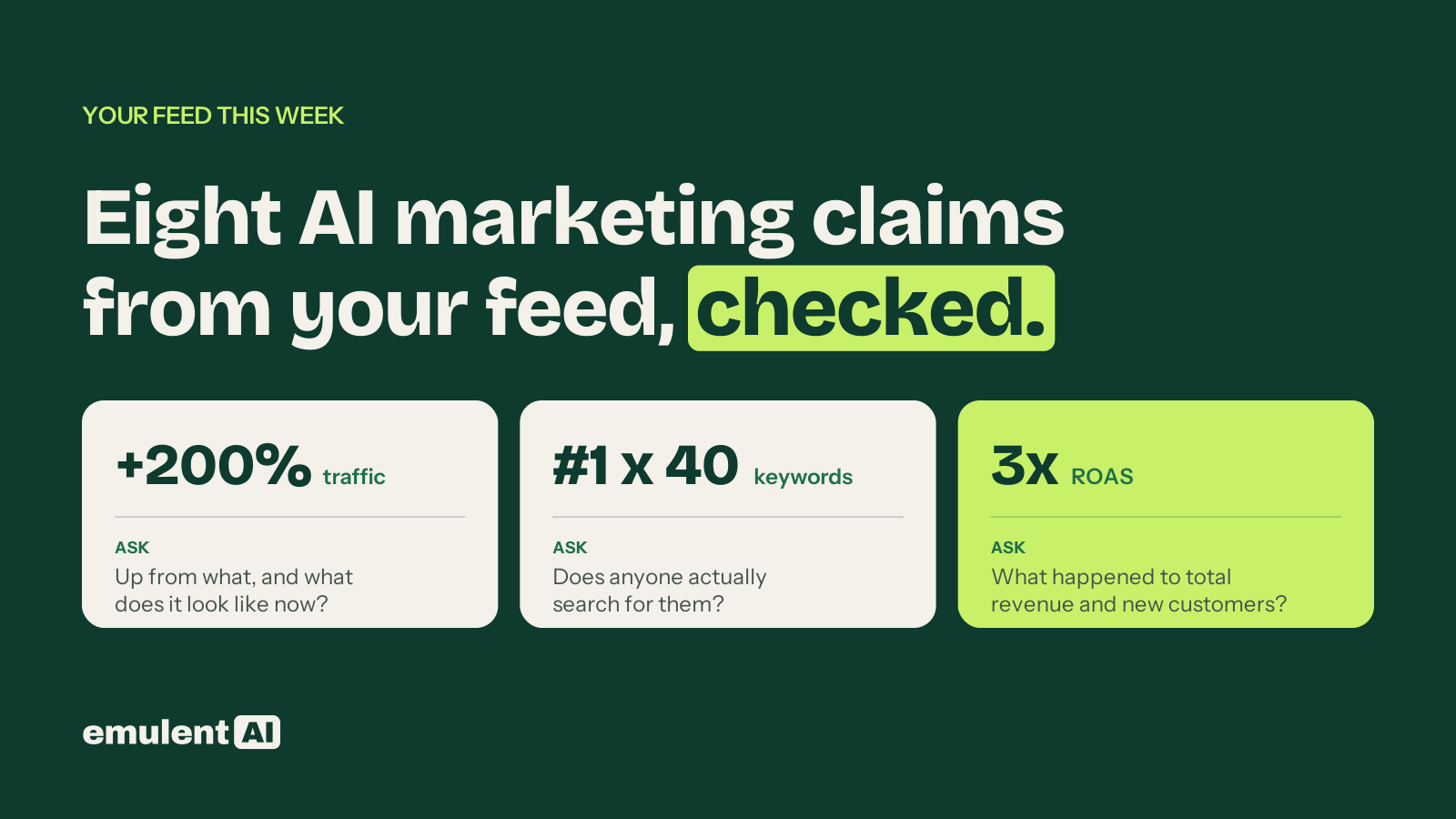
1. “I use AI to create my content and it increased my traffic by 200%. No writers. No agency.”
This can be true for a while. A new or neglected site that suddenly publishes dozens of articles often sees a jump, and 200% sounds impressive until you learn it can mean going from 400 visits a month to 1,200. The post rarely says what happened in month six. The pattern we see on sites built on bulk AI articles is a climb for a few months, a sharp drop, and then a slow recovery once the site changes course.
Google’s spam policies name the practice directly: using generative AI to produce many pages without adding value for users is listed as scaled content abuse. Ask for the starting number, the timeframe and the traffic today. The full picture on AI and search is in How to use AI for SEO in 2026 without hurting your rankings.
2. “I built a set of agents that do all my marketing on autopilot. I haven’t opened my CMS in six weeks.”
AI agents are real and improving fast. Very few companies run them at scale, though, and almost none in marketing. In McKinsey’s State of AI survey from August 2026, about two in ten respondents said their organizations were scaling agents across the enterprise, and the functions they named most often were IT, knowledge management and software engineering.
The bigger question is who checks the work. Not opening your CMS for six weeks means nobody read what went out. Google’s October 2026 guidance calls manual fact-checking of all AI-generated content critical before publishing, because models predict words instead of retrieving facts. (More on that in Your AI tool is predicting words.) An agent that publishes unchecked is a liability with a schedule.
3. “Unpopular opinion: I fired my team and run my business using AI. Best decision I’ve ever made.”
The numbers don’t support this as a trend. In the same McKinsey survey, 39% of respondents expected AI to reduce their headcount in the coming year. Looking back, only 14% said AI had actually reduced their workforce over the past year, less than half of the 32% who had expected it to. Only 37% could attribute any effect on profit to AI at all.
Customers notice too. In Gartner’s March 2026 survey, half of U.S. consumers said they would rather buy from brands that don’t use generative AI in their content. Cutting the people who know your customers and handing their work to a tool is a risky trade, as I explain in Is AI going to take your marketing job?
4. “I designed and built my website using AI. Took an afternoon. Why is anyone still paying developers?”
AI can produce a good-looking page in an afternoon. That page is the easy part of a website. The rest is what happens after launch: hosting, security updates, page speed, accessibility, forms that send leads to the right inbox, analytics that track the right events, redirects from the old site, and technical SEO so Google can crawl it properly. When something breaks at 9 p.m. before a campaign, someone has to know how it was built.
Web design and development is on my list of work where AI needs a person in charge for that reason. Use AI to sketch layouts and draft copy. Let someone who builds sites for a living take it to launch.
5. “AI is going to take my job. Not sure what any of us do anymore.”
This is the honest post in the bunch, and the worry is reasonable. The CMO Survey found AI is involved in 24.2% of marketing activities in 2026, and companies expect that to reach about 56% within three years. A lot of tasks are moving.
Look at which tasks, though: first drafts, reformatting, summaries, reporting. The work that stays with people is judgment, relationships and knowing what good looks like. The marketers at risk are the ones who refuse to use AI and the ones who hand it everything. The middle path is covered in Is AI going to take your marketing job?
6. “We replaced our entire SEO strategy with one ChatGPT prompt. Ranked #1 for 40 keywords in 30 days.”
Ranking first for 40 keywords is easy if nobody searches for them. Long, oddly specific phrases with almost no search volume, or terms that include your own brand name, can rank within weeks. Neither brings in much business.
Ask three things: how many people search those terms each month, how much traffic the rankings send, and how many leads came from it. If the answer is a screenshot of positions and nothing from Search Console or the CRM, you have your answer. A strategy is a set of decisions about which searches are worth winning, and a prompt can’t make those decisions for you.
7. “AI wrote our whole brand voice guide in 4 minutes. Our copywriter needed 6 weeks. Do the math.”
The six weeks were not spent typing. They went into customer interviews, reading reviews and sales call notes, studying what had worked before, and arguing with the founder about what the company actually stands for. The guide is the output of that research. The four-minute version skips the research, so it describes the average brand voice in your industry, which is the one your competitors already have.
AI can help with a voice guide: summarizing interview transcripts, pulling patterns from reviews, drafting examples once the direction is set. It can’t decide what makes you different. Why AI pulls everyone toward the same voice is the subject of AI is the average of everything, and how to give it enough to work with is in Four things to put in every AI prompt.
8. “Let AI run our ad account for a month. ROAS tripled. I just watch the dashboard now.”
Return on ad spend can triple for reasons that have nothing to do with growth. Shift budget toward branded search and retargeting, and you are mostly paying to reach people who were already about to buy. ROAS goes up, while total revenue and new customers stay flat or fall.
Automated bidding inside the ad platforms is useful, and plenty of accounts perform better with it. Watching only the dashboard is the mistake. Ask what happened to total spend, total revenue and the number of new customers over the same month. Measure the business result instead of the metric the tool is optimizing for.
How to read the next one
Every post above leaves out the same few things: the starting point, the timeframe, what happened afterward, and who checked the work. When a claim sounds like it took no effort, ask for those four. If they don’t come back, scroll on.
If you want a straight answer on what AI can and can’t do for your own team, our AI readiness assessment starts there.