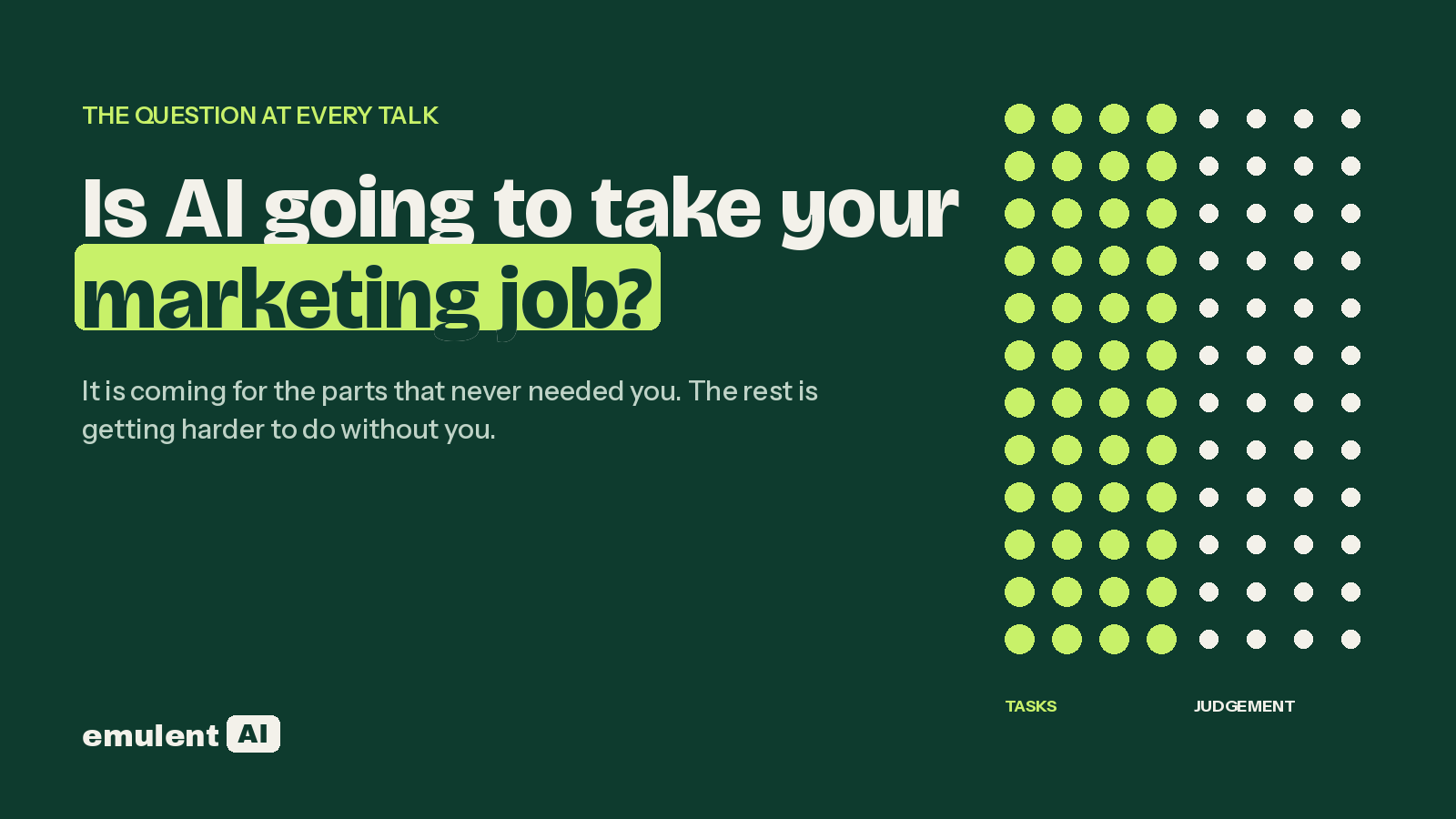
It is the question I get at every talk, usually in the Q&A and usually from someone who has been doing this work for a long time. My honest answer: AI is coming for the parts of your job that never needed you in the first place. The rest of the job is still yours, and it is getting harder to do without the people who are good at it.
What moves to AI, and what stays with you
The shift is already measurable. In The CMO Survey from Duke’s Fuqua School of Business, companies said AI is involved in 24.2% of their marketing activities in 2026 and expect that to reach about 56% within three years. (The budget side of that story is in Marketers are all in on AI. Their customers are not.) That is a lot of tasks changing hands. Look at which tasks, though:
| Going to AI | Staying with you |
|---|---|
| First drafts and variations | Knowing what good looks like |
| Sorting, tagging and reformatting | Deciding what to say, and to whom |
| Summaries and research pulls | Relationships and trust |
| Reporting and data consolidation | Signing your name to the work |
The left column is the work most marketers complain about. The right column is the work clients pay for.
Who is at risk
The marketers who use AI well will replace the ones who don’t.
The people at risk tend to fall into two groups. Some refuse to use AI at all and get slower than their peers every quarter. Others hand it the whole job and ship whatever comes back, which works until the first confident mistake reaches a client.
The people in a strong position give AI the tedious work, keep the thinking for themselves, and spend the hours they save on relationships and on understanding the customer.
How to become the person they can’t lose
Be the one who knows the tools. Learn what AI does well and where it fails. Most teams have nobody who can answer that with confidence, and the person who can becomes the one everyone asks. (Getting a whole team to that level is what our AI training is for.) A good starting list is in Where AI earns its keep in marketing, and where it costs you.
Spend the saved time upstream. Hand off the drafts and the data cleanup. Put those hours into strategy, client relationships and time with customers.
Own the review. Be the person who catches what AI got wrong before it ships. Checking work is a skill, and fewer people have it than you would expect. It helps to understand why models get things wrong in the first place, which I cover in Your AI tool is predicting words.
Bring what AI can’t. Your client stories, your results and your point of view exist nowhere in a model’s training data. That is your edge, and it is the raw material that makes AI output worth reading. More on that in AI is the average of everything.
Set it up before the first prompt
Most bad AI experiences start with a bad setup. Ten things to do before you rely on any assistant for client work (or have us handle it through AI tool implementation):
- Choose one main assistant and learn it well before adding others.
- Check whether your plan uses your chats to train models, and decide before you paste in anything about a client. Business plans usually keep chats out of training by default.
- Write standing instructions about who you are and how you work, so you stop re-explaining your job in every chat.
- Turn on memory, then check what it saves once a month. It saves time, but it can also carry a wrong assumption forward.
- Make a separate project for each client or recurring job, so one client’s details don’t bleed into another’s.
- Gather a reference kit to upload: what you would hand a new hire on day one.
- Connect the apps you already use (Drive, email, calendar) so you aren’t copying and pasting.
- Turn weekly tasks into reusable instructions that run the same way every time.
- Write a “never paste” list: passwords, logins, API keys, customer data.
- Pick a default model and a checking habit. Test code on a staging site, and verify facts before anything reaches a client.
The trade to watch
Every hour AI saves you is real. So is the trust you lose if a customer feels they got a machine where they expected a person. Efficiency you gain can turn into brand trust you lose. Hand AI the tasks, and keep the parts of your brand that are human.
I am covering all of this, along with SEO, GEO, design and content, at AMA Triangle on October 27 at the Beryl Loading Dock. Hands-on AI workshops follow in November and December, where we will work through attendees’ own problems live. If you want help putting any of this to work on your own marketing, get in touch with our team.