Most bad AI output comes from a bad brief. You wouldn’t hand a new hire one sentence and expect great work, so don’t do it to AI.
When someone on a client team tells me ChatGPT or Claude “writes generic stuff,” I ask to see the prompt. Usually it is a single line: “Write a LinkedIn post about our new service.” The model did exactly what it was asked. With nothing else to go on, it predicted the most likely LinkedIn post about a new service, which is the one everybody has already read. (Why that happens is explained in Your AI tool is predicting words.)
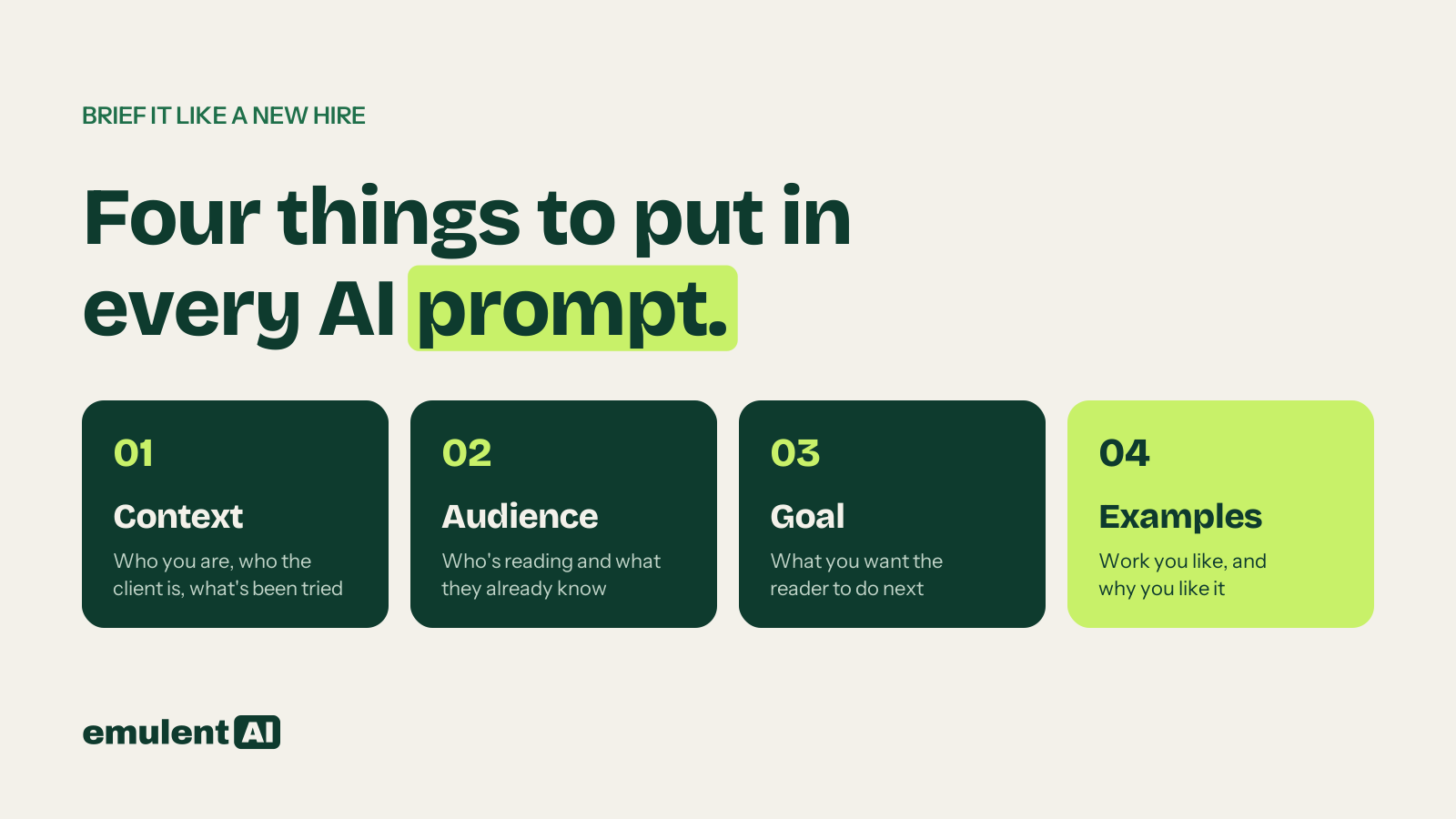
The fix takes about two minutes. Every prompt I write for client work carries the same four things.
1. Context
Who you are, who the client is, and what’s been tried.
The model knows nothing about your business unless you tell it. Give it the company name, what you sell, who you sell it to and what makes you different. Then say what has already happened: the campaign that flopped, the headline the client hated, the angle legal won’t approve. That last part saves the most time, because it stops the model from handing back ideas you already threw out.
A context line might read: “We are a 12-person HVAC company in Raleigh. Most of our work is replacing systems in homes built before 2000. Last spring’s discount emails got opens but almost no booked calls.”
If you find yourself typing the same background into every chat, save it once. Most assistants let you set standing instructions or a project per client, which is the third step in the setup checklist from Is AI going to take your marketing job?
2. Audience
Who’s reading this and what they already know.
“Homeowners” is too broad. “Homeowners in their 50s whose system is 20 years old, who have never bought an HVAC unit and are worried about being upsold” gives the model something to write toward. It changes the vocabulary, the length, the objections it answers and what it bothers to explain.
Say what the reader already knows, too. A CFO doesn’t need a definition of churn. A first-time buyer does need to know what a SEER rating is. Without that line, the model guesses at the middle and talks down to experts while losing beginners.
3. Goal
What you want the reader to do next.
“Write an email” has no goal. “Get the reader to book a free inspection this month” does, and the draft will be built around that ask instead of drifting into a general company update. If there is a format the piece has to fit, put it here as well: 120 words, three subject line options, one link, no discount.
One goal per prompt works best. When you ask a single email to build awareness, announce a hire and push a sale, you get an email that does none of them well.
4. Examples
Paste in work you like and say why.
This is the step people skip and the one that changes the output most. A model can match a tone it can see far better than one you describe. Paste in two or three pieces you’d be happy to publish: an old email that performed, a competitor post you admire, a paragraph in your client’s voice.
Then say what you like about each. “Notice how this one opens with a customer’s question and never uses the word ‘solution'” teaches more than “make it conversational.” An example with no explanation gets copied too closely. An explanation with no example gets ignored.
What the full prompt looks like
Put the four together and the one-line request turns into something like this:
Context: We are a 12-person HVAC company in Raleigh. Most of our work is full system replacements in homes built before 2000. Last spring’s discount emails got opens but almost no booked calls.
Audience: Homeowners in their 50s with a system around 20 years old. They have never bought a unit before, don’t know the jargon and are worried about being upsold.
Goal: Get them to book a free inspection this month. 120 words, plain language, one link, no discount. Give me three subject lines.
Examples: Two emails that performed well are below. The first works because it opens with a question a customer asked us. The second works because it explains one thing clearly and stops.
The business details above are made up for illustration; yours would be real. The structure is what carries over.
Then treat the first draft as a first draft
A good brief gets you a good starting point. It won’t get you a finished piece. Read the draft the way you’d read a new hire’s work, and tell the model what’s off and why: “The second paragraph sounds like a brochure. Our customers talk about their electric bill, not efficiency ratings.” Two or three rounds of specific feedback usually close the gap.
This is the first of the eight habits that keep your marketing out of the middle, and it is the one most teams can fix this week. If you’d like your whole team briefing AI this way, that’s what our AI training covers.
If you can’t explain it to a person, you can’t explain it to AI.