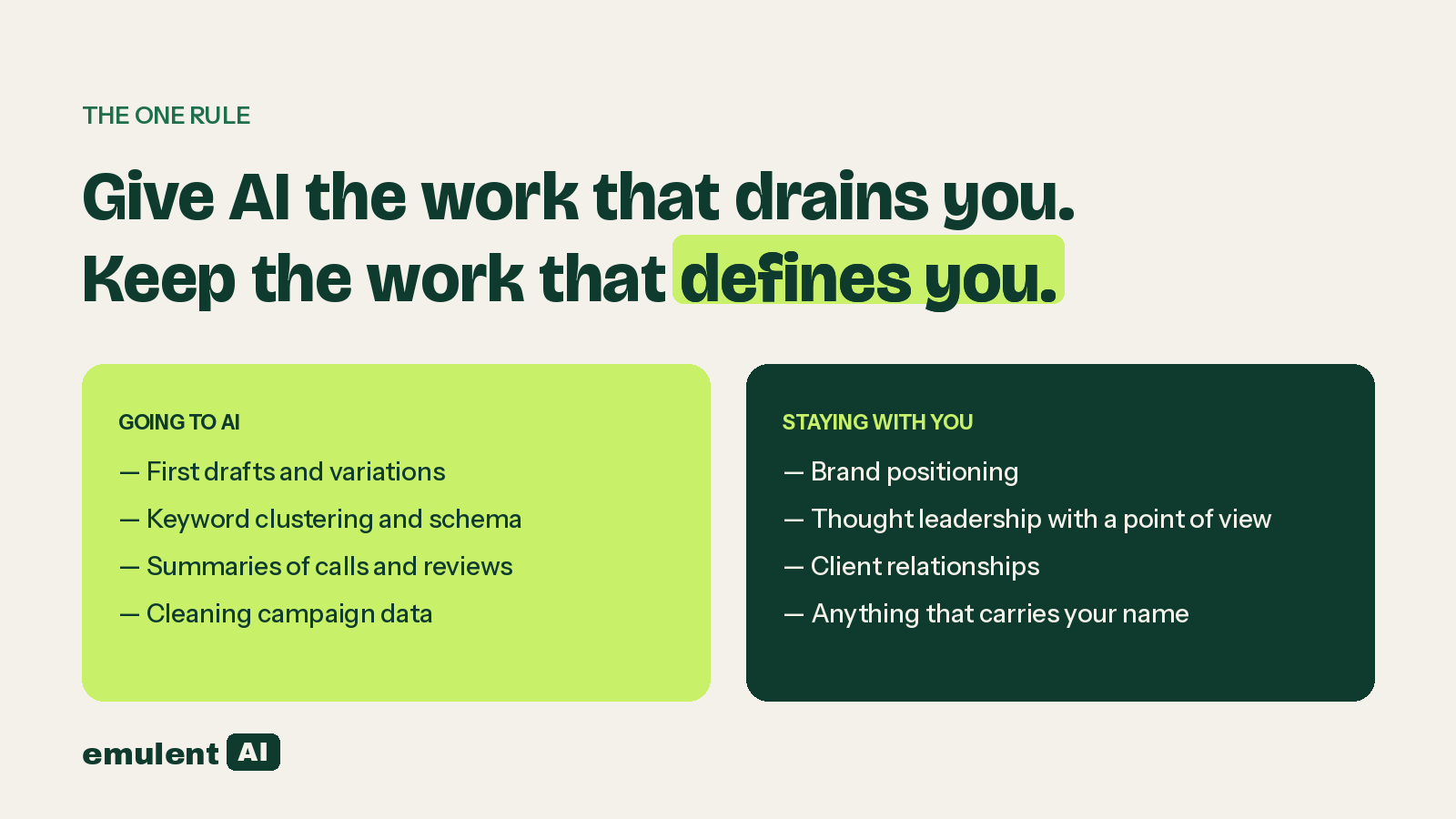
The simplest rule I have found after three years of testing: give AI the work that drains you and keep the work that defines you. The first kind of work is repeatable and easy to check. The second kind carries your name, your judgment or your customer’s trust.
Work AI does well
The tasks where AI saves real time share two traits. You do them often, and you can check the result quickly. On our team that list looks like this:
- First drafts of emails and landing pages
- Headline, subject line and call-to-action variations for testing
- Turning one long piece into social posts, emails and ad copy
- Keyword clustering and grouping by search intent
- Meta descriptions, alt text and schema markup
- Summaries of call transcripts, reviews and survey responses
- Competitor messaging and content audits
- Draft personas and audience segments built from real data
- Cleaning, reformatting and consolidating campaign data
- Small industry-specific tools such as calculators and checklists
Every item on that list still gets a human review. The difference is that the review takes minutes, and a mistake is easy to spot.
What that looks like on real projects
The biggest wins have come from data work nobody wanted to do by hand.
For a biotech company, we took records for 900,000 specimens from scattered, inconsistent sources and pulled them into one structure. AI tagged and classified every specimen, and each classification was checked against the source record. The team now has a database it can search by any of 20 attributes in seconds.
For an SEO audit of a 20,000-page site, Semrush pulled the technical, ranking and backlink data. Claude read the full export, grouped the issues by pattern and flagged the ones that move rankings. The client got a fix list ranked by impact and effort in place of a 20,000-row spreadsheet.
For a competitive analysis, we pulled Semrush keyword and content data for the client and its competitors. Claude compared the sets and surfaced the topics competitors rank for that the client does not. Those gaps became a content calendar aimed at the search traffic most worth taking.
We have also used AI to build WordPress plugins, interactive calculators for clients, a local business review helper, local real estate market reports, and, for fun, a Pokemon card identifier. In each case AI did the build work and a person decided what to build and whether it was right.
Take the feed with a grain of salt
You have seen the posts. Someone replaced their whole SEO strategy with one prompt and ranked first for 40 keywords in a month. Someone else fired their team and runs the business on AI. A marketing director built a website in an afternoon and wonders why anyone pays developers.
Some of those posts are exaggerated and some are short-term results that won’t last. AI-written long-form content can produce a spike in traffic, followed by a fall when search engines catch up. Google’s October 2026 guidance spells out what it rewards: effort, original information, real expertise and accuracy. A single prompt supplies none of those.
There is a scene in Good Will Hunting where Robin Williams’s character tells Will that he could recite everything ever written about Michelangelo, yet couldn’t say what the Sistine Chapel smells like. AI is in Will’s position. It knows the internet. It has never met your customer.
Where AI needs oversight, or shouldn’t be used
These are the areas where the work is hard to verify, the stakes are high, or the result depends on taste:
- Brand positioning and the core strategic idea
- Marketing and branding material
- Thought leadership that takes a real position
- Legal, medical, financial or compliance-sensitive copy
- Reading the room during a crisis, a layoff or another sensitive moment
- Long-form content written to rank in search
- Interpreting results and deciding what to do next
- Client relationships, pitches and hard conversations
- Original research, customer interviews and primary data
- Humor, cultural nuance and local references
- Web design and development
- Anything that carries your name
AI can still help in most of these areas, with research, outlines and a second opinion. It should not have the final word. And it won’t rescue a weak plan: AI doesn’t fix a bad strategy, it carries it out faster.
The should-test
Before any AI-assisted work goes out, run it through six questions:
- Would I sign it?
- Can I check it?
- What breaks if it’s wrong?
- Would the client or customer care that AI did it?
- Would I be fine with them finding out?
- Does it align with my brand and experience?
If any answer makes you uncomfortable, that piece needs more of you in it.
Give AI the work that drains you. Keep the work that defines you.
A strategy call sorts your marketing into what goes to AI, what stays with people, and how to check what comes back.
Book a strategy call
Or call 773-791-3197