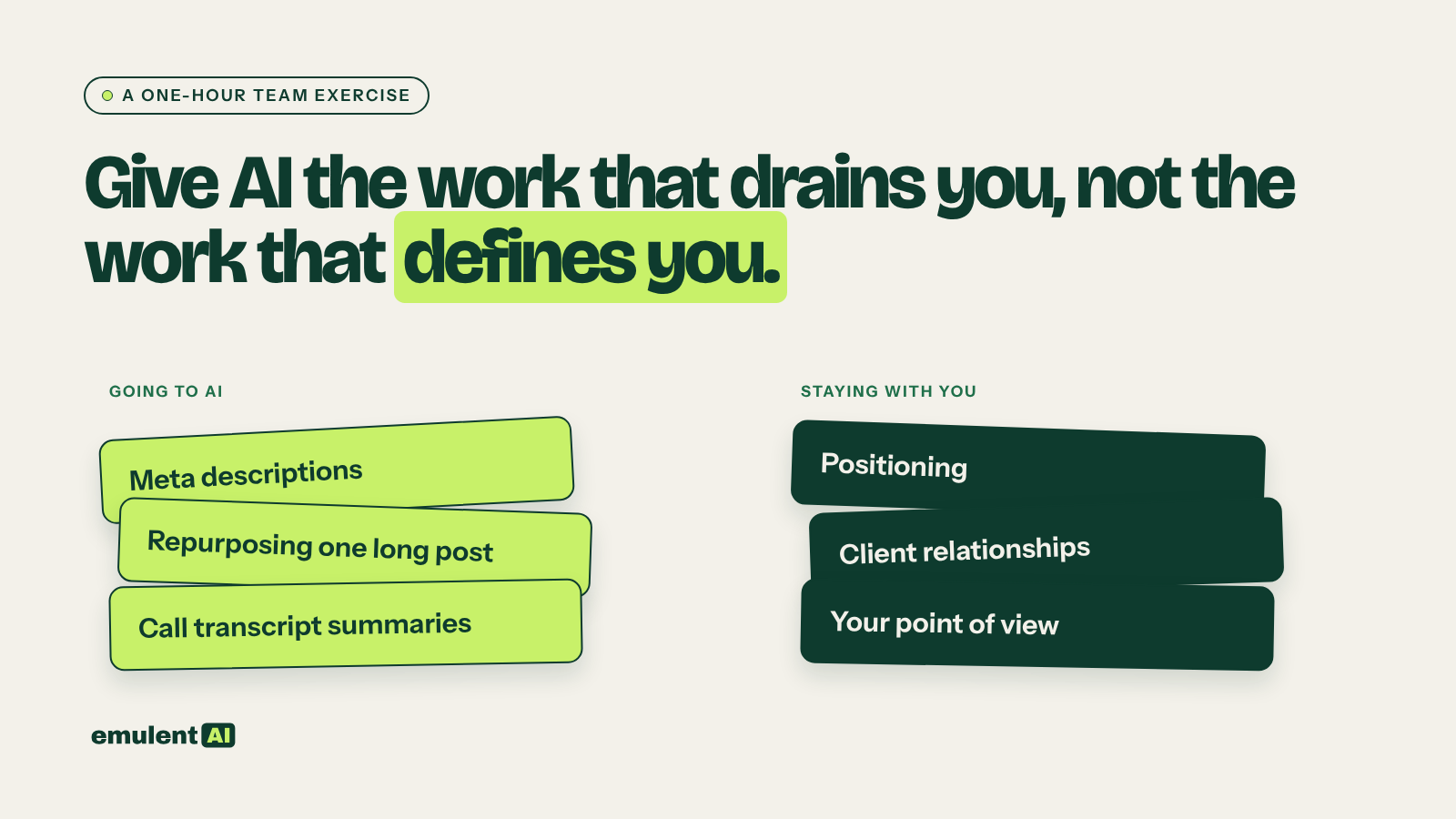
The rule I give every team is short: give AI the work that drains you, not the work that defines you. The tedious, repeatable, checkable tasks go to AI. The work that carries your judgement and your name stays with you.
Saying that is easy. Applying it to a real to-do list is harder, because most tasks don’t arrive labelled. So we built a sorting exercise teams can run in about an hour. Everyone lists their work, sorts it into two piles using the same criteria, and ends up with a shared picture of what to hand off. Here’s how to run it.
Why sort tasks instead of tools
Most AI rollouts start from the tool: here’s the assistant, go find uses for it. People then make hundreds of small, private decisions about what to give it. Some give it too little. Some give it things that should never leave a human’s hands. Nobody compares notes.
Starting from the task list flips that. You look at the work first, decide where AI fits, and only then worry about the tool. It also tends to calm people down. When a copywriter sees that AI is taking the alt text and the subject line variations, not the campaign idea, the conversation about AI changes tone.
There’s a business case for doing this carefully. McKinsey’s State of AI in 2026 report found that while nearly nine in ten respondents say their organizations regularly use AI, only 44% say it is scaling across the enterprise, and 37% report any EBIT impact. Using AI and getting value from it are different things. Deciding well what goes to it is a big part of the difference.
Before the session
Ask each person to write down every task they did in the last two weeks, one per card or row. Real tasks, specific ones. “Content” is too broad; “write the monthly newsletter intro” and “pull last month’s email stats into the client report” are right. Most people end up with 20 to 40 tasks.
You’ll need two columns on a wall, a whiteboard or a shared spreadsheet: going to AI and staying with you. Some teams add a narrow third column for “AI drafts, human owns.” That’s fine, as long as it doesn’t become a place to avoid decisions.
The criteria
Run every task through these questions. They come from the same should-test we use in our workshops, adapted for sorting.
Signs a task can go to AI
- It’s repeatable. You do it often, in roughly the same shape each time.
- It’s checkable. You can tell quickly and reliably whether the output is right.
- Getting it slightly wrong is cheap. A weak first draft or a clumsy variation costs you a few minutes, not a client.
- It drains you. It’s the task you put off, or the one that eats Friday afternoon.
In marketing, tasks that usually pass include first drafts of emails and landing pages, headline and CTA variations for testing, repurposing one long piece into social and email copy, keyword clustering and search-intent grouping, meta descriptions, alt text and schema, summaries of call transcripts, reviews and surveys, competitor messaging audits, and cleaning or consolidating campaign data.
Signs a task should stay with you
- You can’t verify the output. If you’d have to take the model’s word for it, keep it.
- Something real breaks if it’s wrong: legal exposure, a client relationship, a person’s health or money.
- Your name, or your client’s, goes on it, and you couldn’t sign it without rewriting most of it.
- The reader would care that AI wrote it, or you’d be uncomfortable if they found out.
- It depends on taste, local knowledge, humor or a point of view that’s yours.
Tasks that usually stay include brand positioning and the core strategic idea, thought leadership, legal, medical, financial or compliance copy, crisis and layoff communications, client pitches and hard conversations, original research and customer interviews, and interpreting results to decide what happens next.
Consumer attitudes back this up. In a Gartner survey released in March 2026, 50% of U.S. consumers said they’d prefer to give their business to brands that avoid generative AI in consumer-facing messages and content. Gartner’s advice was to start with clearly assistive uses. Most of the going-to-AI pile is exactly that: work the customer never sees in raw form.
Running the sort
Round one: sort your own list (15 minutes)
Everyone sorts their own tasks alone, with no discussion yet. Mark anything you’re unsure about with a question mark.
Round two: swap and argue (20 minutes)
Pairs swap lists and run the criteria on each other’s tasks. Where they disagree, they talk it through. This is the most useful part of the hour. A designer might think social captions are fine for AI; the social lead might point out that the captions are where the brand’s humor lives. The answer often turns out to be a split: AI drafts the boring captions, a person writes the ones that need a joke.
Round three: compare across the team (20 minutes)
Put everything on one wall. Look for tasks that several people do in different ways, since those are often the best candidates for a shared AI setup or a reusable instruction. Look for tasks one person sent to AI and another kept, and settle on one answer.
Round four: write it down (5 minutes)
Capture the final two lists, plus the owner for anything in the “AI drafts, human owns” column. That page is the start of your team’s AI usage guidelines.
What to do with the two piles
The going-to-AI pile is your setup list. For each task, decide which assistant handles it, what reference material it needs (brand notes, audience descriptions, good examples) and how the output gets checked. The tasks you repeat most are worth turning into saved instructions or a small tool so nobody rewrites the brief each time.
The staying-with-you pile is where the saved time should go. If AI takes four hours a week off someone’s plate, decide in advance where those hours land: more customer conversations, better strategy, deeper review of the work that ships. If you don’t decide, they tend to fill up with more output, and volume isn’t a strategy.
One warning from experience. AI doesn’t fix a bad strategy; it executes it faster. If the sort reveals that half the team’s tasks exist to feed a content calendar nobody reads, the right move might be to stop doing them, not to automate them.
Repeat it every quarter
The piles will shift. Tools improve, people get more confident, and some tasks you moved to AI will turn out to need more human time than expected. A quarterly re-sort takes half the time of the first one and keeps the list honest.
Run it with your team
You can run this exercise yourself with nothing more than sticky notes. If you’d like a facilitator, our AI training and team enablement workshops use it as the opening session. When the going-to-AI pile is ready to be set up properly in one assistant, our AI tool selection and implementation service picks up from there.
Put this to work with Bill.
Tell Bill where your team is with AI right now. He’ll tell you what he would do first and what he would leave alone.
Contact Bill directly
Or call 773-791-3197