Everyone on your team can use AI now. Very few of them stop to ask whether they should use it for the thing in front of them. The capability is free. Judgment about when to use it is what you are paying your people for.
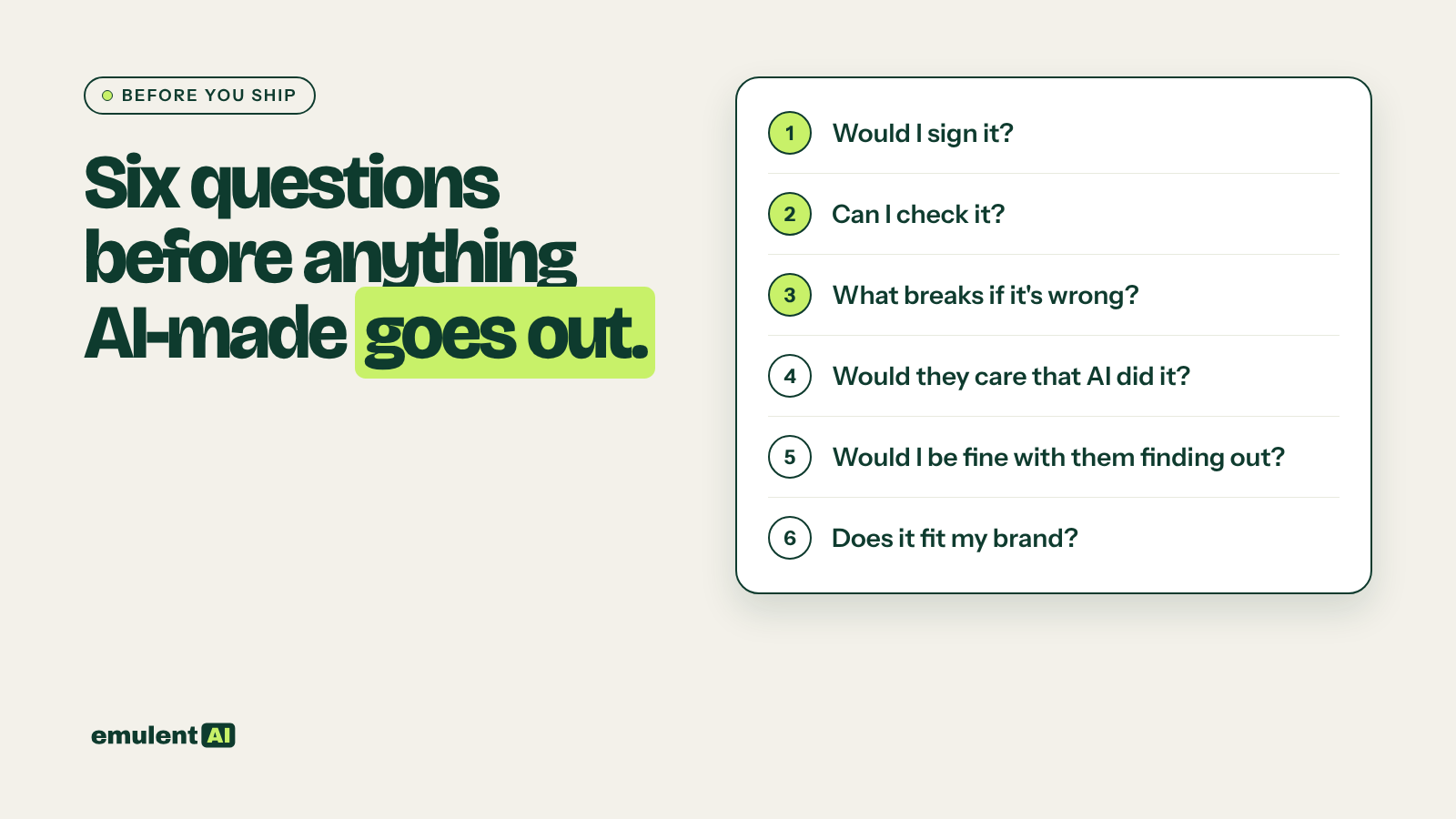
I use six questions before anything AI made goes out the door. I call them the should-test: Would I sign it? Can I check it? What breaks if it’s wrong? Would they care that AI did it? Would I be fine with them finding out? Does it fit my brand and experience? In the sections that follow, each one is written as a rule your team can run, with what a yes looks like, what a no looks like, and what happens next.
How to run the test
Run it at the moment of shipping, by the person whose name goes on the work. It takes two minutes for an email and longer for a campaign. A single no doesn’t always kill the piece; it tells you what has to change before it can go. The outcomes are short:
- All six yes: ship it.
- A no on questions 2, 4 or 6: fix it and run the test again.
- A no on questions 1, 3 or 5: stop and escalate to whoever approves high-risk work.
Keep a one-line record for anything customer-facing (who ran the test, the date, any no and how it was resolved). You will want that trail the first time something goes wrong.
1. Would I sign it?
Read it as if your name is printed under it, because in most cases it is. This is the first question because it sets the bar: AI gets you to good, fast, and getting to great is still your job.
A yes sounds like: “I’d put this in front of my best client without apology. It says what I think, in a voice I recognize.” A no sounds like: “It’s fine. It reads like everybody else’s.” Fine is a no. A model predicts the most likely next word from patterns in its training data, so its first draft lands near the average of what has already been written. Average never built a brand.
What a no means in practice: the draft goes back to a person to add what only you know (your data, your results, your opinion), or it doesn’t ship.
2. Can I check it?
AI output is plausible, which is a different thing from true. It can be wrong with total confidence. The question is whether every fact, number, quote, link and claim in the piece can be traced to a source someone on your team has read.
A yes: every stat has a link to the original, every product claim matches the spec sheet, and the reviewer opened the links. A no: “I think that’s right” or “the AI cited it.” If the piece makes a claim you can’t verify, cut the claim.
Google now says this directly. Its guide on using generative AI content notes that models don’t retrieve facts and can hallucinate, and that manually fact-checking all AI-generated content (titles, structured data and alt text included) before publishing is critical. McKinsey’s 2025 survey found that over half of respondents had seen at least one negative consequence from AI in the past year, with inaccuracy the most common.
3. What breaks if it’s wrong?
This is the risk question, and it sorts work into tiers. A wrong subject line variant costs you a slightly lower open rate. A wrong dosage, price, legal term or crisis statement costs you far more than that.
A yes (low risk) means a mistake is cheap and easy to fix: an internal summary, a test variation, a keyword cluster. A no means the error would reach a customer and hurt them or you: legal, medical, financial or compliance copy, pricing, statements during a crisis, anything about layoffs. Those go to a named approver and a subject matter expert, every time.
4. Would they care that AI did it?
“They” is whoever receives the work: a customer, a client, a reader. Some work nobody cares about. Nobody minds that AI wrote the alt text or grouped search queries by intent. Other work people care about a great deal, and Gartner’s March 2026 survey found 50% of U.S. consumers would prefer brands that don’t use generative AI in consumer-facing messages, advertising and content.
A yes: the work is behind the scenes or purely functional, and the person receiving it would shrug. A no: they’re paying for your thinking, your voice or your attention. A client who hired you for strategy will care that a model wrote the strategy. Fix a no by moving AI to the background (research, outline, data prep) and writing the part they’re paying for yourself.
5. Would I be fine with them finding out?
This one is different from question 4. Question 4 asks whether they’d mind. Question 5 asks whether you’d be embarrassed. If the honest answer is “I’d hope they never notice,” that’s a no.
Finding out is getting easier. Anthropic says Claude models launched on or after August 2, 2026 embed an imperceptible statistical watermark in generated text, and OpenAI has begun a similar watermark for ChatGPT text in the EU. Neither is foolproof; short or heavily edited text may not carry a detectable mark. Even so, “nobody will know” is no longer a plan.
A yes: you’d say it out loud (“we use AI to draft, and a person edits and checks everything”). A no means one of two fixes: disclose it, or redo the work so you’d be comfortable either way.
6. Does it fit my brand and experience?
The last question is about voice and truth. Does the piece sound like you, and does it claim only what you have actually done? AI will happily write “in our 30 years of experience” for a firm founded in 2019, or invent a client result that sounds right.
A yes: the tone matches your best existing work, every experience claim is real, and examples come from your files and not from the model’s imagination. A no: generic phrasing, borrowed claims, or a point of view you don’t hold. Fix it by feeding AI what only you know before it drafts, then editing hard. Brief it like a new hire, with context, audience, goal and examples, and the misses get smaller.
Turning the test into policy
Six questions in a slide deck won’t change behavior. Six questions built into how work gets approved will. This is the version I’d put in front of a team:
- Every piece of AI-assisted work has a named owner, and the owner runs the should-test before it ships.
- Low-risk internal work needs the owner’s test only.
- Customer-facing work needs the owner’s test plus a second reader who checks every fact.
- High-risk work (legal, financial, medical, crisis, layoffs, brand statements) needs a named approver, and AI may assist with research and structure only.
- Any no on question 5 triggers a disclosure decision by the approver.
- Review the policy and the log every quarter. Change the tiers when your results tell you to.
Most work passes in a minute, so the test costs little. The test catches the small share of pieces where a fast shortcut would cost you trust you spent years earning.
Next step
If you want the should-test written into a usage policy and approval process that fits your team, that is what our AI Governance and Brand Safety service does. To get your people running it well, our AI Training and Team Enablement workshops walk through real examples from your own work.
Put this to work with Bill.
Tell Bill where your team is with AI right now. He’ll tell you what he would do first and what he would leave alone.
Contact Bill directly
Or call 773-791-3197