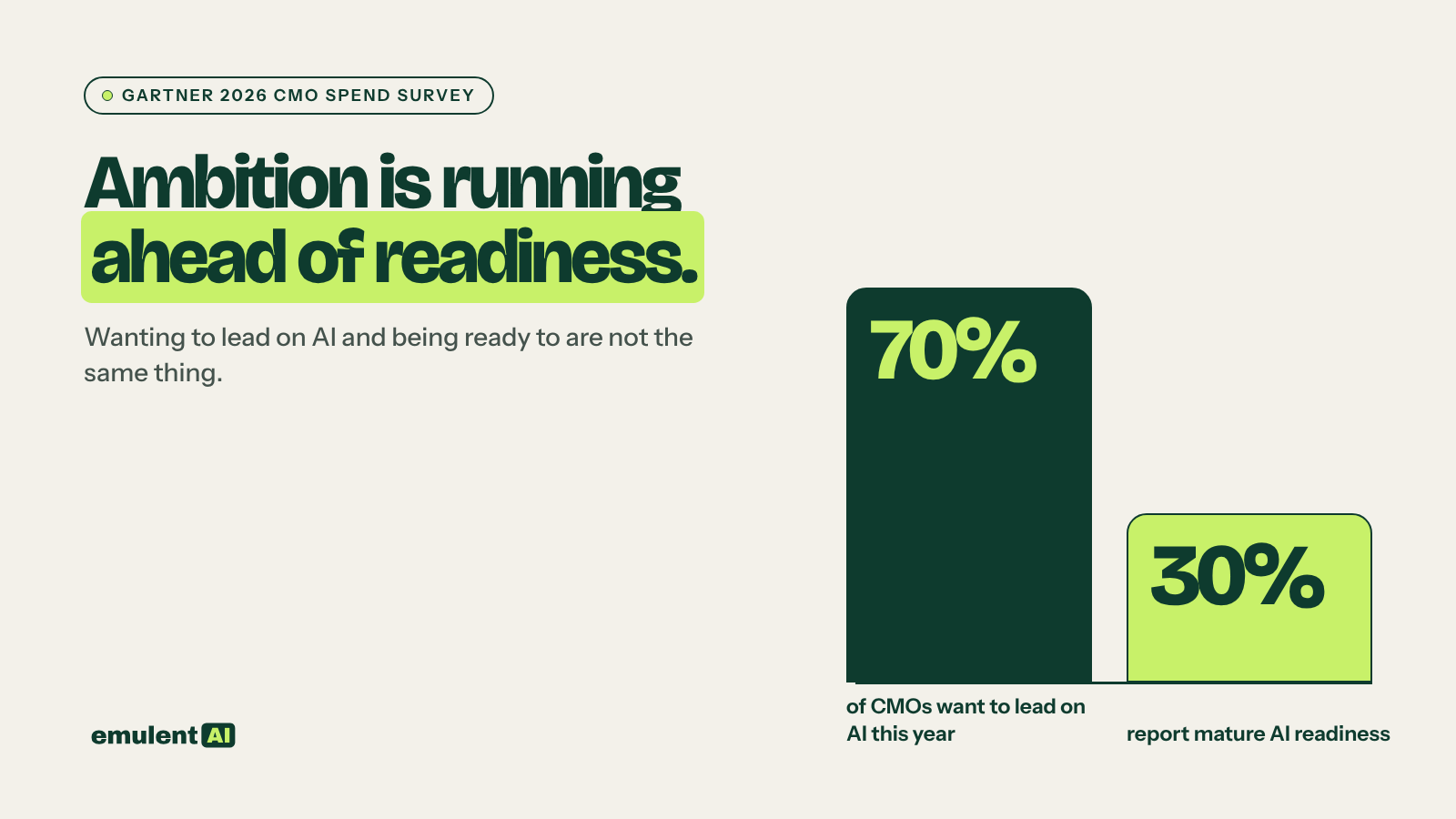
Gartner’s 2026 CMO Spend Survey put numbers on a gap most marketing teams will recognize. 70% of CMOs say becoming an AI leader is a critical goal for 2026, yet only 30% report mature or fully developed AI readiness. A lot of marketing leaders have announced a destination without a map.
The fix is cheaper than most people expect: a 90-day plan with a name and a date next to every step, written before anyone buys more software. That means deciding who audits the data, who owns the first use case, who checks the output before it ships, and when each of those is due. The rest of this post covers why the gap exists and what that plan should hold.
What the Gartner survey found
Gartner surveyed 401 CMOs and senior marketing leaders in North America, the UK and Europe between January and March 2026. A few numbers from the release are worth reading side by side:
- CMOs put an average of 15.3% of their marketing budgets into AI initiatives.
- Organizations Gartner classes as AI-ready put 21.3% of their marketing budget into AI.
- 56% of CMOs say they lack the budget to deliver their 2026 strategy, and 54% report insufficient resources.
- Total marketing budgets sit at about 7.8% of company revenue, against 7.7% in 2025. That is essentially flat.
McKinsey’s state of AI in 2026 research, published in August, shows the same shape from a different angle. Nearly nine in ten respondents said their organizations regularly use AI in at least one business function. Only 44% said AI is scaling across the enterprise, and 37% reported any EBIT impact at all. Using AI is now normal. Getting a measurable result from it is still rare.
One caution on the Gartner figures: ready organizations spend a larger share on AI, but the survey doesn’t tell us which came first. I read it this way. Readiness is what lets a team spend more without wasting it.
Why ambition runs ahead of readiness
Everyone can use AI now. Almost no one is stopping to ask whether they should use it for a given job, and who is responsible when it gets something wrong. The gap tends to open in the same few places.
Tools get bought before the job is named
A team signs up for three assistants and a content platform, then goes looking for things to do with them. The order should run the other way. Pick the repeatable job first (summarizing call transcripts, grouping keywords by search intent, reformatting campaign data) and then choose the one tool that does it well.
Nobody owns the result
When AI belongs to everyone on the team, nobody checks it. A language model doesn’t know facts; it predicts the most likely next word from patterns in its training data. It can be wrong with total confidence. If there is no named person who reviews output before it reaches a client or goes live, errors ship. McKinsey’s 2025 survey found that over half of respondents had seen at least one negative consequence from AI in the past year, and inaccuracy was the most common.
It gets treated as a technology project
Using AI well is a communication skill. You don’t need to write code. You need to give the model context, an audience, a goal and examples, then give it feedback the way you would with a new colleague. That makes your subject matter experts more important to an AI rollout, and IT less central than most org charts assume. If you can’t explain a task to a person, you won’t be able to explain it to a model.
Why a bigger tool budget won’t close the gap
With 56% of CMOs saying they lack the budget for their strategy, the natural reaction is to ask for more money. But more licenses handed to a team with no plan buy more unreviewed output. You get to “good” faster. You also get to “wrong” faster, and at a higher volume.
Consumers are paying attention, too. In a separate Gartner survey of 1,539 U.S. consumers, 50% said they would prefer to give their business to brands that don’t use GenAI in consumer-facing messages, advertising and content. Spending more to put more AI in front of customers, with nobody owning quality, is a risky way to chase leadership.
What a 90-day plan with owners and dates looks like
The plan doesn’t need to be long. It needs to be specific enough that someone can say on day 45 whether you’re on track. Here is the outline we use at Emulent:
- Days 1 to 30, audit. Score where you stand on data, tools, skills and risk. Find out which tools people already use, what they paste into them, and who reviews the results. One owner, one due date for the written findings.
- Days 31 to 60, pilot one job. Pick a single task that is repeatable and easy to check. Brief the assistant like a new hire, with your reference material and examples. Name the person who runs the pilot and the person who reviews every output.
- Days 61 to 90, measure and decide. Compare results against a baseline you recorded before the pilot: hours saved, error rates, conversions, whatever the job affects. Then decide to scale it, adjust it or stop it, and put that decision on a date too.
Before anything ships during the pilot, run it through a short should-test. Would I sign it? Can I check it? What breaks if it’s wrong? Would the customer care that AI did it, and would I be comfortable with them finding out? Does it fit our brand and experience? If the answers are shaky, a person does that job.
What stays out of the first 90 days is just as important. Brand positioning, legal or compliance copy, crisis communication and SEO content produced at volume all carry high stakes and are hard to verify. Give AI the work that drains your team. Keep the work that defines your brand.
How to tell which side of the 30% you’re on
You don’t need a survey to get a rough read. Try answering these questions about your own team:
- Can you name the one person who checks AI output before it reaches a client or goes live?
- Do you know which AI tools your team uses and what information goes into them?
- Is there a written list of things nobody should ever paste into an assistant, such as passwords, logins, API keys and customer data?
- Can you point to one job AI does every week, with a result you’ve measured against how it was done before?
- Does each recurring job or client have its own project, so details don’t bleed between them?
If you answered no to two or more, you’re in good company. Most of the 70% are in the same spot. What the 30% tend to have is a written plan that says who does what, and by when.
Next step
If you want help building that plan, our AI marketing strategy and roadmap work produces a 90-day plan with owners and dates your team can run. If you’d rather start by finding out where you stand, the AI readiness assessment scores your data, tools, skills and risk first.
Put this to work with Bill.
Tell Bill where your team is with AI right now. He’ll tell you what he would do first and what he would leave alone.
Contact Bill directly
Or call 773-791-3197