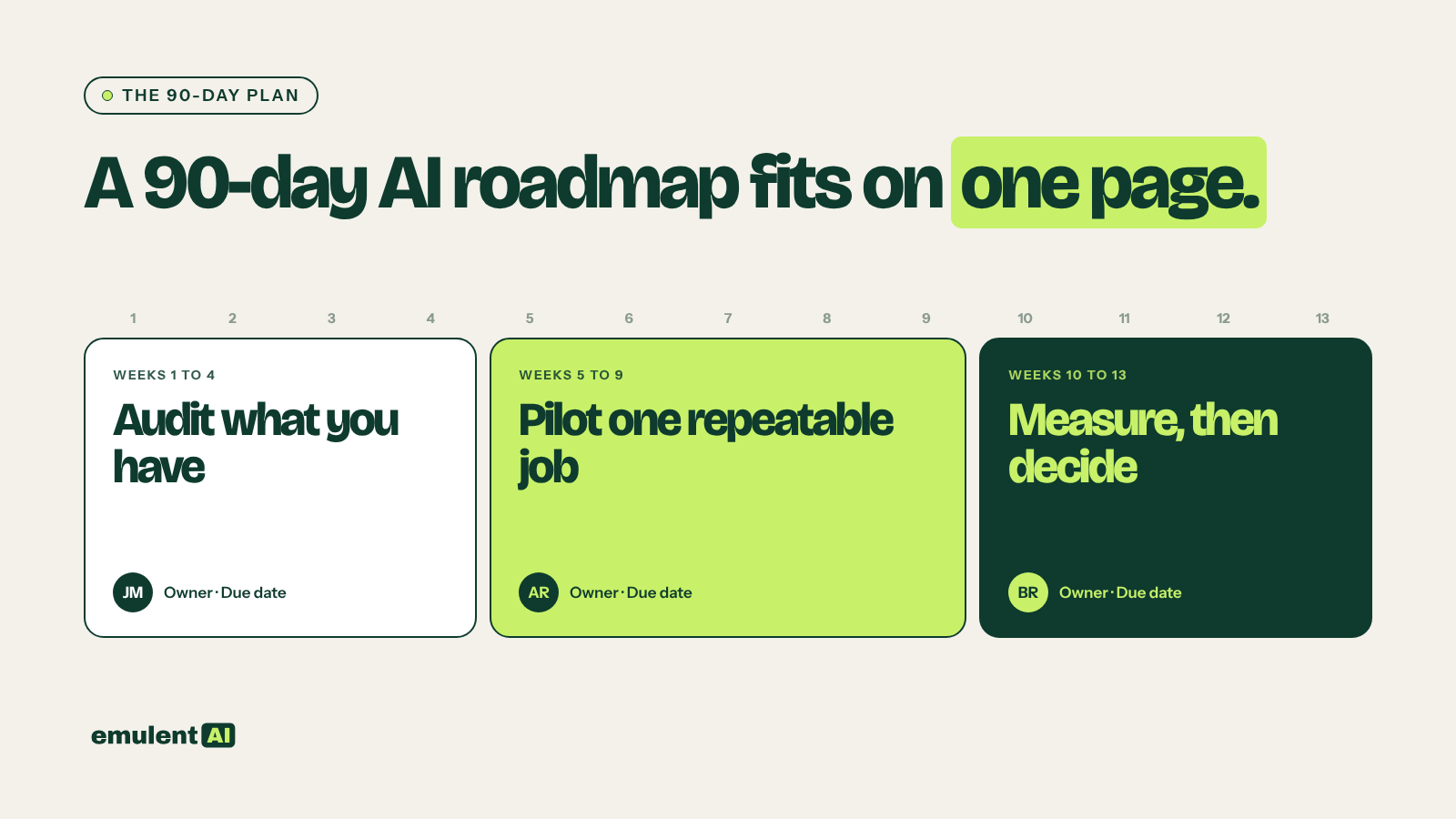
A good 90-day AI marketing roadmap fits on one page. It has three phases: audit what you have (weeks 1 to 4), pilot one repeatable job with a named reviewer (weeks 5 to 9), and measure the result against a baseline before deciding what comes next (weeks 10 to 13). Every step gets an owner and a due date.
That’s the whole idea. The detail below is what goes into each phase, the test to run before anything AI-assisted ships, and a template at the end you can copy into your own planning doc.
Why 90 days, and why one job
Ninety days is long enough to run a real pilot and short enough that people still remember why they started. One job keeps the pilot honest. When a team tries to “roll out AI” across content, ads, reporting and email at the same time, nobody can tell what worked.
The research backs up the case for starting small and measuring. McKinsey’s state of AI in 2026 report, published in August, found nearly nine in ten respondents’ organizations use AI regularly in at least one function, but only 44% say it is scaling across the enterprise and 37% report any EBIT impact. Gartner’s 2026 CMO Spend Survey found 70% of CMOs want to be AI leaders this year, while 30% report mature AI readiness. Plenty of use, not much proof. A 90-day plan is how you get proof.
Phase 1, weeks 1 to 4: audit what you have
Start by finding out where you stand. In most teams, people already use two or three assistants on personal accounts, and nobody has written down what goes into them.
Week 1: inventory tools and habits
List every AI tool in use, who uses it, on which plan, and for what. Check each plan’s data settings so you know whether your chats can be used to train models, and decide on that before anyone pastes in client information.
Week 2: check your data
AI-driven reporting and segmentation are only as good as the data behind them. Look at your CRM, analytics setup and campaign naming. If you find duplicate records or broken tracking, that cleanup belongs in the plan before any automated analysis does.
Week 3: score skills and risk
Who on the team can brief an assistant well? Using AI is a communication skill more than a technical one: context, audience, goal and examples, then feedback. Note who is strong at that. Then list what would hurt if it went wrong: client data in the wrong place, an unchecked claim in an ad, legal or compliance copy.
Week 4: write it up and set rules
Put the findings in a short document. Add a “never paste” list (passwords, logins, API keys, customer data) and name one main assistant the team will learn properly. One owner, one due date for the write-up.
Phase 2, weeks 5 to 9: pilot one repeatable job
Week 5: pick the job
Give AI the work that drains your team, not the work that defines your brand. Good pilot jobs are repeatable and easy to check:
- Summarizing sales call transcripts, reviews or survey responses
- Grouping keywords by search intent
- Writing meta descriptions and alt text for a set of pages, with a person checking each one
- Cleaning and reformatting campaign data for the monthly report
- Drafting subject line and headline variations for an A/B test
Leave brand positioning, thought leadership, crisis messaging, legal or medical copy, and SEO content at volume out of the pilot. Those are high stakes and hard to verify.
Week 5, also: record a baseline
Before AI touches the job, write down how long it takes now, how often it has errors and what result it drives. Without that number, day 90 has nothing to compare against.
Weeks 6 and 7: set it up properly
Create a project in your assistant for this one job so details don’t bleed into other work. Add standing instructions about who you are and how you work. Upload a reference kit, the same material you’d hand a new hire on day one. Brief it like that new hire, then ask for options and pick the best one with your own judgement.
Weeks 8 and 9: run it with a named reviewer
Every output goes through one person before it’s used. That reviewer runs the should-test.
The should-test
Before an AI-assisted piece leaves the building, ask:
- Would I sign it?
- Can I check it?
- What breaks if it’s wrong?
- Would the customer care that AI did it?
- Would I be fine with them finding out?
- Does it fit our brand and experience?
Questions four and five are not theoretical. Gartner found 50% of U.S. consumers would prefer brands that avoid GenAI in consumer-facing content. A job that fails any of these questions goes back to a person.
Phase 3, weeks 10 to 13: measure results, not output
“We produced 40 pieces” tells you nothing. Compare the pilot against the baseline you recorded: hours saved, errors caught, and the business result the job feeds into, such as lead quality or report turnaround.
Then make one of three calls, and put a date on it. Scale the job to more of the team, adjust it and run another cycle, or stop it. Stopping a pilot that didn’t work is a fine outcome. You learned that cheaply.
Use the time you save well. Spend it upstream on strategy, relationships and knowing the customer. That’s where the next pilot idea should come from.
A 90-day roadmap template you can copy
Fill in the blanks with your own names and dates. Keep it to one page.
- Weeks 1 to 4, audit
- Inventory AI tools, plans, users and data settings. Owner: ______. Due: ______.
- Check CRM, analytics and campaign data for gaps. Owner: ______. Due: ______.
- Score team skills and list risks. Owner: ______. Due: ______.
- Written findings, “never paste” list and main assistant chosen. Owner: ______. Due: ______.
- Weeks 5 to 9, pilot one job
- Job chosen: ______. Owner: ______. Due: ______.
- Baseline recorded (time, errors, result). Owner: ______. Due: ______.
- Project, standing instructions and reference kit set up. Owner: ______. Due: ______.
- Pilot running; every output reviewed with the should-test. Reviewer: ______. Runs until: ______.
- Weeks 10 to 13, measure and decide
- Results compared with baseline. Owner: ______. Due: ______.
- Decision (scale, adjust or stop) and next job named. Owner: ______. Due: ______.
Next step
If you’d like this built around your team, our AI marketing strategy and roadmap service produces the 90-day plan with owners and dates filled in. If you want phase 1 handled first, the AI readiness assessment scores your data, tools, skills and risk.
Put this to work with Bill.
Tell Bill where your team is with AI right now. He’ll tell you what he would do first and what he would leave alone.
Contact Bill directly
Or call 773-791-3197