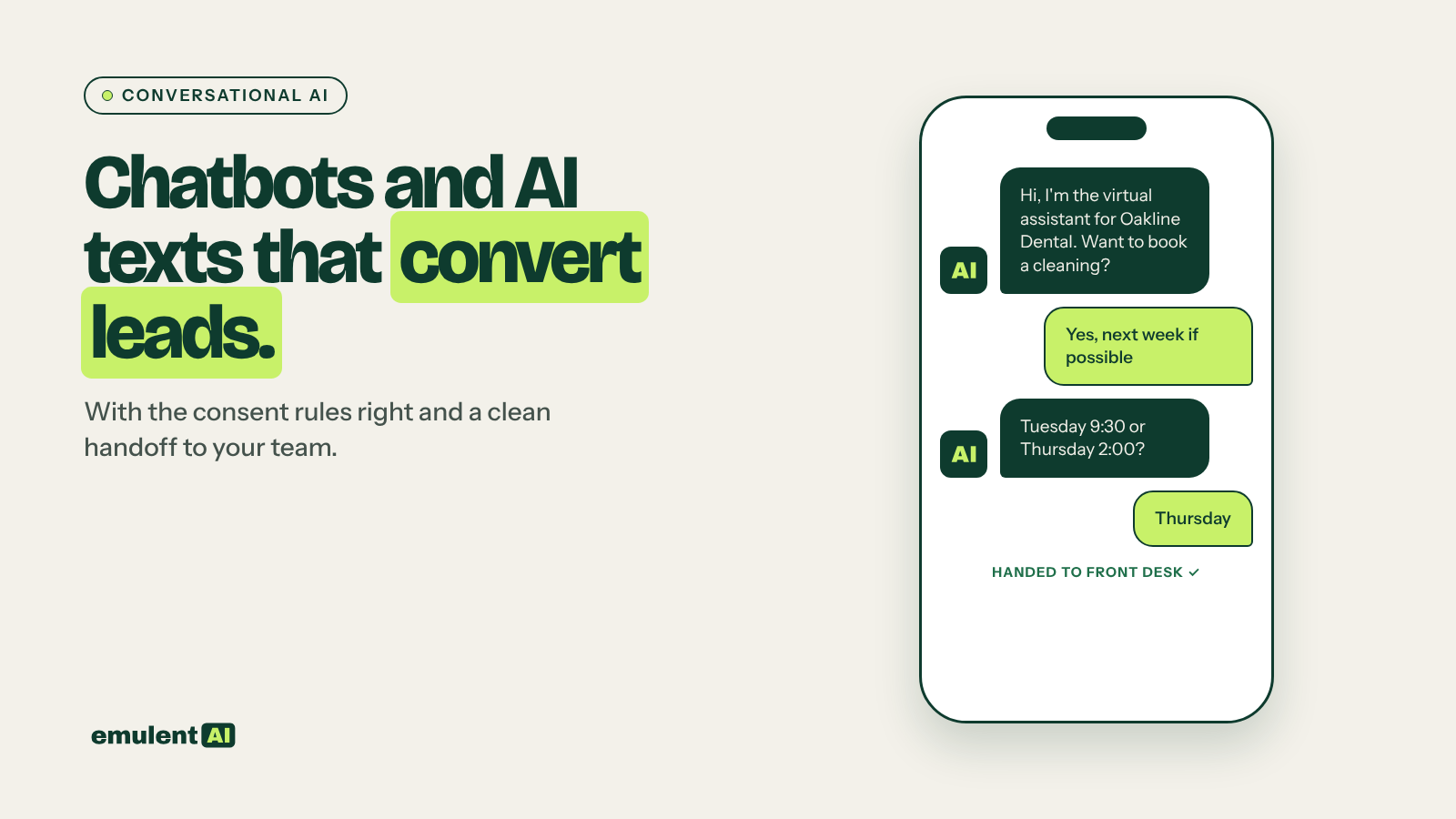
Conversational AI marketing means answering a buyer’s question at the moment they ask it, in website chat, by text message or in a messaging app, with AI handling the first replies. Done well, it answers at 2 a.m., qualifies a lead in four questions and books the meeting. Done badly, it texts people who never agreed to hear from you, pretends to be a person, or gives a wrong answer with total confidence and your logo beside it.
The rule I work from: let AI handle the questions, and keep people on the relationship. The rest of this guide is how to do that, starting with the rules for SMS, because that is where the legal exposure sits.
This is not legal advice. Texting and calling rules carry statutory damages, so have counsel review your consent language and opt-out process before launch.
What conversational marketing looks like now
There are two kinds of bot behind most chat widgets, and they fail in different ways.
| Type | How it works | Good for | Main risk |
|---|---|---|---|
| Rule-based chat flow | Scripted questions and branches you write | Qualifying leads, booking meetings, routing | Rigid; frustrates people with off-script questions |
| AI answer bot (brand bot) | A language model answers from your content and CRM data | Open questions about products, policies and fit | Confident wrong answers |
| AI SMS assistant | Sends and replies to texts, often two-way | Reminders, follow-ups, quick questions | Consent and opt-out violations |
| AI voice agent | Places or answers calls with a generated voice | Inbound call handling, reminders | Treated as an “artificial” voice under the TCPA |
HubSpot is a useful example of the split. Its chatflow bots run “a series of questions and automated responses” to qualify leads, book meetings or create tickets, while its separate customer agent, powered by Breeze, uses your content and CRM data to answer questions. Many teams run both: a scripted flow for qualification and an AI agent for open questions.
Brand bots on your website
A brand bot is an AI assistant that answers in your brand’s voice from your own material. It is good at repeat questions: what’s included, how long setup takes, whether you serve a certain area, how to book. It can ask qualifying questions without sounding like a form.
Its weakness comes from how language models work. A model does not know things. It predicts the most likely next words, and it produces plausible text, not necessarily true text. In my talks I use a cartoon of an AI telling someone a mushroom is safe to eat, then apologizing later that it was poisonous. A bot that invents a refund policy or a price is the same problem with your name on it.
Before a brand bot goes live:
- Limit what it can draw on to approved content: your site, a current FAQ, current pricing rules. Leave out old PDFs and draft pages.
- Write a list of topics it must hand to a person: complaints, pricing exceptions, contract terms, and anything legal, medical or financial.
- Give it a short voice guide and three or four real answers you like.
- Test it on 50 real questions pulled from your inbox and call notes, and grade every answer as right, wrong or “should have handed off.”
- Put a “talk to a person” option in every conversation, not buried three menus deep.
We build assistants on the same principle. Our custom AI tools page puts it as “AI drafts, a person decides,” and the assistants we build draft in the client’s voice and flag what needs care.
AI SMS: get the consent rules right first
Text messages are personal, read quickly and easy to report. The rules below come from the FCC’s regulations and orders and from the wireless industry’s guidelines, as of October 2026.
The TCPA covers texts
The FCC “has long held that the restriction encompasses both voice calls and texts,” as it restated in its 2024 consent revocation order. Under 47 CFR 64.1200, calls that include an advertisement or constitute telemarketing, made with an autodialer or an artificial or prerecorded voice to cell numbers, need the called party’s prior express written consent. That consent is a signed written agreement that clearly authorizes the seller to send those messages to a specific number, and it must say the person is not required to agree as a condition of buying anything. The same section bars telephone solicitations to residential subscribers before 8 a.m. or after 9 p.m. in the recipient’s local time.
Whether a given texting platform counts as an autodialer is a legal question for your counsel. The wireless industry’s guidelines expect written consent for marketing texts either way, so plan on it.
Carrier rules and 10DLC registration
The CTIA Messaging Principles and Best Practices (May 2023) are the wireless industry’s guidelines. They say senders should obtain express written consent specifically to receive marketing messages, use standard “STOP” wording for opt-out instructions, honor plain-language requests such as “please opt me out,” and send one final confirmation after an opt-out and nothing after it. Confirmation messages for recurring programs should say the messages recur, how often, what fees may apply and how to get help.
If you text from a standard 10-digit number, you also need to register. Twilio describes A2P 10DLC as “the standard that United States telecom carriers have put in place to ensure that SMS traffic to US end users through long code phone numbers is verified and consensual.” Registration has two parts: a brand (who is sending) and a campaign (the purpose, plus opt-in, opt-out and help details). Brands generally register through their texting provider, which handles the filing with The Campaign Registry. Twilio says unregistered traffic draws additional carrier fees and that registered traffic sees less filtering.
Opt-outs: what changed in 2025
The FCC’s 2024 order says people can revoke consent in any reasonable way. Replies of “stop,” “quit,” “end,” “revoke,” “opt out,” “cancel” or “unsubscribe” count automatically. You must honor a revocation within a reasonable time, not more than 10 business days. You may send one confirmation text with no marketing in it; if it goes out within five minutes, it is presumed to fall within the person’s prior consent.
Those rules have been in force since April 11, 2025, according to the FCC’s April 2025 order. One piece is on hold: the requirement that an opt-out from one type of message also stops unrelated messages from the same sender. The FCC’s January 2026 order delayed it to January 31, 2027. Build your system so you can apply an opt-out across all message types anyway; it is the safer default and the date may not move again.
AI voices are “artificial” voices
In February 2024 the FCC issued a declaratory ruling (FCC 24-17) that the TCPA’s limits on “artificial or prerecorded voice” calls cover current AI technologies that generate human voices, including voice cloning. Those calls need the called party’s prior express consent, and prior express written consent if they include an advertisement or telemarketing. The FCC’s announcement put it plainly: calls made with AI-generated voices are “artificial” under the TCPA. An AI voice agent that places outbound marketing calls needs the same consent as a prerecorded robocall.
Where AI fits in SMS
Once consent is handled, AI is useful for drafting message variants, answering replies in a two-way thread, and summarizing each thread into the CRM. It should not decide who gets a text. Your consent records decide that, and a person should approve every new campaign before it sends.
Use cases by funnel stage
| Stage | Website chat | SMS (with consent) |
|---|---|---|
| Top of funnel | Answer pre-purchase questions, point to the right page or guide | Rarely appropriate; few people have opted in yet |
| Middle of funnel | Ask qualifying questions, recommend a case study, offer a meeting | Event reminders, replies to a question the person texted in |
| Bottom of funnel | Book the meeting, collect details for a quote, hand hot leads to sales | Appointment reminders, quote follow-ups, “reply YES to confirm” |
| After the sale | Support answers from your help content, ticket creation | Service reminders, renewal notices, short surveys |
CRM handoff is where most bots fail
A chat that ends without a record in your CRM is a lead you paid for and lost. Every conversation should write back the contact details, a summary of what the person asked, the answers to qualifying questions and the next step. In HubSpot, chatflow bots can set contact and company property values, book meetings, submit tickets and route a conversation to an available team member (who needs a Sales or Service seat), according to HubSpot’s documentation.
Set handoff rules in writing. The bot hands to a person when:
- the visitor asks for a person;
- the question is outside the approved topics;
- the lead matches your best-fit profile (send it straight to sales, with the transcript);
- the visitor is upset or the message reads like a complaint;
- the question touches legal, medical, financial or contract terms.
Then set a response time for the human side and measure it. A bot that hands off instantly to a team that answers tomorrow has only moved the wait.
Metrics worth tracking
- Conversations started, and the share that become identified leads.
- Qualified meetings booked from chat and SMS.
- Handoff rate, and time from handoff to first human reply.
- Wrong-answer rate, from a weekly review of 25 transcripts graded by a person.
- SMS opt-out rate per send. A spike after a message tells you the message was the problem.
- Pipeline and revenue from leads whose first touch was a conversation.
The weekly transcript review is the metric most teams skip and the one that catches problems first. Read the conversations. Fix the content the bot is drawing from, then test again.
Tell people they are talking to a bot
Disclose the bot up front, because buyers are already suspicious. Gartner’s March 2026 consumer survey found 50% of U.S. consumers would prefer to give their business to brands that do not use GenAI in consumer-facing messages, and 68% frequently wonder whether the content they see is real. Gartner’s recommendations included labeling AI experiences, making GenAI optional and giving customers a clear way to opt out. The FTC, in a business guidance post on AI deception, lists chatbots among the “doppelgängers” that have drawn enforcement when they mislead consumers, and asks whether a tool needs to imitate a person at all.
My rules for bots:
- Call the bot a bot in its first message. No human name with a stock headshot.
- Offer a person in every flow.
- Run every automated message through two questions from my should-test: would the customer care that AI did this, and would I be fine with them finding out? With a bot, they always find out.
As I say in my talks, “Efficiency you gain can be brand trust you lose.” A written policy on disclosure and approvals helps your team apply these rules the same way every time; that is part of our AI governance work.
If you hire an agency to build it
Many agencies now sell conversational AI as part of website development. Ask them:
- Which platform will the bot run on, and who owns the content, prompts and conversation data?
- What content will the bot be allowed to use, and how do we update it?
- How will you test it before launch, and can we see the graded test results?
- How does it hand off to a person and write to our CRM?
- For SMS: how will you capture and store consent, register for 10DLC and process opt-outs within the FCC’s timelines?
If an agency can’t answer the SMS questions in detail, keep them away from your text program. If you want help choosing and setting up the platform yourself, our AI tool selection and implementation service covers it, or you can book a strategy call to talk through your setup.
Put this to work with Bill.
Tell Bill where your team is with AI right now. He’ll tell you what he would do first and what he would leave alone.
Contact Bill directly
Or call 773-791-3197