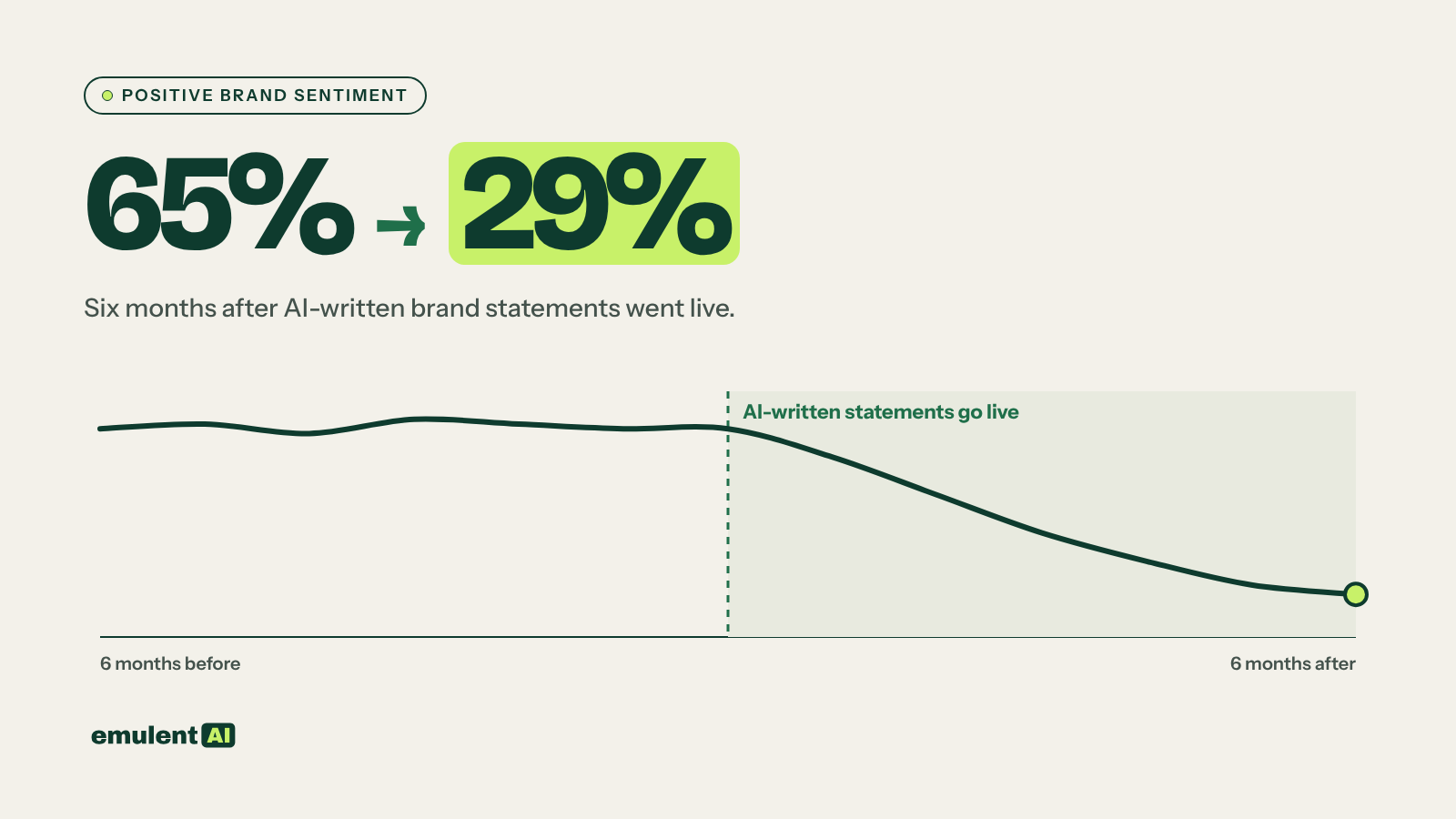
For six months, positive sentiment toward one brand held between roughly 63% and 66%. Then AI-written brand statements went live. Six months later, positive sentiment was about 29%. That’s less than half of where it started.
The lesson I take from that chart is narrow and specific: the words that tell people who you are should not come out of a model. You can use AI for a long list of marketing jobs. Your brand’s voice on the things it stands for, and your messages in the moments people are watching most closely, are not on that list.
The chart
The numbers are simple. Before the change, positive sentiment held in a narrow band around 63% to 66% for six months. After the AI-written statements were published, it fell over the following six months to about 29%.
A chart like this shows timing. It doesn’t prove the statements were the only cause, and other things can happen to a brand in six months. What makes it worth sharing is the size of the drop and how closely it followed the change.
What the statements were
Whatever the specifics, brand statements share one trait: they claim to speak for the company in its own voice. Readers judge them on whether they sound like a real point of view held by real people. That is the hardest thing for a model to supply.
Why AI-written brand statements go wrong
A language model doesn’t know your company. It predicts the most likely next word based on patterns from its training data, which is mostly the public web. That has three consequences, and each one shows up in brand copy.
It writes the average
Ask a model for a values statement and you get the average values statement: committed, customer-first, passionate about excellence. Every competitor’s page says the same thing. AI brings you to the center. A brand’s job is to find its edge, and average copy erases the edge you had.
It only knows what you tell it
The model sees the conversation and nothing else. It has no memory of your founders, the customer who almost left, or the hard call you made last spring, unless someone writes those things into the prompt. Brand statements that lack those specifics read as generic because they are.
It sounds sure when it’s wrong
Model output is plausible, which isn’t the same as true. In a brand statement that can mean a promise the company can’t keep or a claim about its history that isn’t accurate. When customers catch one of those, they stop believing the rest.
Customers are primed to notice. Gartner’s March 2026 survey of 1,539 U.S. consumers found that 68% frequently wonder whether the content and information they see is real, and 50% would prefer brands that don’t use generative AI in consumer-facing content. A brand statement that feels machine-made lands on an audience already looking for reasons to doubt it.
What should never be delegated to AI
Efficiency you gain can be brand trust you lose. The chart above is what that looks like in numbers. This is the work I tell clients to keep with a person, no matter how good the tools get.
Crisis communications
When something goes wrong, people read every word for signs of whether you care. A statement assembled from the average of other companies’ apologies sounds like exactly that. Use AI to pull together a timeline or summarize what customers are saying if it helps. The statement itself needs a person who knows what happened and is willing to own it.
Layoffs and other sensitive moments
Telling people they’re losing their jobs, announcing a death, responding to an injury or a public mistake: these messages carry consequences for real people, and readers can feel whether a human wrote them. If an employee later learns their layoff notice was drafted by a chatbot, the damage spreads well past that one message.
Anything with your name on it
If your name, your CEO’s name or your company’s name is signed to it, a person should have written the substance and read every word. That covers brand positioning, values pages, thought leadership, founder letters, client pitches and hard conversations with clients. AI can help you outline and tighten. It shouldn’t decide what you believe.
Brand positioning itself
The core strategic idea behind a brand is a judgment call about who you serve and why you’re different. AI doesn’t fix a bad strategy; it carries it out faster. Hand it the positioning and you get a fast, confident version of what everyone else is saying.
Where AI still helps brand teams
None of this means brand teams should avoid AI. The work that drains people is fair game: summarizing reviews and survey responses, auditing competitor messaging, organizing social listening data, producing variations of approved lines for testing, and cleaning up reports. Give AI the work that drains you, not the work that defines you.
The rule I use is the same one I’d apply to a new hire. A junior writer can draft, research and format. A junior writer does not publish the company’s values page or its crisis response without someone senior writing the substance and signing off. Hold AI to that standard and you keep the speed without spending the trust.
Next step
If your team is already using AI for brand or customer-facing copy, it’s worth setting the lines now, before a chart like this one belongs to you. Our AI Governance and Brand Safety service writes a usage policy that names what stays with people. For content that does use AI, our AI Content Marketing service puts a human edit on every piece.
Put this to work with Bill.
Tell Bill where your team is with AI right now. He’ll tell you what he would do first and what he would leave alone.
Contact Bill directly
Or call 773-791-3197