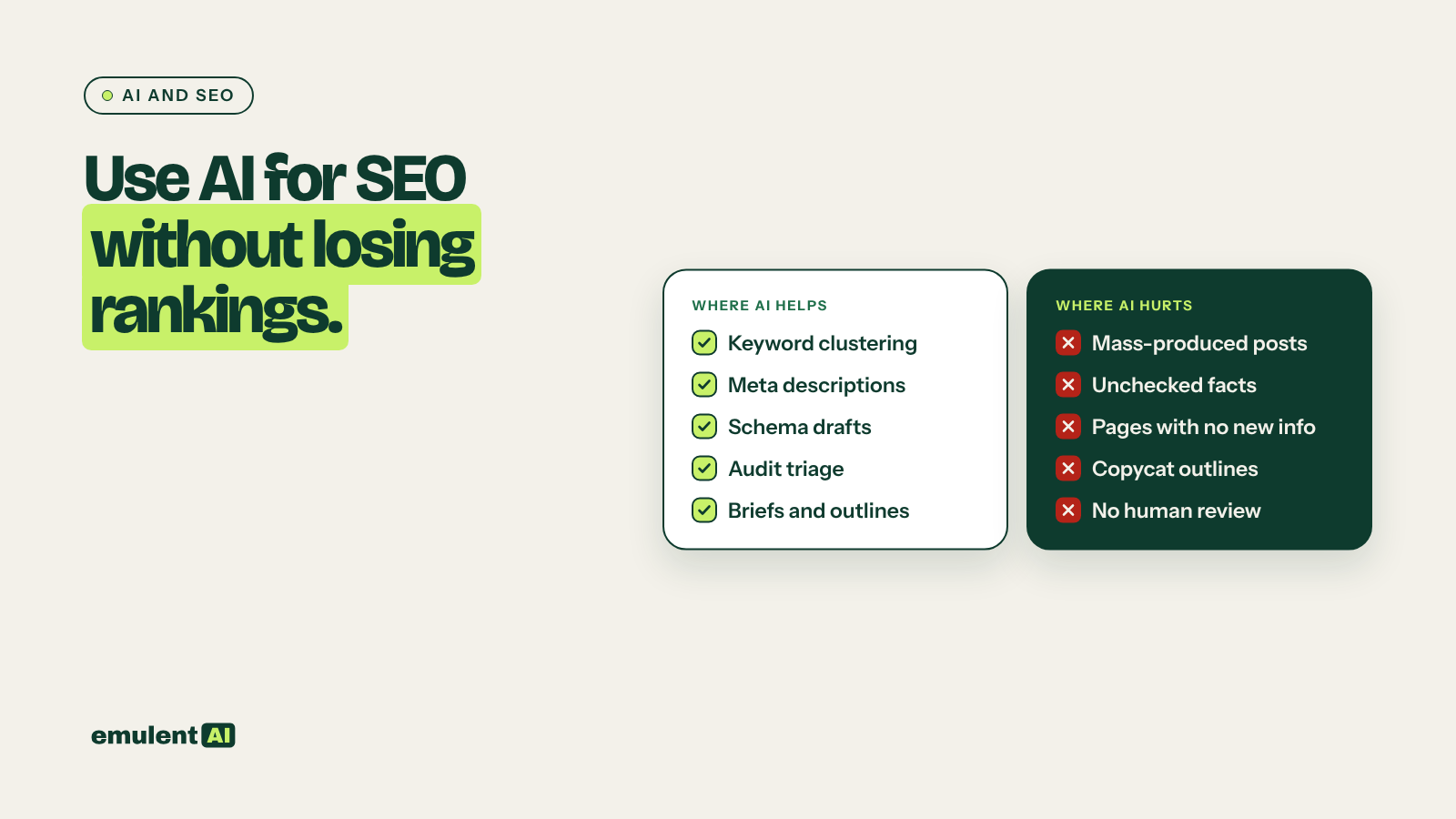
Use AI for the parts of SEO that are repeatable and easy to check: keyword clustering, meta descriptions, alt text, schema markup and making sense of big audit exports. Don’t hand it the content you want to rank. When I let AI write long-form content, traffic spiked for a few months, collapsed to near zero, and took about a year to come back. Google isn’t against AI content. But what it asks for (real effort, original information, first-hand skill, strict accuracy) is close to impossible to deliver with AI alone.
The rest of this article is the data behind that, what Google’s guidance says, and how I’d build an SEO program that uses AI without betting the site on it.
What happened when AI wrote the long-form content
I tracked the website traffic from long-form content written with AI, starting when the AI content production began in January 2025.
| Period | Monthly website traffic |
|---|---|
| January 2025 | About 100 |
| June 2025 | About 1,700 |
| August 2025 | Near zero |
| Late 2025 | Flat near zero |
| Fall 2026 | Back to roughly 1,400 |
The climb looked like a win for five months. Then it was gone within about two, and it took roughly a year to rebuild most of it. Rankings told the same story. Of the keywords that ranked from the AI-written content, 98% landed on page 3 or deeper in Google.
That’s the pattern I warn people about when they see posts like “I use AI to create my content and it increased my traffic by 200%. No writers. No agency. Just prompts.” The early numbers can be real. They just don’t tell you what happens next.
What the larger studies show
My data is one set of content. Ahrefs published a bigger study in July 2026, 331,000 pages checked with its AI content detector, and the results line up with Google’s own position: AI involvement alone doesn’t sink a page, but heavily AI-written pages do worse on average.
- Pages under 20% AI made up 54.7% of the pages ranking in positions 1 to 3. Pages that were 100% AI-generated made up 5.3%.
- 49.28% of the low-AI pages in the sample were indexed, against 40.35% of the very-high-AI pages.
- Low and moderate AI pages got two to three times the impressions of high and very-high AI pages.
Ahrefs says its detector is probabilistic and “not perfect,” so read these as directions, not exact measurements. The direction is the same one my traffic took.
What Google’s guidance says about AI content
Google updated its guidance on generative AI content on October 1, 2026, and updated its helpful content page days later. Read together, they say four things.
AI is allowed. The generative AI page says AI can help with research and with adding structure to original content.
Scale without value is spam. Google’s spam policies define scaled content abuse as “when many pages are generated for the primary purpose of manipulating search rankings,” and list “Using generative AI tools or other similar tools to generate many pages without adding value for users” as an example.
Accuracy is your job. The generative AI page says models “don’t retrieve facts” and instead “predict a likely sequence of words based on their training data.” It asks you to check titles, meta descriptions, structured data and image alt text too, because they can show up in Search.
Quality is judged on effort, originality, skill and accuracy. The helpful content page says raters evaluate main content on effort, originality, talent or skill, and accuracy. It adds that “Attribution or giving credit to other sources doesn’t replace the need for original effort,” and it lists heavy use of automation to produce content on many topics among the warning signs.
That last point is why I say AI alone can’t meet the bar. A model trained on the internet produces, by default, the average of what’s already been said. Original information and first-hand experience are, by definition, the parts it doesn’t have.
A note for ecommerce sites
The same Google page has specific rules for stores. Google Merchant Center requires AI-generated images to carry IPTC DigitalSourceType metadata set to TrainedAlgorithmicMedia, and AI-generated product titles and descriptions must be labeled as AI-generated. If you’re using AI to write product data at scale, check those requirements before you upload a feed.
Where AI helps SEO
The tasks that suit AI share two traits: you do them over and over, and a person can check the result quickly.
| Task | What AI does | What a person checks |
|---|---|---|
| Keyword clustering and search intent | Groups hundreds of keywords by topic and intent in minutes | Whether each cluster maps to a real page and a real buyer question |
| Meta descriptions and title tags | Drafts options for every page | Accuracy, brand voice, and whether the page delivers what the snippet promises |
| Image alt text | Describes images at scale | That the description is accurate for someone who can’t see the image |
| Schema markup | Writes JSON-LD from the page content | Validation in the Rich Results Test; markup matches visible text |
| Technical audits | Reads the full crawl export and groups issues by pattern | Which issues are real and which fixes are worth developer time |
| Content gap analysis | Compares your keyword set with competitors’ | Which gaps fit the business and are worth taking |
| Review and transcript summaries | Pulls recurring customer questions and language | That the themes are real and the quotes are accurate |
The audit row is the one we’ve done at the largest scale. On one project we audited 20,000 pages with Claude and Semrush. Semrush crawled every page and pulled technical, ranking and backlink data. Claude read the whole export, grouped the issues by pattern and flagged the ones most likely to affect rankings. Our SEO team reviewed the groupings, threw out the false alarms and ranked the fixes by impact and effort. The client got a fix list their team could act on in place of a 20,000-row spreadsheet. AI did the reading. People made the calls.
As I put it in my talks, “Give AI the work that drains you, not the work that defines you.” Tagging 20,000 rows drains people. Deciding which fix to ship first is the job.
Where AI hurts SEO
Creating content for SEO is on my list of things that need close oversight or shouldn’t go to AI at all. The reasons, item by item:
The content you want to rank. Your traffic depends on pages that say something other pages don’t. A model’s default answer is the center of what’s already published.
Bulk pages. A hundred city pages or a thousand near-duplicate “best X for Y” posts generated from one template is the scaled content Google’s spam policy describes.
Facts and statistics. A model produces plausible text, not true text, and sometimes it’s wrong with complete confidence. In my talks I use a cartoon of an AI calling a mushroom edible and apologizing later that it was poisonous. On a website, the apology comes after the damage.
Thought leadership and brand voice. Anything with an actual point of view, or anything carrying your name, needs a person who means it.
Reading the results. When rankings move, deciding why and what to do next is human work. AI can sort the data. It can’t tell you which of five plausible explanations is the real one.
An AI-assisted SEO roadmap
This is the order I’d work in for an organic program that uses AI where it fits. The months assume one site and a small team; stretch them for bigger sites.
| Month | Work | AI’s part | People’s part |
|---|---|---|---|
| 1 | Technical audit and fixes | Read the crawl export and group issues | Triage, rank fixes, ship them |
| 2 | Keyword clustering, intent mapping and gap analysis | Cluster and compare keyword sets | Choose which topics fit the business |
| 3 | Update the pages that already rank | Draft meta descriptions, alt text and schema; outline updates | Add first-hand detail, data and examples; edit; fact-check |
| 4 to 6 | Publish fewer, stronger new pieces | Research summaries, outlines, first-draft sections | Subject experts supply the substance; an editor signs off |
| Ongoing | Measure rankings, traffic, leads and AI visibility | Clean and consolidate reporting data | Interpret results and decide next steps |
Technical fixes tend to show up first. On our AI search optimization work, technical changes can show results in weeks, while content gains usually take three to six months. Plan for that, and don’t judge month two by month six’s standard.
“Publish fewer” is deliberate. Volume isn’t a strategy. The goal is more value from the content you produce, which is how our AI content marketing service is built: AI writes first drafts, and experts or editors shape them and sign off.
Quality checks before anything publishes
Run every AI-assisted page through two filters. First, the six questions I ask before handing anything to AI:
- Would I sign it?
- Can I check it?
- What breaks if it’s wrong?
- Would they care that AI did it?
- Would I be fine with them finding out?
- Does it fit my brand and experience?
Then the checks Google’s own pages point to:
- Every fact, number and source is verified against a page someone on your team opened.
- The page has something only you could write: your data, results, process or opinion.
- Titles, meta descriptions, alt text and structured data have been read by a person, and the markup validates.
- The byline leads to a real author page.
- Where readers might wonder how the page was made, it says so.
- The page isn’t one of a set of near-identical pages aimed at keyword variations.
If a page fails the first filter, it doesn’t matter how well it does on the second. In my talks I say “AI gets you to good, fast. Getting to great is still your job.” For SEO, good gets you to page 3.
Next step
If you already published AI-written content and traffic has dropped, start with an audit of those pages: which ones get impressions, which add nothing, and which could be rebuilt with real expertise. We can run that audit with you as part of our AI search optimization service, or book a strategy call to talk through your site.
Put this to work with Bill.
Tell Bill where your team is with AI right now. He’ll tell you what he would do first and what he would leave alone.
Contact Bill directly
Or call 773-791-3197