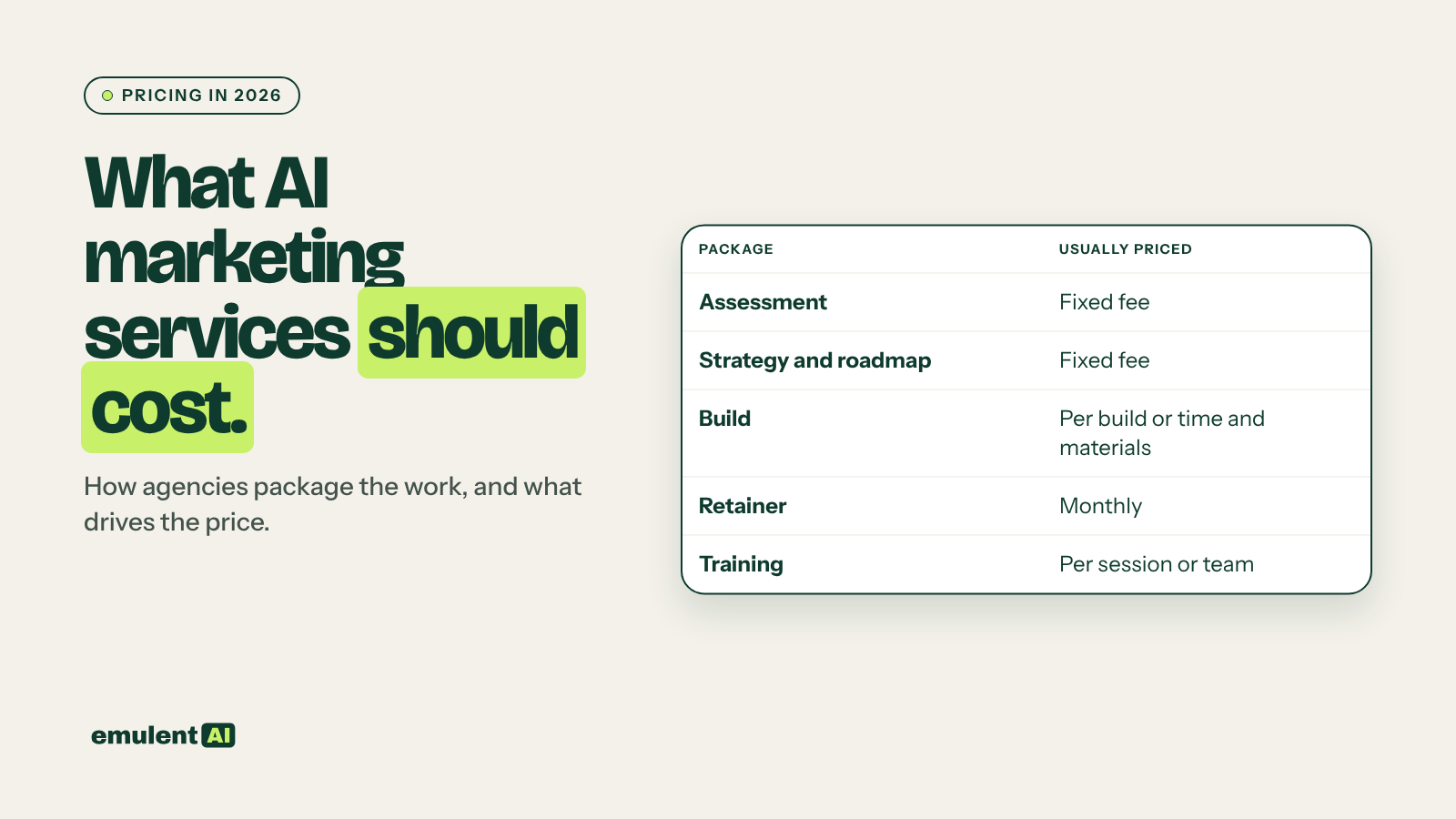
Most AI marketing services are sold as a fixed-price assessment, a fixed-price strategy project, a build priced per project, a monthly retainer or training priced by the session. What you should pay depends far more on scope than on the word “AI”: how many people and tools are involved, how much of the work the agency does for you, how messy your data is and how fast you need it.
Be careful with published price ranges for AI and AI search work. The two guides I read for this article were both tied to an agency that sells the service, and neither showed the data behind its ranges. Below are the benchmarks that do have a survey behind them, what an AI search optimization retainer should cover, what belongs in the contract and how we price our own work.
How agencies package AI marketing services
| Package | What you get | How it is usually priced |
|---|---|---|
| Assessment or audit | A review of your data, tools, people and risk, ending in a ranked list of gaps | Fixed fee |
| Strategy and roadmap | An audit of current marketing, each proposed AI use case judged, and a plan with owners and dates | Fixed fee |
| Build or implementation | Tool setup, automated workflows, custom tools, integrations with your CRM or CMS | Fixed fee per build, or time and materials |
| Retainer | Ongoing content workflows, AI search work, governance updates, reporting | Monthly |
| Training | Keynotes, hands-on workshops, office hours | Per session or per team |
In SE Ranking’s 2023 survey of 135 SEO agencies, a monthly retainer on its own was the most common setup, used by about a third of agencies; most of the rest mixed monthly, project and hourly fees. In the U.S. and Canada, 48% charged monthly.
Automation builds are where quotes vary most. A workflow that drafts first versions of product emails from your own data is a small job. A custom tool that pulls from several systems is not. Two questions settle most of the gap. Who pays for the AI tool licenses and API usage once the build is live? And who fixes it when a vendor changes its model or interface?
What drives the price
- Team size. Training ten people costs less than training a hundred, and every person needs their tools set up.
- Tools and channels. Each platform, account and channel adds setup, testing and reporting.
- Who does the work. Done-for-you costs more than done-with-you, where the agency builds and trains and your team runs it.
- Urgency. A roadmap needed for a board meeting next month costs more than one on a normal schedule.
- The state of your data. When we consolidated 900,000 biotech specimen records, the work was pulling scattered, inconsistent sources into one structure and checking every classification against the source. Clean data is cheaper to work with.
- Risk and review. Legal, medical, financial and compliance-sensitive copy needs more human review, and review time is the expensive part.
- Volume. If a proposal prices AI content by the piece, you are paying for output. Volume is not a strategy, and on the data I tracked it hurt rankings.
What Emulent charges, and why there is no price list
Our pricing page does not list dollar amounts, because scope changes with team size. Here is what it does commit to. Every engagement is quoted after a short call, and you get a written proposal with a fixed scope and a fixed price before any work starts. There are four ways to work with us:
| Engagement | What it covers | Timing and terms |
|---|---|---|
| Readiness assessment | A review of data, tools, team skills and risk, with a readiness score, a setup review, a never-paste list and a ranked gap report | Fixed scope, usually two to three weeks |
| Strategy and roadmap project | An audit of current marketing, a review of proposed AI use cases and a 90-day roadmap with owners, dates and a measurement plan | Fixed scope, usually four to six weeks |
| Ongoing partnership | Content workflows, AI search work, governance updates, tool changes and check-ins every two weeks | Monthly, month to month |
| Training | Keynotes, hands-on workshops and office hours | Per session or per team |
There are no long contracts. What moves our price is the same list as above: team size, the number of tools and channels, how much of the work we do and how much your team does, and urgency. You can start small, with an assessment or a single workshop, and decide from there.
Market benchmarks, and how far to trust them
The closest benchmarks with a real survey behind them come from the channels AI work sits on.
| Benchmark | Figure | Source and caveats |
|---|---|---|
| SEO retainer, most common range | $501 to $1,000 a month | Ahrefs survey of 439 SEO providers, December 2023 |
| SEO retainer, agency average | $3,209 a month | Same survey; consultancies averaged $3,250 |
| SEO hourly rate, most common | $75 to $100 an hour | Same survey |
| SEO project fee, most common | $2,501 to $5,000 | Same survey |
| Social media management retainer | $2,107 a month on average | HeyOrca survey of 100+ social media managers, 2024; three platforms for one client |
| Social media hourly rate | $66.96 on average | Same survey |
Both surveys predate most AI search work, and the gap between the most common retainer and the agency average tells you how wide the spread is. The Ahrefs data is the larger sample. The HeyOrca report is the most direct answer I found on social media marketing rates, though 100 respondents is a small base.
If you run a formal procurement process and need agency rate benchmarks by role, the 4A’s sells a 2025 billing rate benchmark built from 886 agency rate cards and more than 36,000 data points.
For the budget side, Gartner’s 2026 CMO Spend Survey found CMOs put an average of 15.3% of marketing budgets toward AI, with total marketing budgets at 7.8% of company revenue. Most of its 401 respondents work at companies with more than $1 billion in revenue, so treat that share as a reference point, not a target.
What an AI search optimization retainer should cover
AI search optimization means getting cited in answers from ChatGPT, Gemini, Perplexity and Google’s AI Overviews, with classic SEO as the base. Our AI search optimization work includes:
- an AI visibility audit across Google, AI Overviews and AI assistants
- a technical SEO audit with a fix list ranked by impact and effort
- a competitor gap analysis turned into a content calendar
- schema and on-page recommendations for each priority page
Set expectations on timing before you sign. Technical fixes can show results within weeks; content gains usually take three to six months. A retainer that ends at month three will rarely show what the content work did.
Know what not to pay for. Google says there are “no additional requirements to appear in AI Overviews or AI Mode, nor other special optimizations necessary.” Its guide to generative AI features says optimizing for generative AI search “is optimizing for the search experience, and thus still SEO,” that you do not need special AI text files or markup, that you do not need to break content into tiny chunks, and that seeking inauthentic mentions “isn’t as helpful as it might seem.” Line items for llms.txt files, “AI markup” or mention campaigns are padding.
For a mid-market brand, three things set the cost of an AI search retainer. The first is the number of pages: our enterprise audit covered 20,000. Next comes the number of competitors you track (our gap analysis compared 10). The biggest is who writes the content. Original writing by people who know the subject costs more than AI drafts, and it is the version that ranks. Of the keywords that ranked from AI-written content on the site I tracked, 98% landed on page 3 or deeper in Google. The line on our service page puts it well: “Capability is cheap now. Judgement is what you’re paying for.”
Staying under a budget cap
If you are a mid-market firm working with a ceiling, such as an AI consulting budget under $250,000, buy in phases with a decision point after each one:
- A fixed-price assessment first, so you know what is ready and what is not.
- A fixed-price roadmap that ranks use cases as go, wait or don’t.
- One build from the top of that list, priced on its own.
- A monthly partnership only after the first build is in use, on terms you can end.
Keep tool licenses out of the agency fee so you can see them, and do not sign an annual commitment before you have a roadmap. Phasing also gives you three chances to walk away if the work is not paying off.
What a marketing service agreement should include
- Scope and deliverables, plus a plain list of what is out of scope and how changes get priced.
- Price and payment terms: a fixed fee per phase, or a monthly retainer with what each month includes.
- Term and exit: month to month or a notice period, and what happens to work in progress if you leave.
- Ownership of what gets built: workflows, written instructions, custom tools, content and handover documentation. The U.S. Copyright Office concluded in January 2025 that AI outputs can be protected by copyright only where a human author has determined sufficient expressive elements, and that prompts alone are not enough. Your contract should say who owns the work people create and how AI-assisted deliverables are treated.
- Data handling: which AI plans and accounts the agency will use, whether your data can train any model, what must never be pasted in, and how access is removed when the engagement ends. Business plans tend to keep your data out of training; OpenAI, for example, says it does not train on business data by default.
- Human review: who reads what before it ships. Our rule is that nothing AI-written goes out under a client’s name without a person reading it first.
- Tools and third-party costs: who pays, whether there is a markup, and whether the agency earns referral fees on anything it recommends.
- Reporting: the baseline, the metrics (leads, revenue and hours saved, not pieces produced) and how often you will review them.
- Confidentiality for your data, your customers and your plans.
Have your own lawyer review the agreement before you sign. Contract terms and copyright questions depend on your situation.
How to get value from a free marketing consultation
A first call is worth what you bring to it. Bring your rough budget, your team size, the tools you already pay for and one or two numbers you want to move. Bring one real task you are thinking of handing to AI and ask the consultant whether they would.
Then ask four things before you hang up. What would you not use AI for in our business? How do you price, and what would the first phase cost? Will I get a written scope and price before any work starts? What happens if we stop after the first phase?
Watch for three warning signs: no price until you sign, a long contract before anyone has built a roadmap, and a proposal that leads with how many pieces of content you will get.
Our strategy call is 30 minutes, and you leave with a few next steps whether or not you work with us. If it makes sense to go further, the next thing you see is a written proposal with a fixed scope and price. Book a strategy call when you are ready.
Put this to work with Bill.
Tell Bill where your team is with AI right now. He’ll tell you what he would do first and what he would leave alone.
Contact Bill directly
Or call 773-791-3197