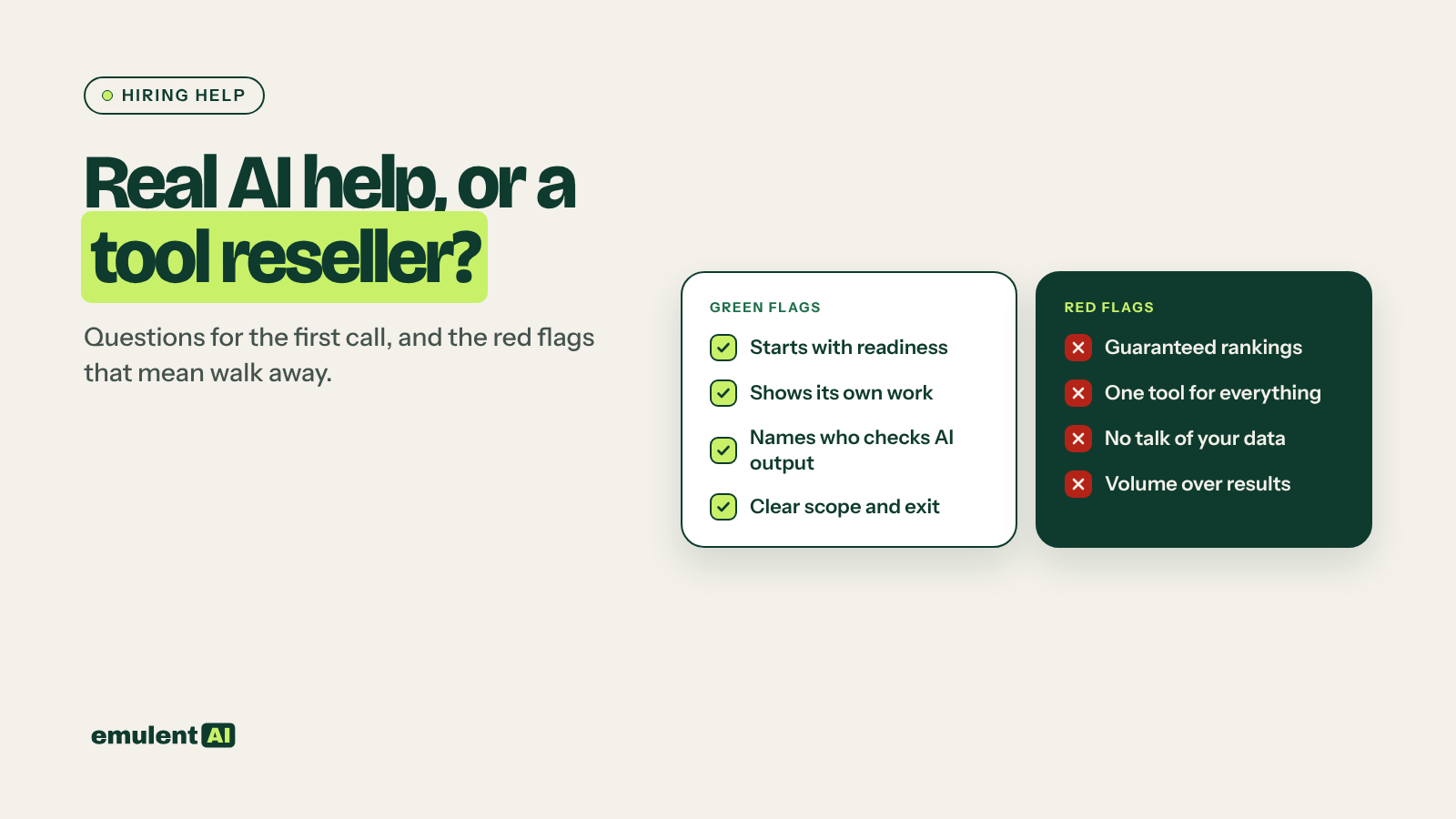
Hire the AI marketing consultant who can tell you, in plain words, which parts of your marketing AI should stay away from, and who can show you work where a person checked the output before it shipped. Everyone has access to the same tools now. What you are paying for is judgement about where to use them.
Pick a consultant when you need a plan, a safe setup and a trained team. Pick an agency when you need someone to produce and run the work every month. For most companies the first comes before the second, and Gartner’s 2026 numbers (below) show why.
What an AI marketing consultant does
An AI marketing consultant decides which of your marketing tasks AI should touch, sets the tools up so your data stays safe, turns repeatable work into workflows and teaches your people to use them. The good ones spend more time on your strategy and your data than on prompts.
At Emulent we run every engagement through the same six steps, laid out on our approach page: assess, sort, set up, build, train, measure. Sorting is where most of the value sits. Work that drains your team and is easy to check goes to AI. Work that defines your brand stays with people.
From a consultant, you should expect most of this:
- a readiness review of your data, tools, people and risk
- a ranked list of AI use cases, each marked go, wait or don’t
- tool setup: the right plans, training settings, standing instructions and a project for each client or recurring job
- reusable workflows, plus custom tools where they pay for themselves
- training that teaches your team to brief AI like a new hire
- a measurement plan built on leads, revenue and hours saved
That last item tells you a lot. AI use is a communication skill more than a technology skill. Output is only as good as the brief, which is why subject-matter experts get more out of it than anyone. A consultant who sells you software and a prompt pack has skipped the part that decides whether any of it works.
Consultant, agency or in-house: which fits your situation
You do not have to pick only one. You can bring in a consultant to set up and train, then run the work yourself or hand the volume to an agency. Here is how the three compare.
| AI marketing consultant | AI marketing agency | In-house AI lead | |
|---|---|---|---|
| Who does the work | A senior person or small team; your staff run it afterward | Agency staff produce and run it for you | Your own employee |
| Best fit | A plan, setup, governance, training and a few custom builds | Ongoing content, search and ads at volume | AI as a permanent skill across the company |
| How you pay | Fixed-scope project, sometimes a monthly follow-on | Monthly retainer | Salary, benefits and tools |
| What you own at the end | Workflows, written instructions, trained people | Whatever the contract says | Everything, as long as the person stays |
| Main risk | A plan with no follow-through | Junior staff shipping volume without judgement | Slow hiring and one person asked to cover everything |
The in-house column is the expensive one. The U.S. Bureau of Labor Statistics puts the median pay for marketing managers at $166,790 as of May 2025, and benefits add to that: BLS data shows benefits make up 30% of private-industry compensation costs (June 2026). A senior hire who knows both marketing and AI is unlikely to come in under that median.
Start with readiness, because most teams are not ready
Gartner’s 2026 CMO Spend Survey asked 401 marketing leaders about AI. Seventy percent said becoming an AI leader is a critical goal for 2026. Only 30% reported mature or fully developed AI readiness. They are putting an average of 15.3% of marketing budgets toward AI while total budgets stayed flat, at 7.8% of company revenue against 7.7% the year before. Gartner’s Ewan McIntyre put the risk this way: “The risk is that CMOs invest in AI tools faster than they build the data foundations.”
That gap should shape who you hire. If your company is in the 70% and not the 30%, the first job is an honest look at your data, your settings and your people. A readiness assessment answers that in a few weeks. A consultant who skips straight to a tool rollout is selling into the gap, and you will pay twice.
Selection criteria that separate real help from resellers
- They can name what AI does badly. Ask where it fails, and listen for specifics: brand positioning, thought leadership with an actual point of view, legal or medical or financial copy, reading the room during a crisis, humor and local references. “It gets better every month” means they have not pushed it hard.
- They can explain how a model works. A language model does not know things. It predicts the most likely next word, over and over, from patterns in what it was trained on. So its default answer is the average of what everyone has already said, it remembers nothing about your brand unless you tell it, and it can be wrong with total confidence. If a consultant can explain that to your CFO in two minutes, they can teach your team.
- Marketing came first. As I put it in my talks, “AI knows the internet. It doesn’t know your customer.” You need someone who has done enough marketing to tell good output from output that only sounds good.
- Their case studies describe the human check. Ours do. When we built a searchable database of 900,000 specimens for a biotech company, AI tagged and classified every record, and people checked those classifications against the source. Nothing went into the final database without that check. Ask every candidate for that level of detail.
- Strategy comes before tools. My line on this is short: “AI doesn’t fix a bad strategy. It executes it faster.” A sound proposal puts a roadmap with owners and dates ahead of any software purchase. Our AI marketing strategy work produces exactly that before anyone buys anything.
- They have rules for your data. Which plans will your team use? Do your chats train the models? What must never be pasted in? Business plans tend to keep your data out of training; OpenAI, for example, says it does not train on business data by default for ChatGPT Business, Enterprise and its API. Personal plans often work the other way. Get the answer in writing.
- They measure results, not output. Leads, revenue and hours saved count. Posts published do not. A team that publishes half as much and gets twice the response is ahead.
- You keep what they build. Workflows, written instructions, custom tools and documentation should stay with you if the engagement ends.
Does a local AI marketing consultant help?
For strategy, setup and audits, location makes little difference. Video calls and a shared project space work fine. Training is the exception. Hands-on workshops, where your team brings real tasks and works through them with AI in the room, tend to stick better in person. Our workshops in the Raleigh-Durham area are mostly in person at client offices and local venues around the Triangle. If your search started with “AI marketing agency near me,” weigh distance against expertise. A strong remote consultant beats a weak local one.
Questions to ask on the first call
- What does AI do well in marketing like ours, and where does it fail? A good answer separates repeatable, checkable work (first drafts, subject line variations, keyword clustering, call transcript summaries, cleaning campaign data) from work that is high-stakes, unverifiable or a matter of taste.
- How do you decide whether a task goes to AI? Look for a real test. Mine is six questions: Would I sign it? Can I check it? What breaks if it’s wrong? Would they care that AI did it? Would I be fine with them finding out? Does it fit my brand and experience?
- Who reviews the output before it goes live, and what are they checking for?
- Which plans and settings will our team use, and who can see our data?
- What will you never put into an AI tool? Passwords, logins, API keys and customer data should be on that list.
- What is our baseline today, and how will we know in 90 days whether this worked?
- Do any of the tools you recommend pay you referral fees?
- If we stop working together, what do we keep?
Red flags that mean walk away
Results that read like a social post. You have seen the feed: traffic up 200% with “no writers, no agency, just prompts.” An entire SEO strategy replaced by one ChatGPT prompt and 40 number-one rankings in 30 days. An ad account handed to AI for a month and ROAS tripled. Take all of it with a grain of salt. Ask for the account, the dates and what happened six months later. When I tracked traffic from AI-written long-form content, it climbed from about 100 visits a month to about 1,700 between January and June 2025, then fell to near zero by August.
Guarantees about what AI can do. Regulators test these claims. The FTC’s Operation AI Comply, announced in September 2024, included DoNotPay, which called itself “the world’s first robot lawyer” and, according to the FTC, never tested its chatbot against human lawyers. In April 2025 the FTC announced a proposed order against Workado, which had claimed its AI content detector was 98% accurate; the FTC says testing on general content found 53%. That August it sued Air AI over what it alleges were deceptive claims, among them that the company’s conversational AI could replace human customer service reps. If a vendor makes a claim about AI performance, ask for the test behind it.
A volume pitch. “Fifty AI blog posts a month” is a plan to fill your site with average content. Google’s guidance on generative AI content, updated October 1, 2026, warns that producing many pages with AI tools without adding value for users may violate its scaled content abuse policy.
A software license on page one. If the proposal opens with a platform subscription, the consultant may be a reseller.
No answer about data. If nobody can tell you which plan your team will use or whether your client information trains a model, stop there.
Handing AI the whole job. Anyone who ships whatever comes back, with no person reading it, is putting your name on work nobody checked.
What the first 90 days should look like
A good engagement shows you something working inside a quarter. The timing below follows how we scope our own work: an assessment usually takes two to three weeks, and a strategy and roadmap project four to six.
| Weeks | What happens | What you should have at the end |
|---|---|---|
| 1 to 3 | Assessment of data, tools, people and risk, through a short team survey, two or three interviews and a look at your AI settings | A readiness score, a setup review, a draft never-paste list and a gap report ranked by effort and impact |
| 3 to 8 | Audit of current marketing and existing AI use; each proposed use case tested and marked go, wait or don’t | A 90-day roadmap with owners and dates, plus a measurement plan |
| 6 to 12 | Tools configured, the first workflows built, hands-on training on real tasks | Workflows in daily use, a team that can brief and review AI, first results against the baseline |
Expect check-ins every two weeks and a readout at the end that covers what was done, what changed and what comes next. If day 90 arrives and nothing is in use, ask why before you sign for more.
If you have a proposal on your desk and want a second opinion, or you want to know where your team stands before you hire anyone, book a strategy call. It takes 30 minutes, and you will leave with a few next steps whether or not we work together.
Put this to work with Bill.
Tell Bill where your team is with AI right now. He’ll tell you what he would do first and what he would leave alone.
Contact Bill directly
Or call 773-791-3197