This guide is part of our series on AI for branding and design.
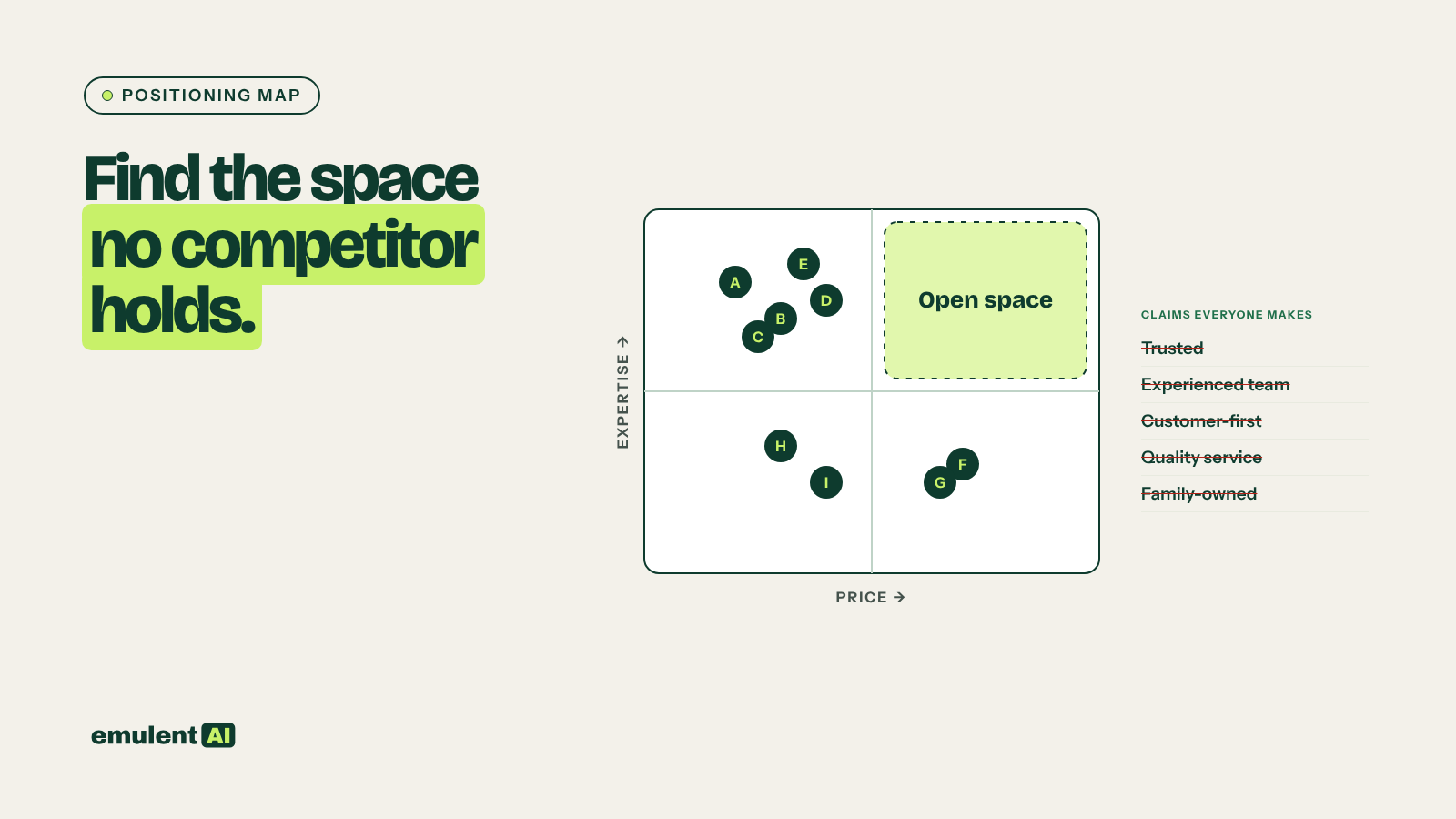
Read the homepages of ten businesses in one category and you will see the same claims over and over: “trusted,” “experienced team,” “customer-first,” “quality you can count on.” When every competitor says it, it stops meaning anything to a buyer. A positioning map shows where everyone stands and which space nobody has claimed.
AI makes this fast. Give it the homepage and About copy from 8 to 10 competitors, and it can score them on two axes, plot them and list the claims they all share.
What you need
- An AI assistant that accepts file uploads, such as Claude
- The homepage and About page text of 8 to 10 competitors, saved as text or PDF
- The client’s own homepage and About text
- Any pricing information that is public
Step 1: Choose the competitors
Pick the businesses a buyer actually compares, not the biggest names in the industry. Ask the sales team who prospects mention, and look at who ranks for the main search terms in the client’s area. A mix of direct competitors and one or two alternatives (a DIY tool, an in-house hire) gives a more honest map.
Step 2: Choose the axes
Two axes that matter to buyers make a useful map. Common pairs:
- Price against depth of expertise
- Friendly against authoritative
- Specialist against generalist
- Fast and simple against thorough and custom
Pick axes the buyer cares about. If you are not sure, ask the AI to propose four pairs based on the review language from review mining, and pick two.
Step 3: Have AI score and list the claims
Attached is homepage and About copy from 9 competitors and our client.
1. Score each business from 1 to 10 on two axes:
   - [axis 1, with what 1 and 10 mean]
   - [axis 2, with what 1 and 10 mean]
   Quote the copy that justifies each score.
2. List every claim that appears on 3 or more of the sites, with the sites
   that make it and the exact wording each uses.
3. List claims that only one site makes.
4. Say which areas of the map (high/low on each axis) have no business in them.
Output the scores as a CSV with columns: business, axis1, axis2, evidence.
Paste the CSV into a spreadsheet and make a scatter chart, or ask the AI to draw the map as a simple chart.
Step 4: Read the map with the client
The shared claims list is often the most useful part. If eight of ten competitors say “family-owned” and “quality service,” those words do no work in the client’s headline. The empty areas of the map are possible positions, but only if the client can back them up. A business cannot claim “fastest” if it is not, however open that space looks.
Step 5: Write positioning options for the open space
Ask for three to five positioning statements aimed at the open areas, each one built from facts the client can prove. Then take the best ones into persona message testing and, later, real conversations with customers.
Checks before you act
- Scores based on website copy show how competitors present themselves, not how good they are. Note that on the map.
- Check the evidence quotes for the businesses at the edges of the map. A single unusual sentence can push a score too far.
- Redo the map once a year, or when a major competitor rebrands.
Put this to work with Bill.
Tell Bill about your next brand or website project. He’ll tell you which of these jobs to hand to AI first.
Contact Bill directly
Or call 773-791-3197