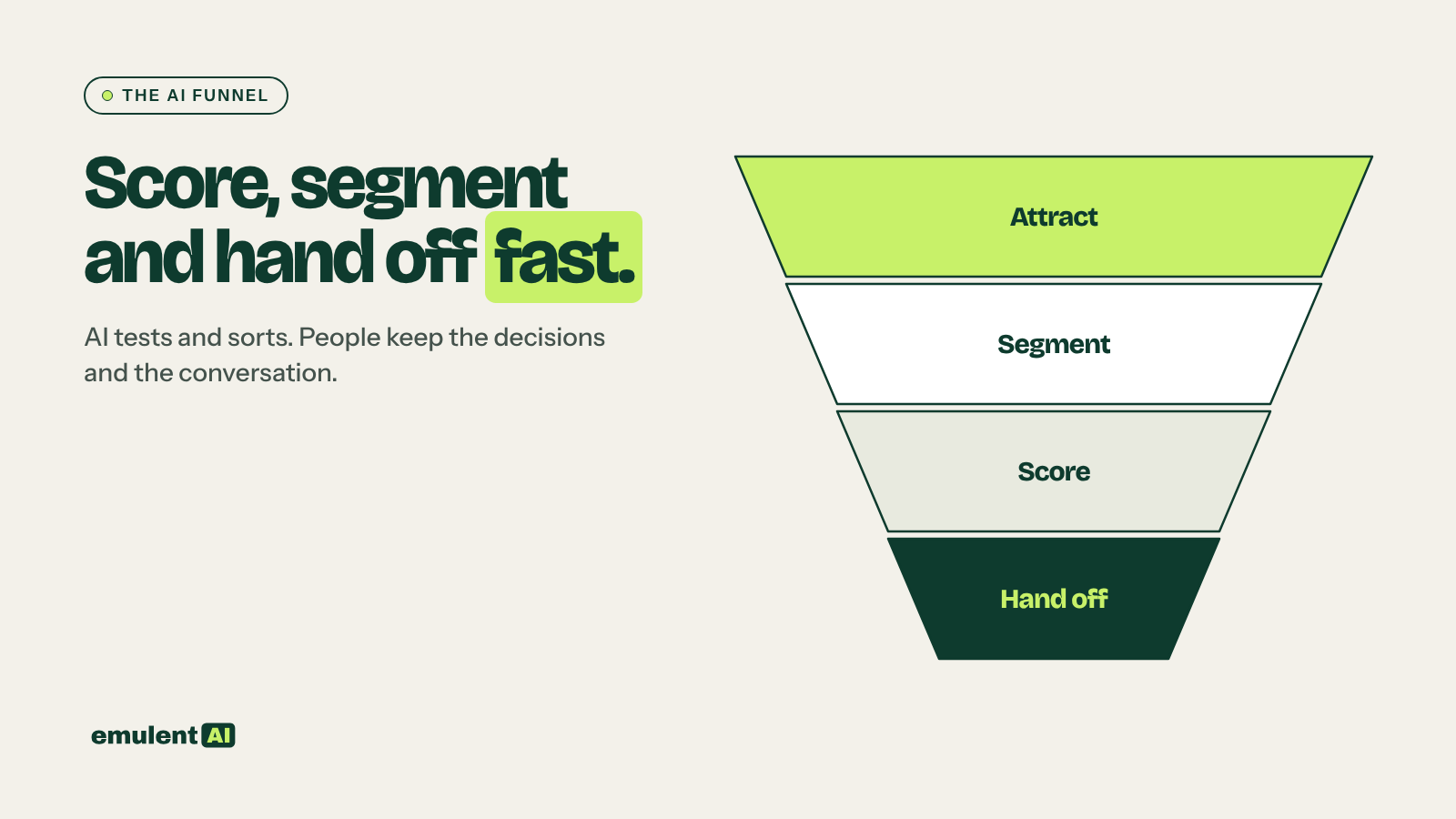
An AI-powered marketing funnel is the funnel you already need, with AI doing the sorting, scoring, drafting and testing at each stage. The build order is what decides whether it works: define the funnel first, then segment by behavior, then score leads with a model you can explain, then let AI test campaigns inside those rules. Teams that start with the tools get a faster version of the funnel they already have, problems included.
Below is how I would set one up, with a lead scoring model you can copy and the HubSpot features (and subscription tiers) that support each step.
Start with the strategy, because AI copies whatever you give it
As I put it in my talks, “AI doesn’t fix a bad strategy. It executes it faster.” A funnel is a set of decisions about who you want, what counts as a qualified lead and when sales should step in. AI can’t make those decisions for you. It has never sat in your sales meetings and has no memory of which deals closed last year unless you hand it that data.
Before you open any tool, write down four things on one page:
- Who buys from you, described from closed deals (job titles, company size, industry, region), not from who you wish bought from you.
- Your lifecycle stages and the exact rule for moving between them. “Marketing qualified” should mean something specific, such as a fit score above a set number plus one high-intent action.
- What sales wants in a handoff and how fast they will follow up.
- What you will measure: leads, pipeline and revenue by segment, not emails sent or posts published.
Most teams are not there yet. Gartner’s 2026 CMO Spend Survey found CMOs put an average of 15.3% of marketing budgets into AI, but only 30% report mature AI readiness. That gap is usually the missing page above. Our AI marketing strategy and roadmap work starts there for the same reason.
Map what AI does at each stage
A funnel map shows where AI saves time and where a person has to stay in the loop. This is the split I use.
| Stage | The buyer’s question | What AI does well here | What a person owns |
|---|---|---|---|
| Top of funnel (TOFU) | Do I have this problem, and who can help? | Keyword clustering, search-intent grouping, repurposing one long piece into social, email and ad copy, meta descriptions | The point of view, the topics worth owning, final edits |
| Middle of funnel (MOFU) | Is this the right approach for us? | Behavior-based segments, persona drafts from real data, nurture email first drafts | Which segments are real, what each one is told |
| Bottom of funnel (BOFU) | Is this the right company, at the right price? | Lead scoring, routing, call summaries, follow-up drafts | The sales conversation, pricing, the pitch |
| After the sale | Did I make the right call? | Summarizing reviews, survey responses and support transcripts | The relationship, renewals, hard conversations |
Top of funnel: attract the right people, not the most people
TOFU (top of funnel) is the stage where people first meet your brand, usually through search, social, ads or a referral. AI is good at the repeatable parts of this stage. It can cluster a keyword export by intent, draft meta descriptions and alt text, and turn one long article into a week of social posts and an email.
It is weaker at the content itself. I tracked what happened when AI-written long-form content went live on a site starting in January 2025. Monthly traffic climbed from about 100 to about 1,700 by June 2025, collapsed to near zero by August, sat flat through late 2025, and took about a year to climb back to roughly 1,400 by fall 2026. Of the keywords that ranked from that AI-written content, 98% landed on page 3 or deeper in Google. A TOFU built on bulk AI content can disappear in a month.
Two top-of-funnel jobs where AI earns its keep:
- Target account lists. We built a process for B2B clients that uses AI to collect publicly listed details from directories, put them in one format, remove duplicates and sort them by the client’s criteria. People defined what a good-fit prospect looks like, chose the sources and reviewed the lists before anything went to outreach. The target client lists case study has the detail.
- Interactive tools as lead magnets. Calculators, checklists and maturity models give prospects a reason to hand over an email address. We use AI to draft the logic, questions and scoring from a brief, and a person checks every formula before launch, as the industry-specific tools case study describes.
Middle of funnel: segment by what people do
Job title tells you who someone is. Behavior tells you what they want right now. A contact who viewed your pricing page twice this week is in a different place than a contact with the same title who opened one newsletter in March.
HubSpot calls these groups segments (the older name was lists). An active segment updates its members automatically as people meet or stop meeting the criteria; a static segment is fixed when you save it, according to HubSpot’s create segments documentation. For behavior, HubSpot’s filter criteria page lists event filters for page views, form submissions, marketing email opens and clicks, ad interactions, CTAs, marketing events, documents and SMS events, with options to limit an event to a date range or a number of completions. Page view filters need Marketing Hub or Content Hub Professional or Enterprise.
Segments I would build first:
| Segment | Filter logic (example) | What they get |
|---|---|---|
| Pricing-page visitors | Viewed a URL containing /pricing 2 or more times in the last 14 days, not a customer | Sales alert if fit is high; a case study email if fit is medium |
| Engaged, not converted | Clicked 3 or more marketing emails in 60 days, no form submission | An offer with a clear next step (assessment, consult, tool) |
| Gone quiet | No email click or page view in 90 days, was engaged before | A short re-permission email, then suppression |
| Event attendees | Attended a marketing event in the last 30 days | Follow-up with the recording and one question |
AI helps here in two ways. HubSpot’s Breeze Assistant can generate segment filters from a plain-language description, which you then edit. And with Marketing Hub Enterprise, HubSpot can build lookalike segments from a seed segment using contact, company and event properties. Check both against your own definitions before you send anything to them.
The bigger win is persona work. Export real material (call transcripts, closed-won notes, reviews, survey answers) and ask a model to draft segments and the language each one uses. That is one of the jobs AI does well. The drafts are a starting point. AI knows the internet; it doesn’t know your customer, so test every draft persona against the salespeople who talk to those buyers every week.
Lead scoring: a worked example you can copy
A lead score adds up points for fit (who the person is) and engagement (what they have done), so sales can work the best leads first. HubSpot’s lead scoring tool supports fit, engagement and combined scores. Combined scores land in a grid from A1 to C3: the letter is fit (A is high) and the number is engagement (1 is high). Engagement points can decay over 1, 3, 6 or 12 months, so old activity counts for less.
The sample model below is for a B2B service company selling to mid-market firms. It is an illustration of the math, not a model from a client account. Change the criteria to match your closed deals.
| Criterion | Type | Points |
|---|---|---|
| Job title is director, VP or C-level in marketing or sales | Fit | +15 |
| Company has 50 to 1,000 employees | Fit | +15 |
| Industry is one you serve | Fit | +10 |
| Located in your service area | Fit | +10 |
| Personal email domain (gmail.com, yahoo.com) | Fit | -10 |
| Job title contains “student” | Fit | -25 |
| Requested a consultation or demo | Engagement | +25 |
| Viewed the pricing page in the last 30 days | Engagement | +10 |
| Attended a webinar | Engagement | +10 |
| Downloaded a guide or used a calculator | Engagement | +5 |
| Clicked a marketing email (capped at 6 points) | Engagement | +2 each |
| Viewed the careers page | Engagement | -10 |
Set cutoffs for each score. In this sample, fit of 35 or more is high, 20 to 34 is medium and below 20 is low. Engagement of 30 or more is high, 15 to 29 is medium and below 15 is low. Turn on decay at 3 months for the engagement points.
Two leads run through it:
- A VP of marketing at a 300-person company in your industry and area scores 50 on fit. She viewed pricing, downloaded a guide and clicked two emails, for 19 on engagement. That is high fit and medium engagement, or A2. Send her a relevant case study and alert the account owner; she may not want a call yet.
- A student using a Gmail address requests a demo and views pricing. Fit is -35 (low) and engagement is 35 (high), or C1. Lots of activity, little chance of a sale. Route this one to a qualifying email, not a sales rep’s calendar.
Where does AI come in? HubSpot can build contact scores with AI in Marketing Hub Enterprise. You choose a lifecycle stage change (for example, subscriber to sales qualified lead) and a timeframe, and the model studies the contacts who made that move and recommends criteria and points. It needs at least 50 contacts in the sample, including 25 that converted and 25 that did not, and you review the criteria before turning the score on.
Treat those recommendations as a hypothesis. A model trained on 50 contacts will find patterns, and some of them will be coincidence. If the AI says people who read a certain blog post convert more, ask sales whether that rings true before you give it 20 points. If you don’t have the volume for the AI version, the manual model above works fine for most small and mid-market companies.
Bottom of funnel: hand off fast, keep the conversation human
The bottom of the funnel is where speed pays and where automation can cost you. Route A1 and A2 leads to an owner within minutes, with a summary of what they did. HubSpot’s Breeze Assistant can build workflows from a prompt in the workflow builder (Professional or Enterprise tiers), adding triggers and actions you review on the canvas.
AI can draft the follow-up email and summarize the discovery call. HubSpot also lists a prospecting agent that researches target companies and generates personalized outreach, and a data agent that enriches and maintains CRM records, both managed in Agent Hub, which uses HubSpot Credits.
Keep a person on the send button for anything a buyer reads at this stage. Gartner’s March 2026 consumer survey found 50% of U.S. consumers would prefer to give their business to brands that do not use GenAI in consumer-facing messages, and 68% frequently wonder whether the content they see is real. Before you automate a bottom-funnel message, run it through two questions from my should-test: would the buyer care that AI wrote it, and would you be fine with them finding out? If either answer is uncomfortable, a person writes it.
Campaign optimization: let AI test, keep the decisions
AI is very good at producing variations: ten subject lines, five landing page headlines, three CTAs. Use that to run more tests, with a few rules:
- Test one variable at a time, and write down what you expect before the test starts.
- Give each test enough volume and time to mean something. A winner after 40 opens is noise.
- Judge variants on the funnel metric that counts (form fills, meetings booked, pipeline), not on opens or clicks alone.
- Have a person decide what the result means and what to try next. Interpreting results is on my list of jobs AI should not own.
You will see posts claiming someone let AI run their campaigns for a month and tripled their return. Take them with a grain of salt. Ask what was measured, over what period, and compared with what.
Setting it up in HubSpot
Features and tiers change often, so this list reflects HubSpot’s knowledge base as of October 2026. Check your own portal before you plan around a feature.
| Funnel job | HubSpot feature | Subscription noted by HubSpot |
|---|---|---|
| Behavior-based segments | Active segments with event filters | All plans; page view filters need Marketing Hub or Content Hub Professional or Enterprise |
| AI-written segment filters | Breeze Assistant in the segment builder | All plans, per the segments article |
| Lookalike audiences | Lookalike segments | Marketing Hub Enterprise |
| Manual lead scores for contacts | Lead scoring tool (fit, engagement, combined) | Marketing Hub Professional or Enterprise |
| AI-built lead scores | Create score with AI | Marketing Hub Enterprise |
| Routing and nurture | Workflows, built with Breeze Assistant | Professional or Enterprise |
| Prospecting and CRM cleanup | Prospecting agent and data agent in Agent Hub | Varies by agent; HubSpot Credits required |
A setup order that works:
- Define lifecycle stages and lead status values in the CRM, using the one-page strategy from the first section.
- Clean the data first. Merge duplicates and fill in company size and industry, or your fit score will be wrong from day one.
- Build the four behavior segments above as active segments.
- Build the manual score, run it against the last six months of contacts, and check whether high scores closed more often.
- Connect segments and scores to workflows: alerts for A1 and A2, nurture for B-level leads, qualifying emails for C-level leads.
- Only then test the AI-built score or lookalike segments, and compare them with your manual versions.
If you would rather not do the platform work alone, our AI tool selection and implementation service covers choosing, configuring and documenting the setup.
Measuring whether the funnel works
Measure results, not output. The numbers to watch each month:
- Conversion rate between stages (lead to MQL, MQL to SQL, SQL to opportunity, opportunity to won), by segment.
- Time from a high-score action to first sales contact.
- Win rate by score grade. If C-grade leads close as often as A-grade leads, the model is wrong and needs new criteria.
- Pipeline and revenue by source and segment.
- Sales feedback on lead quality, collected every month, in their words.
Run a score review every quarter. Pull the last quarter’s closed-won and closed-lost deals, look at what each scored when it entered the pipeline, and adjust the points. That review is where the funnel gets better, and it takes a person who knows the customers.
If you want help mapping your funnel before you buy or configure anything, book a strategy call and bring your lifecycle stages and last quarter’s closed deals.
Put this to work with Bill.
Tell Bill where your team is with AI right now. He’ll tell you what he would do first and what he would leave alone.
Contact Bill directly
Or call 773-791-3197