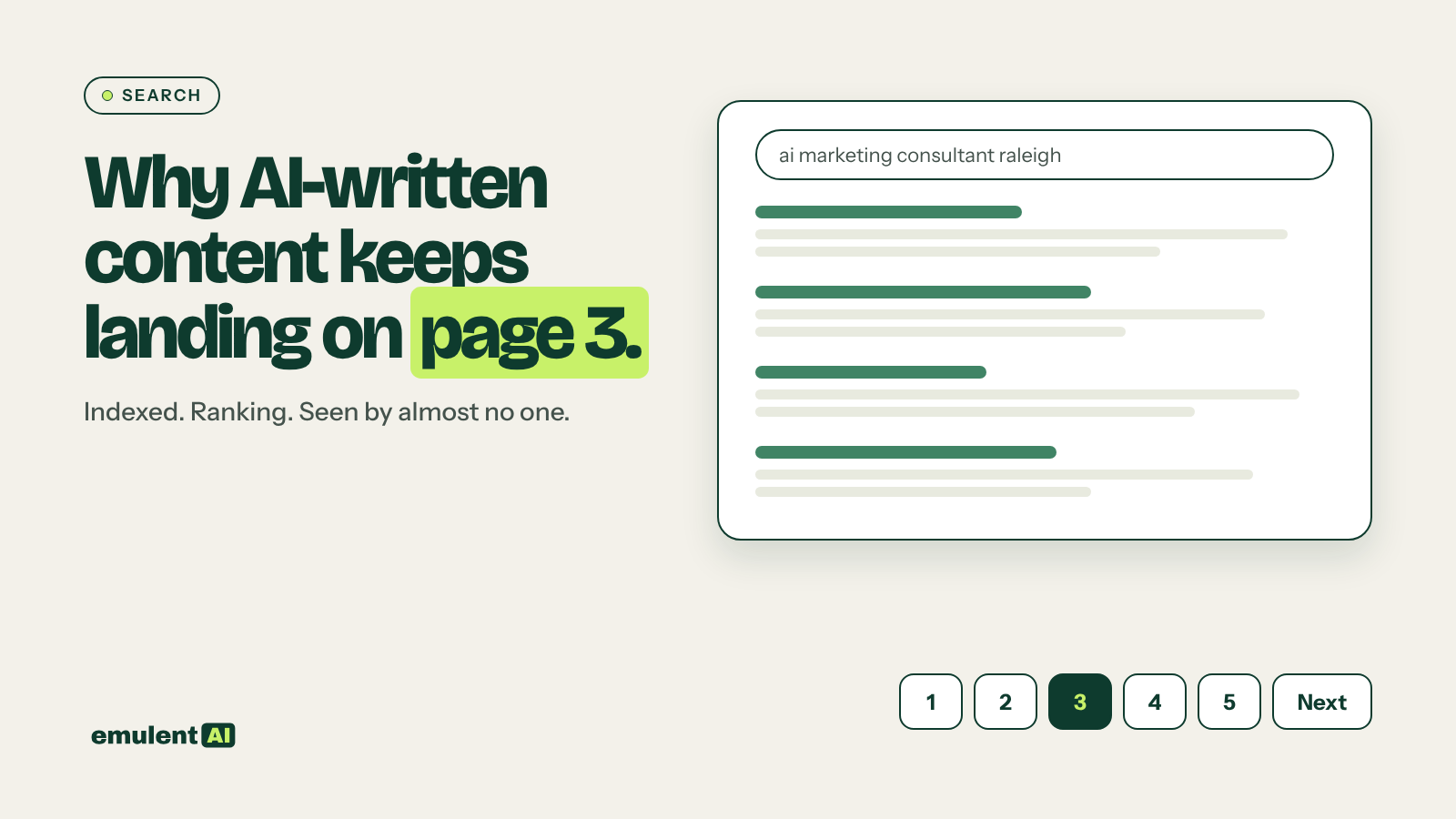
AI-written content usually doesn’t get banned or deindexed. It gets ignored. It ranks for plenty of terms, on page 3 or further back, where almost nobody clicks. On one site I tracked, 98% of the keywords that AI-written pages ranked for sat on page 3 or deeper.
The reason is simple once you see how these models work. A language model writes the average of what’s already been published. Google’s updated guidance, published October 1, 2026, says in plain terms that it wants effort, originality, skill and accuracy, and that it expects a person to fact-check AI output before it goes live. Average content with no human effort fails most of that test.
What “page 3” looks like in your reports
This problem hides well. Pages get indexed. Your SEO tool shows rankings for hundreds of new keywords. The chart of “keywords ranked” goes up and to the right. Then you look at visits and leads from those pages and find very little.
On the site I mentioned, traffic rose to about 1,700 monthly visits, collapsed to near zero, and took about a year to climb back to roughly 1,400. I wrote that one up separately, phase by phase, in a post on what happened to that site’s traffic after it went all-in on AI-written long-form content.
The “average of everything” problem
A large language model doesn’t look things up. It predicts the most likely next word based on patterns it learned in training, and a lot of that training material is the public web. Three things follow from that, and each one pushes content toward page 3.
Its default answer is the consensus answer
Ask for “a complete guide to commercial roof maintenance” and you’ll get a tidy summary of what the existing guides already say. Those existing guides are the pages ranking on page 1. Google has no reason to rank a rewrite of them above the originals. AI is the average of everything, and average never built a brand or a ranking.
It knows nothing about you
The model only sees the conversation. Unless you tell it, it has no idea about your clients, your pricing, the job that went sideways last spring or the question your sales team hears ten times a week. That missing material is the part Google calls originality, and it’s the part a competitor can’t copy.
It’s plausible, and sometimes wrong
Models are built to sound right. They can state something false with total confidence, and a fluent wrong answer is harder to catch than a clumsy one. Every error that slips through costs you on accuracy, and in some industries it costs a lot more than rankings.
What Google changed on October 1, 2026
Google has said for years that it rewards helpful content however it’s made. The October update makes the expectations much more specific.
Manual fact-checking is now spelled out
The using generative AI content guide now explains that generative models don’t retrieve facts and can produce inaccuracies, often called hallucinations. It says it is critical to manually fact-check and review all AI-generated content for accuracy before publishing. That review covers more than body copy: titles, meta descriptions, structured data and image alt text are named too.
Raters judge effort, originality, skill and accuracy
The people-first content page now describes how Google’s quality raters look at main content. Effort is the extent of human work that went into it. Originality is whether it gives information or perspectives that aren’t already available elsewhere. Talent or skill is whether it shows the expertise needed to satisfy the visitor. Accuracy means factually correct, and for health, money or safety topics, highly accurate and consistent with expert consensus.
The line that should get every content team’s attention is this one: using generative AI to produce large amounts of text without manual oversight or curation counts as little to no effort. That describes a lot of programs I’ve seen pitched over the last two years.
Google is careful to say rater guidelines don’t directly change rankings. They describe what its ranking systems are trying to reward, though, and they’re about as close to a marking scheme as you’ll get.
Scaled content is still a spam risk
Google also repeats that generating many pages without adding value for users may violate its scaled content abuse spam policy. A hundred AI pages targeting a hundred keyword variations is the pattern it describes.
AI is still allowed
None of this bans AI. Google says generative AI can help with research and with adding structure to original content. What it cares about is whether a person added something of value.
How to get AI-assisted content off page 3
You can keep using AI. Just stop asking it for the parts it can’t supply. Here’s how we approach it at Emulent.
- Start from something only you have. Customer questions from sales calls, your own project data, a result you measured, an opinion you’d defend in a meeting. If you can’t name it, don’t write the post yet.
- Brief the model like a new hire: the audience, the goal, examples of work you like, and your raw notes. If you can’t explain it to a person, you can’t explain it to AI.
- Ask for options rather than a finished answer. Three outlines, five headline angles. Then pick with your own judgement.
- Have a subject matter expert rewrite the parts that carry the argument. The draft gets you to good; the expert gets it to great.
- Fact-check every number, name, date and claim against a primary source, and check the title, meta description and alt text too.
- Publish less. One strong page on a topic beats five thin pages on its keyword variations.
- Judge pages on visits, leads and sales, not keyword counts.
A quick test before you publish
Read the draft and ask: could a competitor have produced this same page by typing the same prompt? If yes, it’s headed for page 3. Add the material only your team has, or don’t publish it.
Next step
If you want AI to speed up your content without sending it to page 3, that’s what our AI Content Marketing service does: faster drafts, with a human edit on every piece. If your team is already publishing AI drafts with no written rules on review and sign-off, start with AI Governance & Brand Safety so everyone follows the same policy.
Put this to work with Bill.
Tell Bill where your team is with AI right now. He’ll tell you what he would do first and what he would leave alone.
Contact Bill directly
Or call 773-791-3197