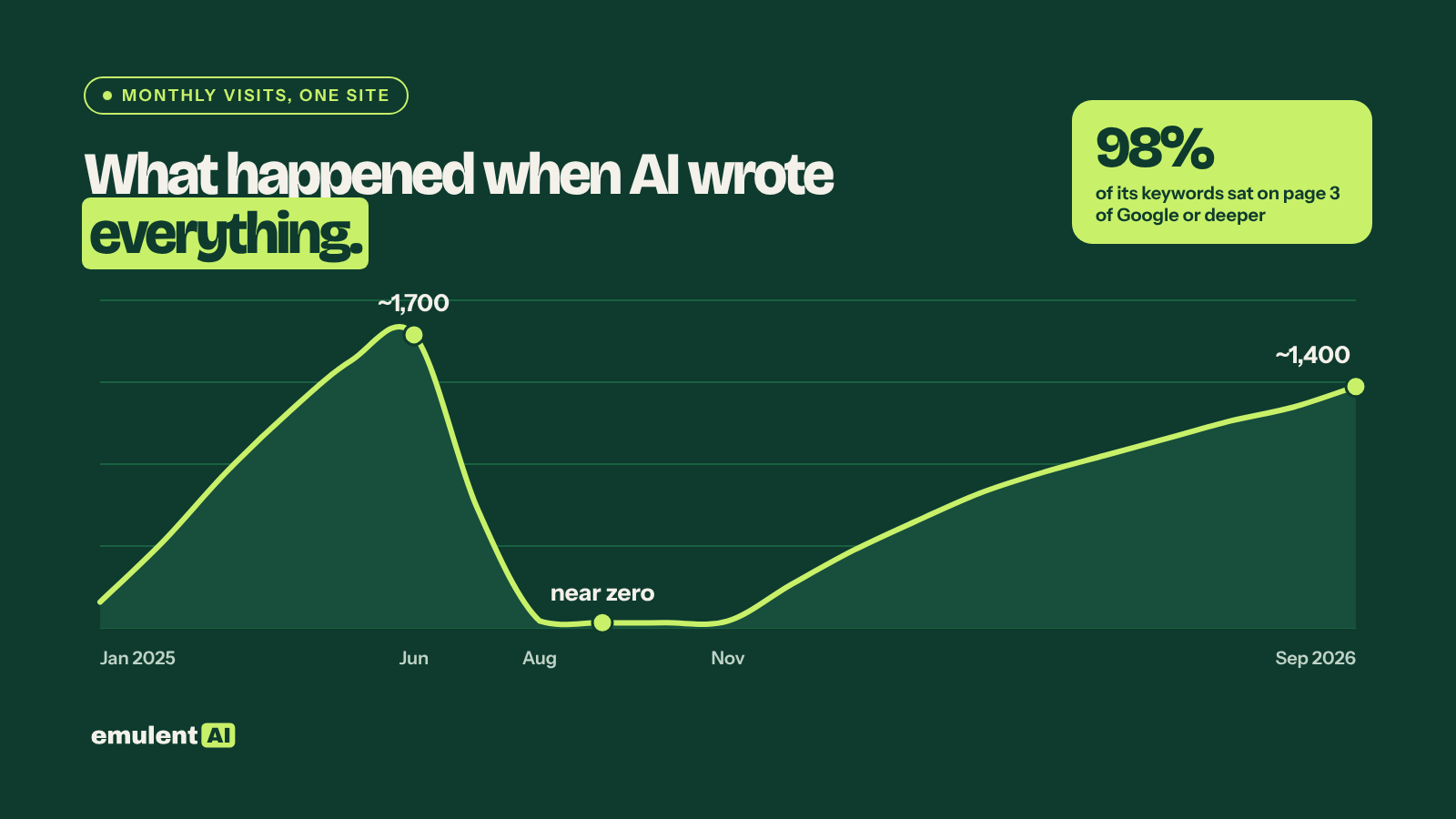
Here is the short version. A site started publishing AI-written long-form content in January 2025. Traffic climbed for about five months and peaked near 1,700 visits a month. By August it was close to zero. It sat there through the fall, then took roughly ten months to climb back to about 1,400.
When I looked at what those AI-written pages ranked for, 98% of the keywords sat on page 3 of Google or deeper. Plenty of pages were indexed and showing up somewhere. Almost none of them were anywhere a buyer would see them. If you’re weighing an “AI writes everything” content plan, this is the chart I’d want you to see first.
Why I’m showing this chart
You’ve seen the posts. “AI tripled my traffic, no writers.” Sometimes the first half of that story is true. The early months of this chart would have made a great LinkedIn post. The part that rarely gets posted is what happens next, and that’s the part that pays the bills or doesn’t.
I’ve spent close to three years running marketing tests on the major AI platforms with their most advanced models. I use these tools every day at Emulent. What I push back on is handing a model the whole job and shipping whatever comes back.
The chart, phase by phase
January to June 2025: the climb
Traffic rose from the start of the year to roughly 1,700 monthly visits by about June. That’s the part that convinces people. New pages get indexed, some of them pick up long-tail queries, and the line goes up. It looks like the strategy is working, and it’s easy to respond by publishing even more.
July and August 2025: the drop
Then traffic fell to near zero over July and August. This wasn’t a gentle slide. Most of what the site had gained in five months was gone in about two.
September to November 2025: the flat months
From there the line stayed flat through about November. This stretch is the one owners find hardest. Nothing obvious is broken. The site loads, the pages are still indexed, and the content calendar keeps running. The traffic just doesn’t come back on its own.
December 2025 to September 2026: the slow climb back
Recovery started around the end of 2025 and was slow. By September 2026 the site was back to about 1,400 monthly visits, still below the old peak. It took roughly twice as long to rebuild as it did to lose.
The 98% number
The crash bothers me less than where the AI-written pages were ranking even when they ranked: 98% of their keywords sat on page 3 of Google or deeper.
Page 3 means roughly positions 21 through 30, and “deeper” is further back still. A page can rank for hundreds of terms down there and send you almost nothing, because very few searchers ever click that far. If your reporting counts “keywords ranked,” AI content at volume can look healthy on a dashboard while doing very little for the business. Measure visits, leads and sales from those pages, not how many terms they technically rank for.
Why I think this happens
One chart from one site can’t prove a cause. What I can tell you is what I’ve seen across years of testing, and what Google now says in writing.
The model writes the average
A language model doesn’t know things. It predicts the most likely next word based on patterns in its training data, and much of that data is the public web. So its default answer to “write 2,000 words on X” is the average of what everyone has already published about X. The pages ranking on page 1 are part of what it learned from. A page that repeats them in different words gives Google no reason to put it above them.
Google’s guidance says so directly
On October 1, 2026, Google updated its guide to using generative AI content. It says generative models can produce inaccuracies, and that it is critical to manually fact-check and review all AI-generated content before publishing, including titles, structured data and alt text. It also warns that generating many pages without adding value for users may violate its scaled content abuse spam policy.
Google’s page on creating helpful, people-first content now explains that quality raters judge main content on effort, originality, talent or skill, and accuracy. It says that producing large amounts of generative AI text without manual oversight or curation counts as little to no effort. That is a fair description of how a lot of “all-in” AI content programs run.
Google is also clear that AI can help with research and with structuring original content. The problem is publishing at volume with nobody adding anything the model couldn’t.
Everybody else is doing it too
The 2026 edition of The CMO Survey found that 73.9% of companies using AI in marketing use it for content creation, the top use on the list. When most of your competitors are asking the same tools for the same article, the average gets very crowded.
What I’d tell anyone about to try this
AI doesn’t fix a bad content strategy. It executes it faster, and this chart is what “faster” can look like. If you still want AI in your content process (and I think you should), these are the habits I’d put in place before the first post goes live:
- Publish less and make each piece more relevant. Volume is not a strategy.
- Feed the model what only you know: your data, your results, your opinions, your customer questions.
- Have a subject matter expert edit every piece, and give that person the authority to say “this isn’t good enough.”
- Verify every fact, stat and source before it goes live, including titles and meta descriptions.
- Track visits, leads and revenue per page. Rankings on page 3 don’t count.
- Prune or rewrite pages that aren’t earning their place before you add new ones.
Before any piece goes out, I also run it through a few questions. Would I sign it? Can I check it? What breaks if it’s wrong? If the honest answer to the first one is no, it shouldn’t carry your brand’s name either.
Where to go from here
If your site is publishing AI-assisted content and you’re not sure whether it’s helping, start by pulling the same two views I used here: monthly visits to those pages, and where their keywords actually rank. Then decide what to keep, fix or remove.
That’s the work we do in AI Content Marketing: faster drafts, with a human edit on every piece. If your team needs written rules on when AI drafts are allowed and who signs off, our AI Governance & Brand Safety work sets that up.
Put this to work with Bill.
Tell Bill where your team is with AI right now. He’ll tell you what he would do first and what he would leave alone.
Contact Bill directly
Or call 773-791-3197