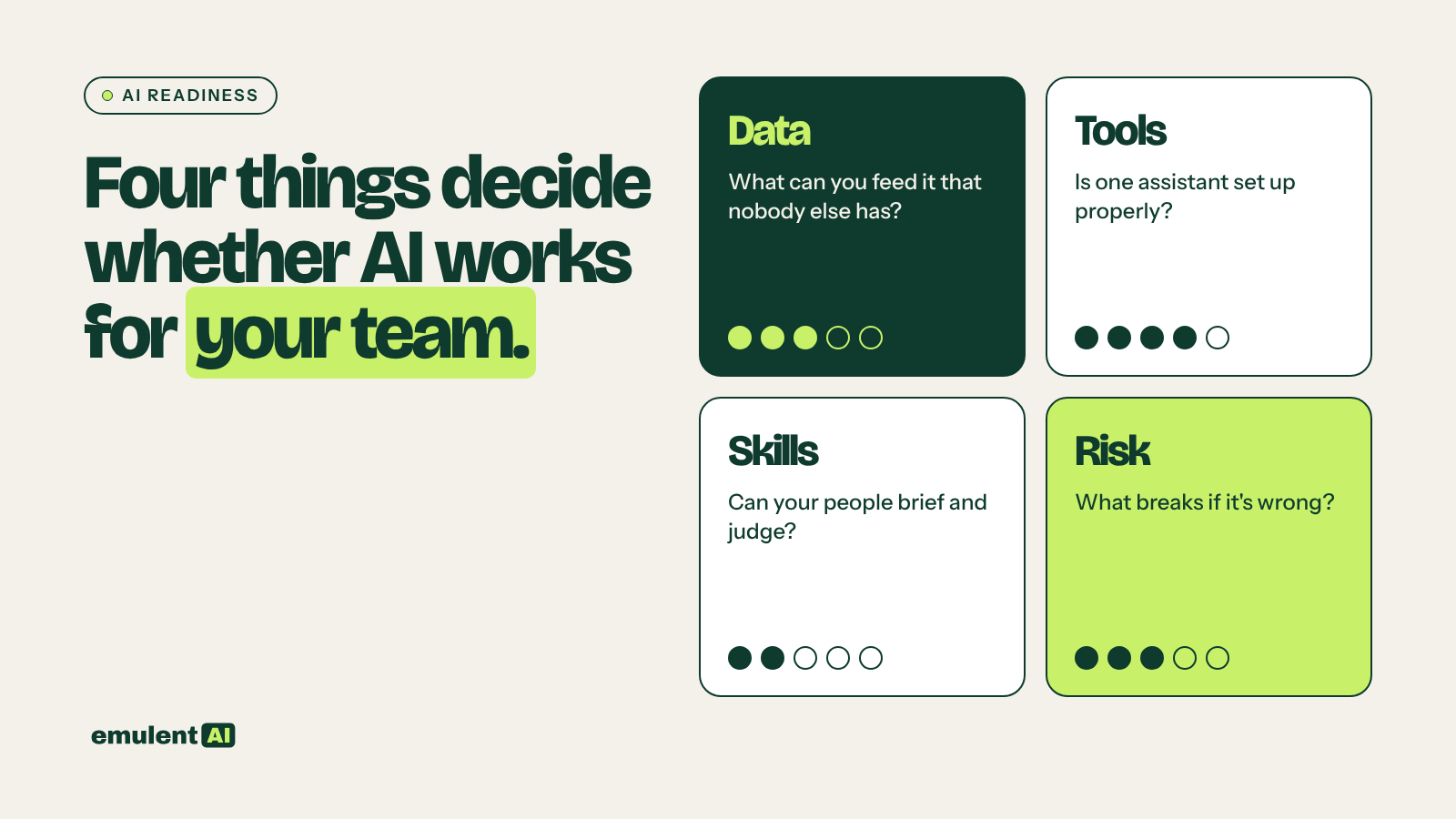
Whether AI works for your marketing team comes down to four things: the data you can give it, the tools you have set up, the skills your people bring to it, and the risk you are willing to carry. If one of those is weak, it drags the others down. A team with great tools and no usable data gets fast, generic output. A team with great data and no usage policy gets fast output nobody should have published.
That is the short version of what we score in an AI readiness assessment. The rest of this post explains each area and, more usefully, what a low score looks like in daily work, so you can spot it in your own team before you spend money on it.
Why readiness, and why now
Almost every marketing team uses AI in some form. Very few are getting much back. McKinsey’s State of AI in 2026 report, published in August, found nearly nine in ten respondents say their organizations regularly use AI in at least one business function, but only 44% say it is scaling across the enterprise, and 37% report any EBIT impact at all. In McKinsey’s 2025 survey, more than half had at least one negative consequence from AI in the past year, with inaccuracy the most common.
Marketing leaders see the gap too. In Gartner’s 2026 CMO Spend Survey, CMOs said they put an average of 15.3% of marketing budget into AI initiatives, and 70% called becoming an AI leader a critical goal for 2026. Only 30% reported mature or fully developed AI readiness.
1. Data: what can you feed it that nobody else has?
A language model doesn’t know things. It predicts the next likely word based on patterns from its training, which is mostly the public web. Ask it about your market with no context and you get the average of what everyone has already said. The only way past that average is to give it what only you know: customer research, sales call notes, campaign results, reviews, the reasons deals were won and lost.
Data readiness asks whether that material exists, whether anyone can find it, and whether it is in a state you could hand over.
What a low data score looks like
- Your best customer insight lives in one account manager’s head or inbox.
- Campaign results sit in four platforms with four naming conventions, so nobody can say which offer worked last year.
- Personas were written in a workshop years ago and never checked against real customers.
- When someone asks AI for a persona or a message, they give it nothing, and the draft sounds like every competitor.
One of our own jobs started with 900,000 biotech specimens that had to become one database searchable by 20 attributes. AI did the tagging and classifying, and we checked its work against the source records. The model was the easy part. Getting the inputs organized and verifiable was the job.
2. Tools: is one assistant set up properly?
Low tool readiness rarely means “no tools.” More often it means too many, none set up well. Five people use five different assistants on five personal accounts, each with its own settings, and nobody knows which one touched the client proposal.
Tool readiness asks whether the team has picked a main assistant and a plan that fits business use, whether there are standing instructions and projects for recurring work, whether it connects to the apps you already use, and whether repeat jobs have become reusable instructions instead of prompts retyped every week.
What a low tools score looks like
- People paste client details into free personal accounts because that is what they had open.
- Every brief starts from a blank chat; the brand guide gets uploaded again each time, if at all.
- Someone bought an “AI marketing platform” that nobody opens after the first month.
The fix is usually smaller than people expect: one assistant, set up properly, with projects per client or recurring job. That is the scope of our AI tool selection and implementation work.
3. Skills: can your people brief and judge?
Using AI well is mostly a communication skill. No code is required. You need to give context, name the audience and the goal, show examples, then react to the draft the way you would with a colleague. A subject matter expert who explains things well will get far more out of AI than a technical person who doesn’t know the customer.
The second half of the skill is judgement: knowing what good looks like, checking facts, and catching the confident wrong answer. AI gets you to good, fast. Getting to great still takes a person who knows the work.
What a low skills score looks like
- Prompts are one line long (“write a blog post about our new service”).
- People accept the first draft, or give up after it and call the tool useless.
- Stats and sources in AI drafts go live without anyone opening the link.
- Nobody can say which tasks belong with AI and which ones should stay with a person.
A rule I use for that last point: give AI the work that drains you, and keep the work that defines you. First drafts, variations, summaries, reformatting and data cleanup go to the machine. Positioning, the core idea, client relationships and anything carrying your name stay with people.
4. Risk: what breaks if it’s wrong?
Risk readiness asks whether the team knows where AI must not be used without a human, what information never goes into a chat, and who signs off. It also covers reputation, which most policies skip.
Customers have opinions about AI. A Gartner consumer survey published in March 2026 found 50% of U.S. consumers would prefer to give their business to brands that don’t use generative AI in consumer-facing messages, ads and content. Search engines have opinions too. In October 2026, Google updated its guidance on generative AI content to say all AI-generated content, including titles, structured data and alt text, should be fact-checked and reviewed by hand before publishing, and that large amounts of AI text produced without oversight count as little to no effort.
We have seen what that looks like on a real site. On one site that started publishing AI-written long-form content in January 2025, traffic rose to roughly 1,700 monthly visits by about June, then fell to near zero by July and August and stayed flat until about November. It has since climbed slowly back to about 1,400 by September 2026. Of the keywords that AI-written content ranked for, 98% sat on page 3 or deeper.
What a low risk score looks like
- There is no written list of what never gets pasted (passwords, logins, API keys, customer data).
- Nobody has checked whether the team’s chats are used to train the provider’s models.
- Legal, financial or compliance copy goes through AI with the same review as a social post.
- When I ask “would you be fine with the client finding out AI wrote this?”, the room goes quiet.
A short set of questions does most of the risk work. Would I sign it? Can I check it? What breaks if it’s wrong? Would the reader care that AI did it? Does it fit our brand and our experience? If a task fails two or more of those, it needs a human in charge, or it shouldn’t go to AI at all.
How the four scores work together
The scores don’t average out. A strong tools score with a weak data score means you produce average content faster. A strong skills score with a weak risk score means talented people shipping things that hurt the brand. AI doesn’t fix a bad strategy; it carries it out faster.
That is why we score each area separately and fix the weakest one first. For most teams I talk to, that turns out to be data or risk, not tools.
A quick self-check
Answer these honestly with your team:
- Could we hand AI a folder today that explains our best customer, with real quotes and results?
- Do we all use the same assistant, on a business plan, with settings someone has checked?
- Can the people who know our customers best write a clear brief?
- Is there a written rule for what never goes into a chat and what always gets a human review?
If any answer is “no” or “not sure,” that is where to start.
Next step
Our AI readiness assessment scores your team on data, tools, skills and risk and tells you which one to fix first. If you already know where you stand and need the plan, the AI marketing strategy and roadmap turns it into 90 days of work with owners and dates.
Put this to work with Bill.
Tell Bill where your team is with AI right now. He’ll tell you what he would do first and what he would leave alone.
Contact Bill directly
Or call 773-791-3197