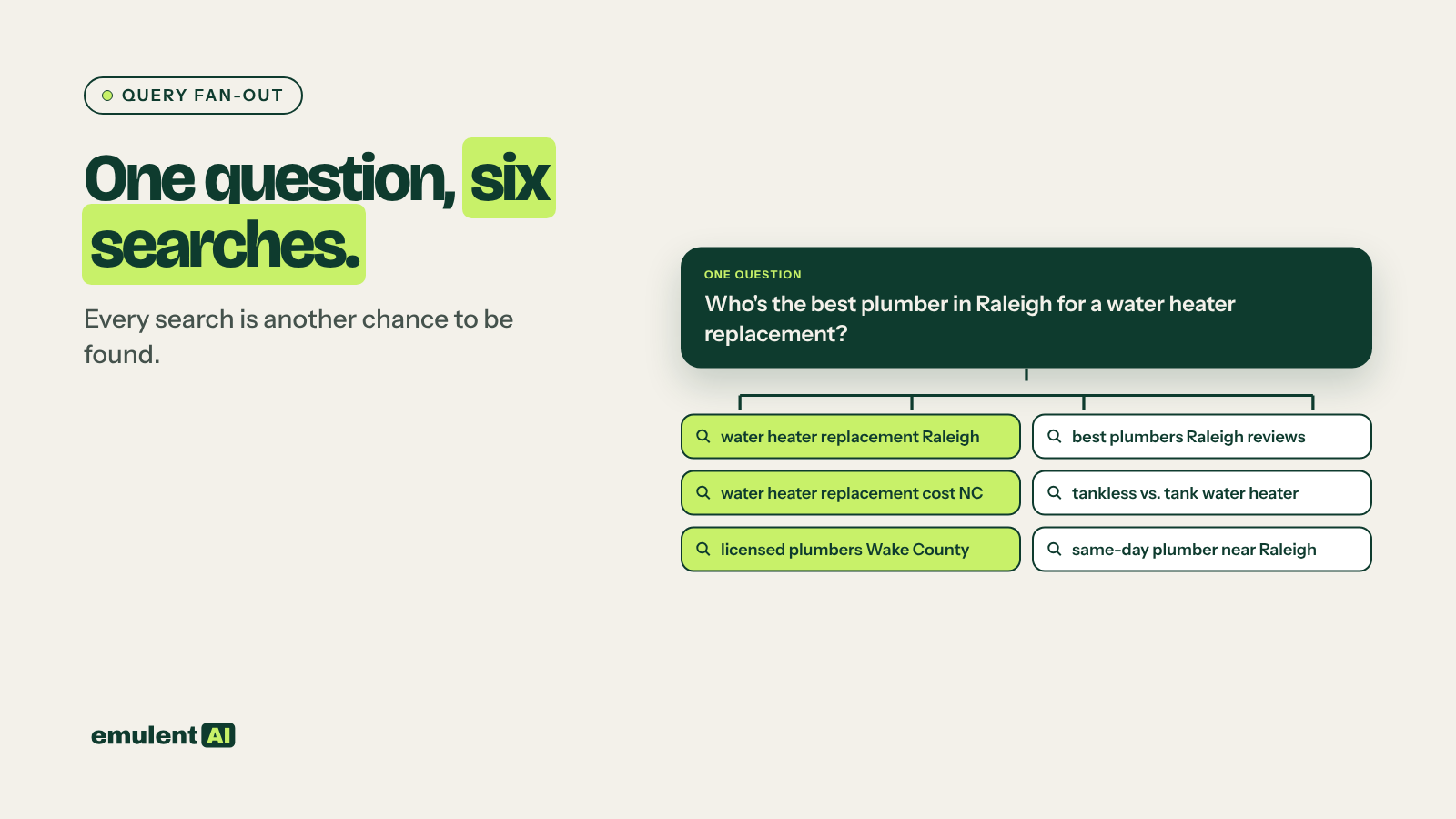
A customer types one question into Google’s AI Mode: “Who’s the best plumber in Raleigh for a water heater replacement?” Behind the scenes, the AI runs a handful of different searches before it writes a word.
How an AI tool builds an answer
First, it reads the question and works out what the person wants and where they are. Here, that’s a water heater replacement, in Raleigh, from someone good.
Then it runs searches. Google’s AI Overviews and AI Mode split a question into subtopics, run related searches at the same time and gather pages, profiles and reviews. This is query fan-out.
Next, it weighs what it found. It favors pages that answer clearly and businesses that other sites mention.
Last, it writes the answer. It summarizes what it found and links to some of the sources it used.
What the fan-out might look like
For the plumber question, the searches could include:
- water heater replacement Raleigh
- best plumbers Raleigh reviews
- water heater replacement cost NC
- tankless vs. tank water heater
- licensed plumbers Wake County
- same-day plumber near Raleigh
The answer names a few plumbers and links to the pages, profiles and reviews it pulled from. A plumber who only has a homepage and a generic services page might show up in one of those six searches. A plumber with a cost page, a tankless comparison and a license number on the site could show up in four.
Every search is another chance
Each of those searches is a separate shot at being found. So answer the follow-up questions too: cost, options, credentials and reviews.
A cost page with a real range from your own jobs covers the cost search. A plain comparison of tankless and tank heaters, written by someone who installs both, covers the options search. Your license number and the year you got it cover credentials. Recent Google reviews that mention water heaters and Raleigh cover the review search.
What you can’t control
You can’t see the exact searches an AI runs. The list above is an example, and Google doesn’t publish its fan-out queries. Different tools also run different searches for the same question, and the same tool may run different ones tomorrow.
That’s why the best guide is your own phone log. The questions people ask before they book are the questions the AI is guessing at.
Start with your calls
Ask whoever answers your phone to write down every question a caller asks for two weeks. Group them. Most businesses end up with 15 to 30 questions that come up again and again. Each one is a page, or a section of a page, that an AI search might land on.
Put this to work with Bill.
Tell Bill what you found when you asked AI about your business. He’ll tell you what he would fix first.
Contact Bill directly
Or call 773-791-3197