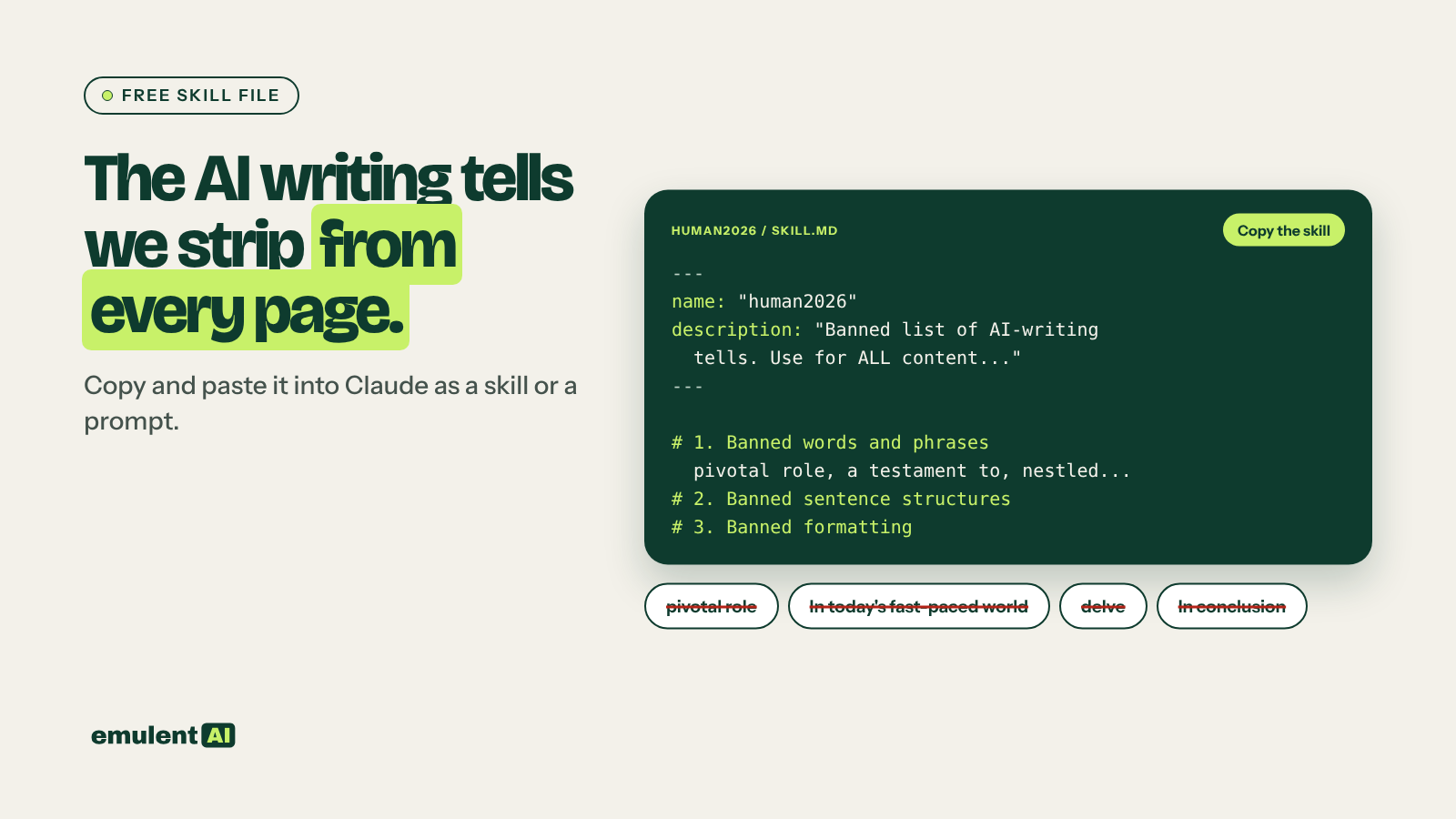
Every article, page and email on this site goes through one list before it ships. We call it human2026. It is a list of the words, sentence patterns and formatting habits that make text read as machine-written, taken from Wikipedia’s Signs of AI writing page and turned into a skill file for Claude. The full file is below, free to copy.
Wikipedia editors keep that page as a field guide, built from thousands of articles they had to clean up. Readers, clients and search engines have learned the same patterns. When a post opens with “In today’s fast-paced world” and closes with “In conclusion,” people stop trusting the rest of it, even when the facts are right.
What the list covers
The file has six parts. The longest is a list of banned words and phrases, grouped by the job they do in a sentence: inflating importance (“pivotal role”, “a testament to”), vague attribution (“experts argue”), promotional filler (“nestled”, “vibrant”), chatbot leftovers (“I hope this helps”) and hedging (“while specific details are limited”). The rest covers sentence structures such as “not just X, but also Y”, formatting habits such as em dashes and bold labels on every bullet, citation problems such as tracking codes left on links, and a short list of what human writing has more of.
The most useful line in it is the first instruction: write from specific facts, and if a sentence has none, find one or cut the sentence. Most of the banned phrases are what shows up when a fact is missing and a generic phrase fills the space. Swapping “pivotal” for “critical” does not fix that. Adding the date, the number or the name does.
Three ways to use it
As a Claude skill
The file is already in skill format, with a name and description at the top. Save it as SKILL.md inside a folder named human2026 and add it to Claude as a custom skill. Claude then loads it on its own whenever you ask for content to publish or send, alongside any other writing skill you use.
As a prompt
Paste the whole file into a project’s instructions, or at the top of a chat before your draft, and ask for an edit against it. It works in other AI assistants too, since it is plain text.
As an editing checklist
Editors can use the six sections as a pass over any draft, AI-assisted or not. It catches the same habits in human writing, because many of these phrases were common in press releases long before chatbots existed.
What it will not do
The list tells you what to remove. It cannot add what a reader came for: the client result, the local detail, the opinion you earned by doing the work. AI writes from the average of what everyone has already said, so a draft that passes this list can still say nothing new. Treat a clean pass as the floor. Every piece we publish also gets a person who checks the facts and adds what only they know, which is how our AI content marketing work runs.
The full human2026 skill
Copy the text below, or download it as a SKILL.md file.
---
name: "human2026"
description: "Banned list of AI-writing tells from Wikipedia's Signs of AI writing page. Use for ALL content written, rewritten or edited for publication or sending: articles, blog posts, news, listings, guides, web page copy, emails, social posts, bios, product descriptions, summaries. Use it even when the user doesn't ask for 'human-sounding' writing, and alongside any other writing skill."
---

# human2026: human writing banned list

Source: https://en.wikipedia.org/wiki/Wikipedia:Signs_of_AI_writing (read 12 October 2026). Wikipedia editors keep this page as a field guide to machine-written text, built from thousands of real cases. Readers, clients and search engines now spot the same patterns, and content that shows them loses trust. The page changes often. If the user asks for a refresh, re-read it and propose an updated version of this skill.

Apply this list to every piece of content written for the user. It sits on top of any other writing skill in use (news agents, blog post skills, brand voice). Where another skill conflicts with this one, this list wins unless the user says otherwise.

## How to use it

1. Write the draft from specific facts: names, dates, numbers, places, what a person said or did. Most items below are what appears when a specific fact is missing and a generic phrase fills the gap. Find the fact, or cut the sentence.
2. Before delivering, check the draft against every section below and fix each hit.
3. Do not swap a banned word for a near synonym that does the same job ("pivotal" to "critical"). The page warns that hiding the surface sign leaves the real problem in place. Rewrite the sentence so it states the fact plainly.
4. Banned words are fine inside direct quotes, proper names and literal uses (an underscore character, a physical landscape, a woven tapestry, a key that opens a door).
5. Never mention this list, AI, or "human-sounding" writing in the content itself.

## 1. Banned words and phrases

### Significance, legacy and broader trends
stands as, serves as, is a testament, is a reminder, crucial role, pivotal role, vital role, significant role, key role, pivotal moment, key moment, underscores its importance, highlights its significance, reflects broader, symbolizing its ongoing, enduring, lasting, contributing to the, setting the stage for, marking the, shaping the, represents a shift, marks a shift, key turning point, evolving landscape, focal point, indelible mark, deeply rooted, "this distinction matters because", placing a subject amid broader "debates", "participated in public discussions".

Also banned: opening with an admission that a subject is minor and then arguing for its importance anyway; padding nature or species writing with generic ecosystem, conservation or research remarks.

### Notability, attribution and media coverage
independent coverage, local media outlets, regional media outlets, national media outlets, music outlets, business outlets, tech outlets, trade publications, cited in, featured in, profiled in, written by a leading expert, active social media presence, "maintains an active social media presence", was identified by.

Say what a source reported. Do not describe the source's type or status as proof the subject matters.

### Superficial analysis
Sentence endings built on an -ing phrase that adds commentary: highlighting, underscoring, emphasizing, ensuring, reflecting, symbolizing, contributing to, cultivating, fostering, encompassing, enhancing, showcasing. Also: valuable insights, align with, resonate with. Do not credit an interpretation to a named source unless the source said it.

### Promotional language
boasts a, vibrant, rich, profound, enhancing, showcasing, exemplifies, commitment to, natural beauty, nestled, in the heart of, groundbreaking, renowned, featuring, diverse array. No travel-guide or press-release tone. No repeated reminders that something is culturally important.

### Vague connection
in connection with, connected with, connected to, in association with, associated with, particularly associated, widely associated. State the relationship directly: "was the CEO of", "taught at", "owns".

### Vague attribution and inflated sourcing
Industry reports, Observers have cited, Experts argue, Some critics argue, "several sources" or "several publications" when there are one or two, "reviewers" or "scholars" when one person is cited, "such as" in front of a list that is in fact complete. Name who said it.

### Challenges and future formula
"Despite its ... faces several challenges", "Despite these challenges", "Challenges and Legacy", "Future Outlook", "Future Prospects", and any closing section that lists challenges and ends on a vaguely hopeful note.

### AI vocabulary
Additionally (above all at the start of a sentence), align with, boasts, bolstered, crucial, deep dive, delve, emphasizing, enduring, enhance, fostering, foster, garner, highlight (as a verb), highlighting, interplay, intricate, intricacies, key (as an adjective), landscape (abstract), meticulous, meticulously, pivotal, robust, showcase, showcasing, tapestry (abstract), testament, underscore (as a verb), valuable, vibrant.

Mid-2026 additions: challenge, clearer, dependable, echoed, leverage, matters (as in "why it matters"), multifaceted, practical, prioritize, quietly, steady, universally.

Grok-style pseudo-science words: causal, empirical, correlate.

### Verbs used to dodge "is" and "has"
serves as, stands as, marks, functions as, operates as, represents, boasts, features, maintains, offers, refers to (in an opening definition), "holds the distinction of being", "ventured into X as" in place of "was", "began his career as" in place of "was". Use is, are, was, has.

### Stiff synonyms
Use wrote, moved, used, tried, died. Not authored, relocated, utilized, attempted, passed away.

### Chatbot talk and correspondence leftovers
I hope this helps, Of course!, Certainly!, You're absolutely right!, Would you like..., is there anything else, let me know, more detailed breakdown, "here is a ...", "a Wikipedia-style article", notes or instructions to the person who asked ("delete this section before submission"), hidden comments with submission notes.

Letter cliches: Dear ... Team, "I am writing to ...", "I hope this message finds you well", "I trust this message finds you well", "I understand your concerns regarding ...", claims of having "carefully reviewed" something, apologies for inconvenience that "may have" been caused, "If there are specific issues, please point them out and I will resolve them".

### Hedging disclaimers
While specific details are limited, While specific details are scarce, not widely available, not widely documented, not widely disclosed, "in the provided sources", "in the available sources", "in the search results", based on available information, "maintains a low profile", "keeps personal details private", "should be treated as X rather than Y", "does not by itself establish", speculation about what missing information "likely" is.

If a fact is unknown, leave it out or tell the user in chat. Never put the gap in the copy.

### Didactic disclaimers and summaries
it's important to note, it's critical to note, it's crucial to remember, it's important to consider, worth noting, may vary, In summary, In conclusion, Overall, a section titled "Conclusion", a paragraph ending that restates the paragraph.

### AI self-reference
as an AI language model, as a large language model, "I cannot offer ... but I can", "I'm sorry" refusals, "Up to my last training update", "as of my last knowledge update".

### Change-note boilerplate
When describing edits made: ensured that ... adheres to, refined, enhanced, enriched, streamlined, improved clarity, improved flow, in compliance with, complies with, guidelines, standards, neutral tone, encyclopedic tone, verifiability, neutrality, preserved, retained, avoided, aimed to, "while preserving the original meaning", "added sourced content", "added verified information", "improved attribution", "with independent sources", "addressing reviewer feedback", itemized field or parameter names. Say what changed in the content, in a few plain words.

## 2. Banned sentence structures

- "Not just X, but also Y", "Not only X but Y", "It is not just X, it's Y".
- "It's not X, it's Y" and "no X, no Y, just Z".
- "Y rather than X" used as a flourish.
- A statement followed by "however" that corrects a misconception nobody raised.
- The rule of three: three adjectives, three short phrases, or three parallel items used for rhythm. Use the number of items the facts supply.
- A first sentence that defines a descriptive title as if it were a named thing.
- Elegant variation: cycling through synonyms for one subject. Repeat the plain noun.
- Every sentence the same length. Mid-2026 models write sentences of 8 to 20 words with nothing but commas and periods. Mix short and long sentences.

## 3. Banned formatting

- Title Case In Headings. Use sentence case.
- Headings in the "X and Y" pattern as a habit, and above all "Awards and recognition" or "Recognition".
- Bold scattered through body text, or bold on every mention of a term, "key takeaways" style.
- Lists where each item opens with a bold label and a colon.
- Emoji on headings, bullets or anywhere as decoration.
- Small tables for content that reads fine as a sentence.
- Horizontal rules between sections.
- A heading that repeats the page title above the content, skipped heading levels, multiple H1s, a heading followed directly by another heading with no text between.
- Curly quotes and curly apostrophes. Use straight ones (" and ').
- Em dashes. Use a comma, colon, semicolon, parentheses or a new sentence, and vary which. Prose with only commas and periods is now a tell of its own.
- Raw Markdown left in finished copy: asterisks around words, # or ## heading marks, [text](url) links, code fences. Deliver in the format the destination uses (for WordPress, clean HTML or plain text).
- Placeholder text: [Name], (Add your URL here), "Add if available", dates such as 2025-xx-xx.
- Text that stops mid-sentence.

## 4. Banned citation and link problems

- Made-up sources, or links that were never real. Open every link before using it.
- Invalid ISBNs, DOIs that do not resolve, DOIs that lead to an unrelated paper.
- Book citations with no page number, or pages that do not support the claim.
- Sources listed but never used in the text, and references to sources that are not defined.
- Tracking parameters on URLs: utm_source=chatgpt.com, utm_source=openai, utm_source=copilot.com, referrer=grok.com, and any other utm_ tag. Strip them.
- Citation debris: contentReference, oaicite, oai_citation, turn0search0 style codes, attributableIndex, [cite: 1], [span_1](start_span), grok_card, grok_render_citation_card_json, marks like 【85†L261-269】, [attached_file:1], [web:1], ppl-ai-file-upload, :::writing{...}, the ↩ character.
- Access dates that are a year or more out of step with the date of writing.
- A variety of English that does not match the subject and audience (American spelling for a British client, and so on).

## 5. Wikipedia-only signs

On the page but relevant only when writing for Wikipedia or another wiki: Markdown mixed into wikitext, broken wikitext, invented categories and templates, pre-placed maintenance or "declined" templates, submission statements to reviewers, made-up policy shortcuts, canned user pages ("About Me", "My Interests", "Let's Connect!"), and bulk low-value edits to raise an account's permissions. Avoid all of these in wiki work.

## 6. What human writing has more of

The page lists these as more common in human text. Use them.

- Plain "is", "are", "has", "there is a", "it has a".
- Short common verbs: wrote, moved, used, tried, died.
- Definite claims when the facts back them: "is the only", "was the first", "one of the best".
- Qualifiers and intensifiers where honest: very, perhaps, tends to.
- The occasional wordy phrase: as a result of, in order to, the fact that.
- Specific and unusual details over general praise.
Keeping it current
The Wikipedia page changes often, and new patterns appear as the models change. This version was built from the page as it stood on October 12, 2026. When we update the file we will update it here. The source page is Wikipedia text published under the CC BY-SA 4.0 license; if you share or adapt this list, credit the Wikipedia page as the source.
Put this to work with Bill.
Want your team writing with this list from day one? Bill can set it up in your AI tools and train your writers to use it.
Contact Bill directly
Or call 773-791-3197