The future of AI in marketing is already visible in the 2026 numbers. AI is used in about a quarter of marketing activities and is expected to pass half within three years. It takes 15.3 percent of the average marketing budget while total budgets stay flat. Google and Meta are rebuilding their ad products around AI agents and AI answers. The gap that will separate winners from everyone else is readiness: most marketing teams want to lead with AI, and few are set up to do it well.
Below is where things stand, what has already changed, and the six shifts I would prepare for, each tied to a source or to what I have seen in close to three years of testing AI on marketing work.
Where marketing is with AI now
Here are the numbers, with the source for each.
| Measure | Figure | Source |
|---|---|---|
| Organizations using AI in at least one business function | 88% in 2025, up 10 points from 2024 | McKinsey, December 2025 |
| Organizations where AI is scaling across the enterprise | 44% in 2026, up from 38% | McKinsey, State of AI 2026 |
| Share of marketing activities using AI | 24.2% now; 55.9% expected within three years | The CMO Survey, spring 2026 |
| Companies using AI for content creation | 73.9%, the top marketing use | The CMO Survey, spring 2026 |
| Share of marketing budget going to AI | 15.3% | Gartner 2026 CMO Spend Survey |
| Total marketing budget as a share of revenue | 7.8%, up from 7.7% | Gartner 2026 CMO Spend Survey |
McKinsey’s 2026 report adds one more line that marketers should read twice: revenue gains from AI are most often attributed to its use in marketing and sales. Marketing is where companies report the payoff, so expect the pressure to land there.
After content creation, the CMO Survey’s top uses were content personalization (65.4 percent), optimizing content and timing (49.5 percent), marketing automation (48.9 percent) and data analysis and reporting (46.3 percent).
Is the marketing industry growing?
Slowly, yes. The money inside it is moving fast.
The CMO Survey found overall marketing spending grew 1.7 percent over the prior 12 months, while digital marketing spending grew 8.2 percent. Marketing budgets sit at 9.0 percent of company revenue in that survey. Gartner’s survey of larger companies puts budgets at 7.8 percent of revenue, which it calls effectively flat, and 56 percent of CMOs told Gartner their budget is not enough for their 2026 strategy.
Employment is still growing too. The Bureau of Labor Statistics projects 6 percent growth for advertising, promotions and marketing managers from 2025 to 2035, with about 36,300 openings a year.
Put those together and the picture is a profession growing at a walking pace with AI taking a bigger slice of a budget that barely moves. Nearly every dollar that goes to AI comes out of something else. That makes “what did we get for it?” the question every marketing leader will have to answer.
The AI market around marketing
The wider AI market is growing far faster than marketing budgets. Gartner’s September 2026 forecast puts worldwide AI spending at $2.7 trillion in 2026, up 49.5 percent, with about $3.6 trillion projected for 2027. Most of that is data center infrastructure. The parts closest to marketing are smaller and growing quickly: AI software at about $462 billion in 2026, and AI agents and assistants at about $29 billion, projected to more than double to about $65 billion in 2027.
Gartner also notes that software vendors of every type are embedding agentic AI into their existing products, and that companies are using those built-in features from incumbent vendors to automate workflows. For SaaS marketing tools, that is the growth story of 2026: AI arriving inside the tools you already pay for.
What machine learning already changed
Machine learning was changing marketing long before anyone typed a prompt. Google describes Smart Bidding as bid strategies that “use Google AI to optimize for conversions or conversion value in every auction,” adjusting bids using signals such as device, location and time of day. If your account uses Target CPA or Target ROAS, a model is already setting your bids in every auction.
That first wave optimized numbers inside a system with a clear scoreboard. A bid either produced a conversion or it didn’t. The current wave is different in kind. Generative models produce words, images and video, and agents take actions. Their output is much harder to score automatically, which is why the human review step carries more weight now than it did when the model was only moving bids.
Martech shifts: fewer new tools, more AI inside the ones you have
Scott Brinker’s 2026 martech supergraphic counts 15,505 products, up just 121 from 15,384 the year before. That is 0.79 percent growth, which Brinker calls effectively flat. New additions fell 40 percent while removals rose 13 percent. He describes AI-native startups attacking from below while incumbents bundle AI features from above, and he floats the idea that the industry may have finally hit peak martech.
For a marketing team, the lesson is simple. Before you buy another AI tool, check what your current platforms added this year. You may already be paying for it. The harder work is configuring what you have, deciding who can use it and setting rules for what it is allowed to do, which is the job of tool selection and implementation.
What Google and Meta are building for advertisers
Both platforms are moving the same direction: AI that writes the creative, agents that run the account, and ads placed inside AI answers.
At Google Marketing Live on May 20, 2026, Google announced:
- New ad formats for AI Mode, now in testing. Conversational Discovery ads answer a person’s specific question with creative Gemini tailors to the search, and Highlighted Answers let a relevant ad appear in a list of AI Mode recommendations. Both stay labeled “Sponsored.” AI-powered Shopping ads and a Business Agent for Leads, which puts a chat agent inside the ad, are coming in the following months.
- Ask Advisor, a single agent built with Gemini that works across Google Ads, Google Analytics and Google Marketing Platform. It is in beta for English-language accounts and can go from a plain-language request to a new campaign built from Merchant Center product data.
- Asset Studio updates that generate ad assets from your brief, brand guidelines and website, with video coming through a new multimodal Gemini model.
- Agentic commerce tools, including an expanded Universal Commerce Protocol and a Universal Cart, so products can be discovered and bought inside conversational AI.
Meta’s own announcements point the same way. In September 2026 it introduced Muse for Small Business, an agent that connects to Facebook Pages, Instagram analytics and Meta ad accounts, reviews what is and isn’t performing, and drafts a campaign for the coming week. Meta’s wording on control: “nothing publishes, sends, or spends without your approval.” In an October 2026 post, Meta pointed advertisers to Advantage+ for creating and running ads, click-to-WhatsApp ads and Meta Business Agent for customer inquiries.
My view of all this comes from a line in my talks: “AI doesn’t fix a bad strategy. It executes it faster.” An agent that can build and launch a campaign in a few clicks will scale a weak offer and the wrong audience just as quickly as a good one. The platforms are handing you speed. Direction is still your job.
AI search is changing where brands get found
The CMO Survey found 41.5 percent of companies already use generative engine optimization to get their content into AI-generated answers. Google putting ads inside AI Mode means paid and organic visibility will both increasingly be decided inside an AI answer.
What Google rewards has not changed much, and it was restated on October 1, 2026, when Google updated its guidance on generative AI content. Google’s helpful content documentation names the qualities its raters look for in main content: effort (how much human work went into it), originality, talent or skill, and accuracy. Google is not against AI content. In my experience, meeting all four of those with AI alone is close to impossible, because originality and lived experience are exactly what a model trained on the average of the internet can’t supply. If you want to be cited in AI answers, the work is getting your real expertise and data onto the page. That is the core of AI search optimization.
The readiness gap
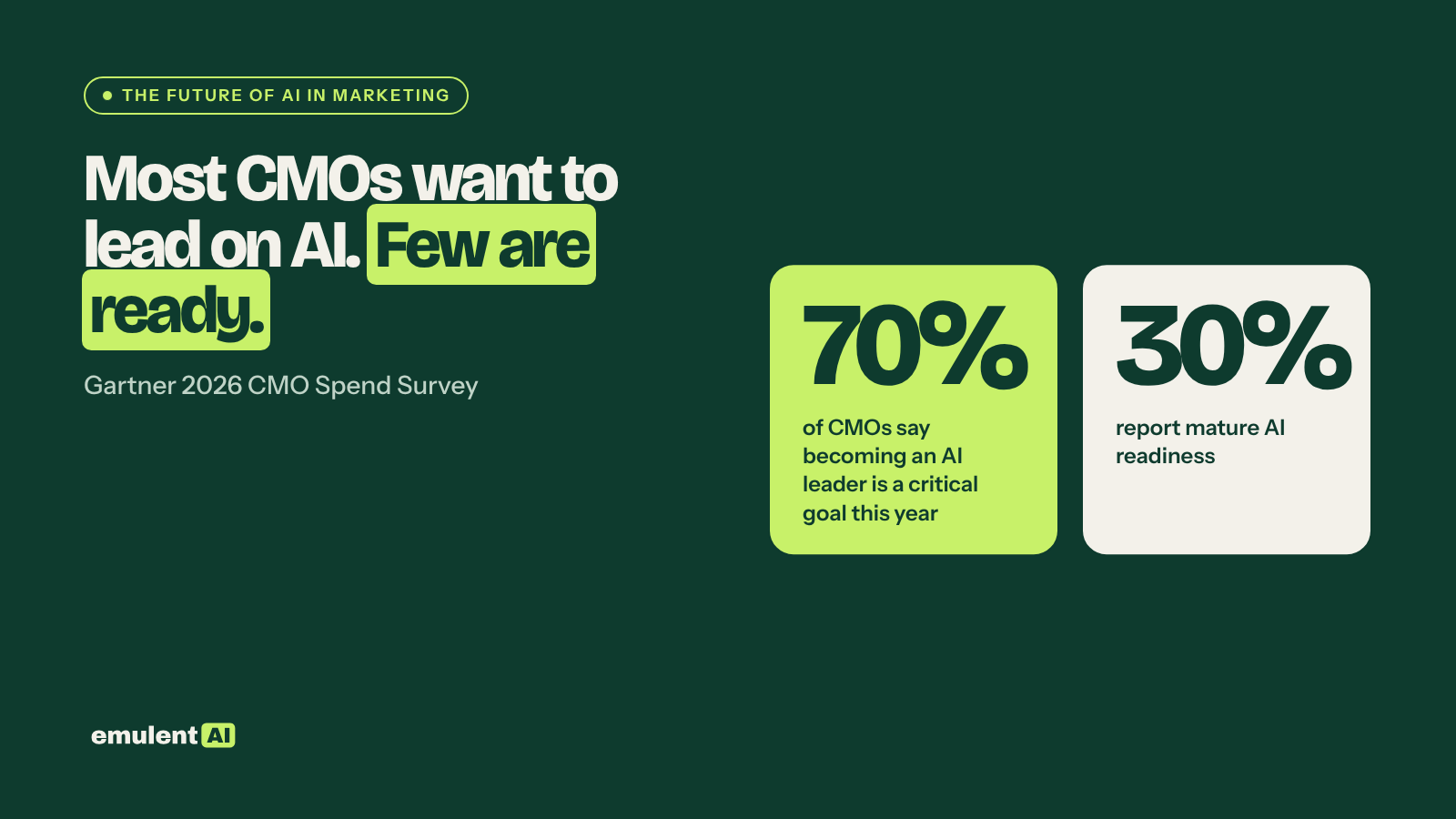
Gartner’s 2026 CMO Spend Survey found that 70 percent of CMOs say becoming an AI leader is a critical goal this year. Only 30 percent report mature AI readiness, and 70 percent say their internal processes are not yet mature enough to implement and scale AI. The AI-ready group spends 21.3 percent of its marketing budget on AI.
The skills data says the same. In the CMO Survey, 49.7 percent of marketing leaders say their teams have the skills and training to use their marketing technology, down from 54.1 percent in 2022. Training is 3.8 percent of marketing budgets. Meta’s YouGov survey of 3,983 small business owners in Asia-Pacific found 84 percent already use AI and 86 percent say small businesses need more guidance to get the full benefit.
Companies are buying faster than they are learning. That gap is the real story of 2026, and it is the first thing to close.
What to prepare for
Each of these is tied to something already announced or measured.
- Agents that act inside your ad accounts. Google’s Ask Advisor and Meta’s Muse can propose and build campaigns. Decide now who approves an agent’s changes, what spending limits apply and how changes get logged.
- Ads and answers merging. With ads moving into AI Mode, measure whether your brand appears in AI answers, in addition to where it ranks.
- Provenance marks on AI output. Anthropic announced in August 2026 that new Claude models watermark the text they generate, applied globally, to comply with the EU AI Act, and attach C2PA content credentials to supported files. OpenAI announced in October 2026 that it will watermark eligible ChatGPT and Codex text in the EU. Google already requires Merchant Center sellers to label AI-generated product images with IPTC metadata. Plan your disclosure policy before someone else’s detector answers the question for you.
- A trust premium. A Gartner survey released in March 2026 found 50 percent of U.S. consumers would prefer to buy from brands that don’t use generative AI in consumer-facing content, and 68 percent frequently wonder whether what they see is real. My bet is that brands that keep a visible human voice will stand out more as AI content spreads.
- AI’s share of marketing work doubling. If AI goes from 24 percent to 56 percent of marketing activities in three years, the people running it need training now, before the tools are in place.
- Flat budgets and harder questions. With AI funded out of existing budgets, measure results (leads, revenue, hours saved), not output. More content is not a return.
The thread through all six is a line from my talks: “When anyone can create anything, judgement becomes the premium.” The tools will keep getting cheaper and more capable. Knowing when to use them, and when not to, is what clients and employers will pay for.
If you want to know where your team stands before these shifts land, our AI readiness assessment scores your data, tools, skills and risk and ranks the gaps to fix first. From there, an AI marketing strategy and roadmap turns the gaps into a plan. Book a strategy call to start.
Put this to work with Bill.
Tell Bill where your team is with AI right now. He’ll tell you what he would do first and what he would leave alone.
Contact Bill directly
Or call 773-791-3197