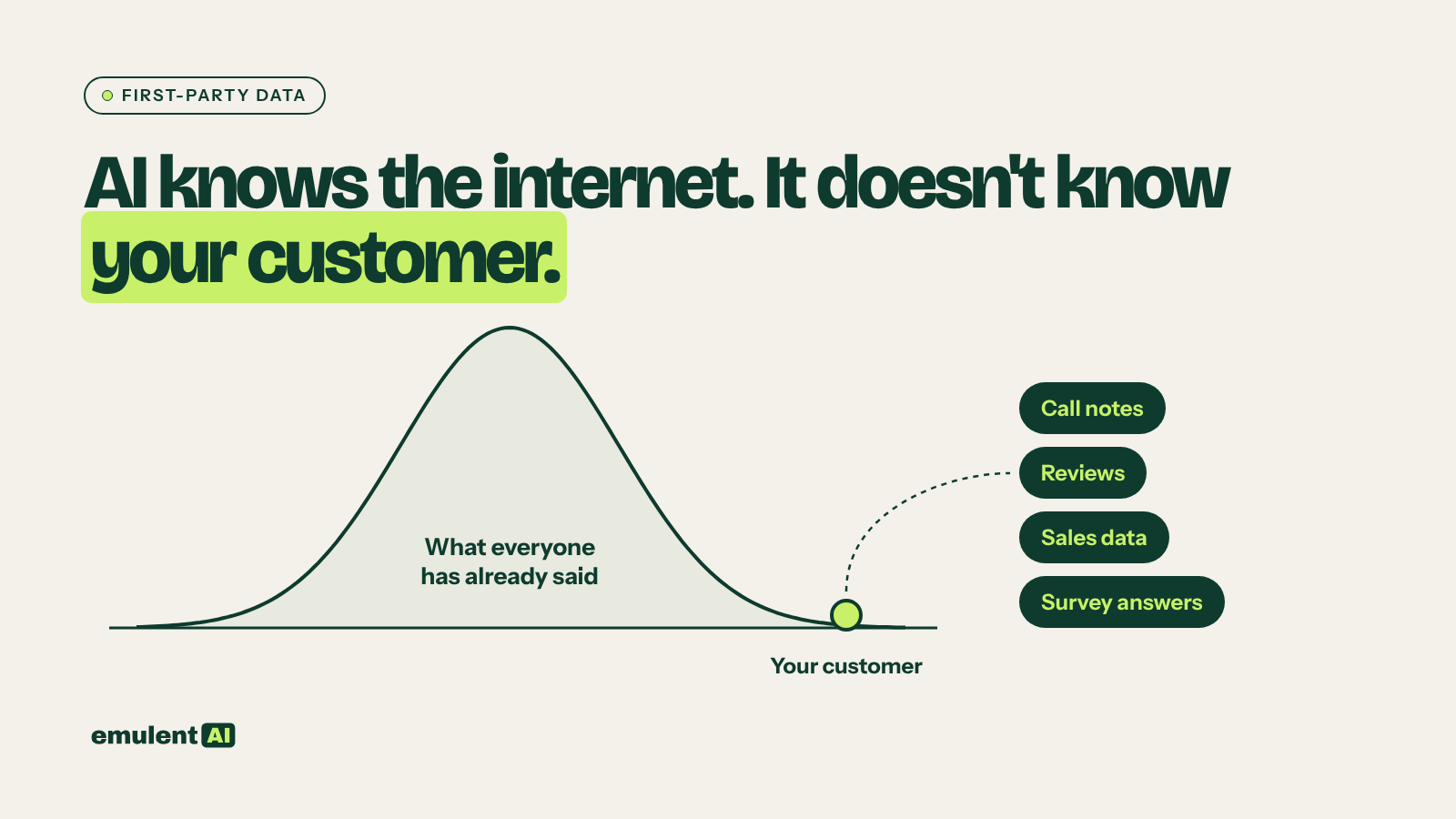
AI has read a huge share of the public internet and nothing about your customers. Unless you give it your own data, it will write for the average buyer in your category, and the average buyer doesn’t exist. Before AI can produce anything better than what your competitors get from the same tool, you need to collect what your customers have actually said, done and bought, and put it in a shape you can hand over.
This post covers which first-party data does the most work, how to tidy it without a six-month project, and how to tell whether you are ready. It is one of the four areas we score in an AI readiness assessment, and in my experience the one teams most often skip.
Why AI defaults to average
A language model doesn’t look facts up. It predicts the most likely next word based on patterns in its training data, which is mostly the public web. Three things follow from that.
First, its default answer is the middle of everything already written on your topic. Ask for “a landing page for a regional HVAC company” and you get the landing page that every regional HVAC company already has. Second, it only knows what is in the conversation. It has no memory of your clients, your brand or last year’s results unless you supply them. Third, it aims for what sounds plausible, so it will fill gaps in what you gave it with confident guesses.
Average never built a brand. AI brings you to the center; the edge comes from you, and much of what you know is sitting in your own data.
The first-party data that changes the output
You don’t need everything. You need the material that tells a model what your customers care about, in their own words, and what has worked for you before. These are the sources I look for first.
The customer’s own words
Sales call transcripts, support tickets, reviews, survey open-ends, and interview notes. This is the richest source because it carries the phrases buyers use, the objections they raise and the outcomes they want. AI is good at summarizing this kind of material. The catch is that it has to exist somewhere you can export it.
Results, with the reasons attached
Campaign and email performance, landing page tests, won and lost deals. A number alone teaches little. “Subject line B beat A by a wide margin” is more useful when someone wrote down why the team thinks it won. If your reports only hold numbers, add a line of interpretation to the next few.
Segments built from real records
Persona and segmentation drafts are a good AI job, but only from real data: CRM fields, purchase history, survey responses. A persona written from memory in a workshop gives the model your assumptions back in nicer sentences.
Your positioning and point of view
The brand guide, the positioning statement, the opinions your leadership holds that competitors don’t. This is what sets you apart, and it is also the material AI should never write for you. It should read it, though.
Proof
Case studies, before and after numbers, client stories you are allowed to share. If AI doesn’t have your proof, it will write claims with nothing behind them, or invent the proof.
What “ready” looks like
Data is ready for AI when a new hire could use it. That is the test I use: if you gave this folder to a smart person on their first day, could they write a credible email to your best customer by lunch? If they would need to interview three colleagues first, AI will need the same thing, and it can’t do the interviews.
In practice that means the material is:
- Findable, in one place, not spread across inboxes and personal drives.
- Current enough that it describes today’s customer and today’s offer.
- Labeled, so a file called “Q3 final v2” says what it is and when it came from.
- Stripped of what should never go into an AI tool: personal customer details, credentials, anything under NDA.
- Checked by someone who knows the business, so the model isn’t learning from a wrong spreadsheet.
How to organize it without a huge project
Most teams think data readiness means a data warehouse. For marketing work with an AI assistant, it usually means a well-made reference kit and a few habits.
- Pick one recurring job, such as monthly email or service pages, and list what a person would need to know to do it well.
- Gather that material into one folder or project in your AI assistant: brand guide, two or three of your best past pieces, a summary of recent results, a page of real customer quotes.
- Remove anything sensitive. Replace customer names with descriptions if you need the context but not the identity.
- Write a short cover note: who the customer is, what they want, what you believe that competitors don’t, and what you never say.
- Run the job with the kit and without it, and compare. The gap tells you whether the data is doing work.
- Keep the kit current. Add new results and quotes each month and remove what is stale.
Larger data sets need more structure, and AI can help build it. On one Emulent project, 900,000 biotech specimens became one database searchable by 20 attributes. AI tagged and classified the records, and we checked the output against the source data before anyone relied on it. On another, Semrush crawled a 20,000-page site and Claude read the full export, grouped the issues by pattern and produced a fix list ranked by impact and effort. In both cases the value came from organized, checkable inputs.
Where your data is not enough
Feeding AI your data improves the starting point. It doesn’t remove the need for judgement. A model given your call transcripts can still misread them, overstate a theme that came up twice, or invent a quote that sounds like your customer. Every fact, stat and quote in an AI draft still needs checking against the source before it goes live.
Google’s October 2026 update to its guidance on generative AI content says the same thing for search: generative models don’t retrieve facts and can hallucinate, so AI-generated content needs a manual fact-check and review before publishing. Its people-first content page now names effort, originality, skill and accuracy as the measures of main content quality. Your own data is how you get originality. Review is how you keep accuracy.
Some work shouldn’t be generated even with great data: original research and customer interviews, the core strategic idea, anything that carries your name without a human on it. Data makes AI drafts more specific. It doesn’t make AI the author of your point of view.
A test you can run this week
Pick a piece of content you need anyway. Ask your AI assistant to write it with no context and save the result. Then give it your reference kit: real customer quotes, recent results, your positioning, one example you are proud of. Ask again. If the second draft could only have come from your company, your data is doing its job. If both drafts read about the same, the kit is missing what makes you different, and that is where to spend your time.
Next step
The data section of our AI readiness assessment looks at what customer data you have, where it lives and what to organize first. If the data is in good shape and the setup is the problem, our AI tool selection and implementation work builds the projects and reference kits around it.
Put this to work with Bill.
Tell Bill where your team is with AI right now. He’ll tell you what he would do first and what he would leave alone.
Contact Bill directly
Or call 773-791-3197