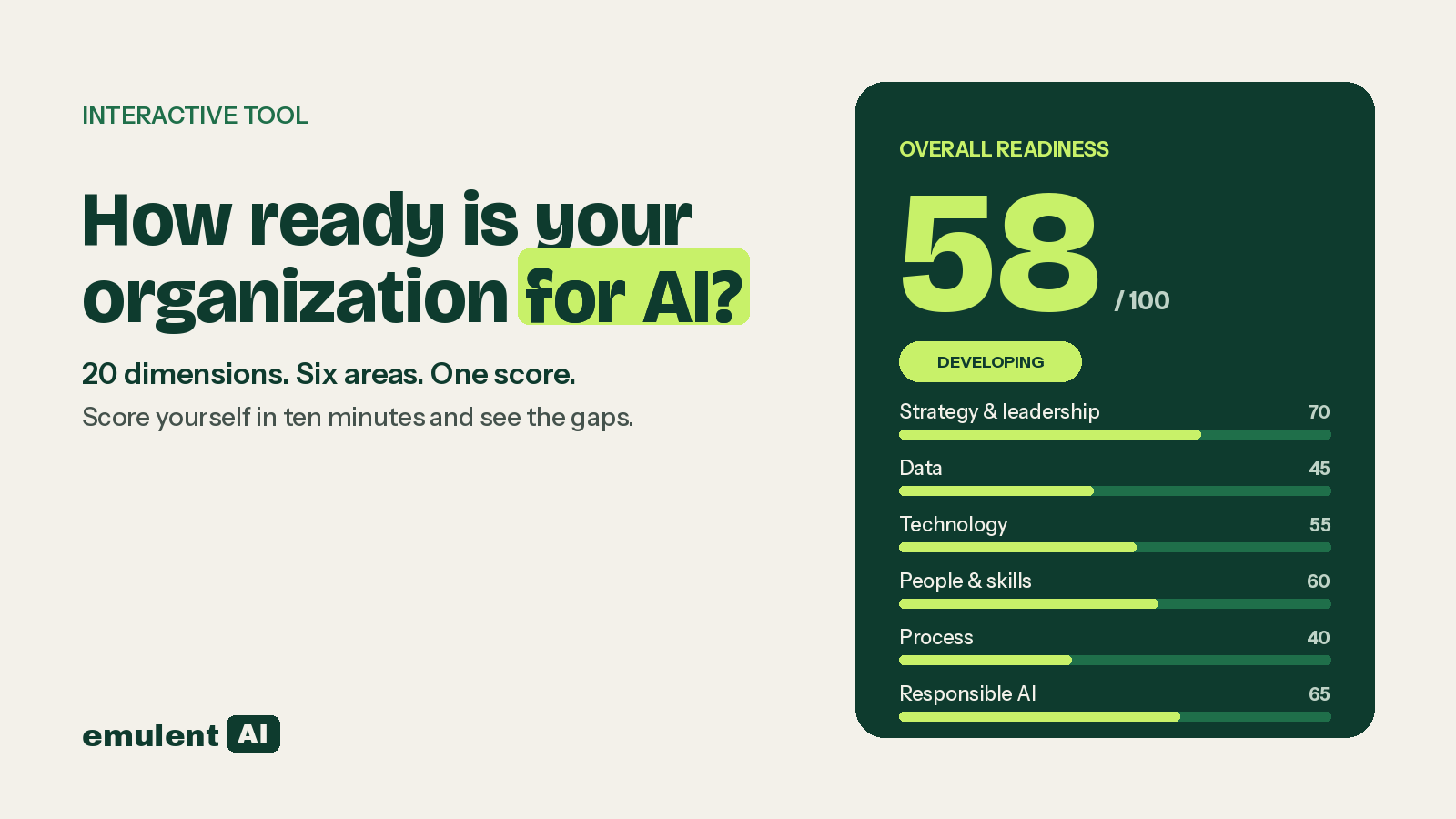
Almost every company uses AI somewhere now. Very few could tell you how ready they are for it. This index gives you a number. More usefully, it shows you which of six areas is holding that number down.
Capability is cheap. Any team can open a tool and have output in a minute. What decides whether AI pays off is readiness, and readiness has six parts: someone owns it, the data exists and can be reached, the systems connect, the people have been trained, the process is written down somewhere, and somebody measures what happened afterwards. The index below scores each of the six.
It takes about ten minutes. Answer for how things are today, since the point is to find the gaps. Nothing is sent anywhere: your answers are stored in your own browser, and the Copy summary button gives you a plain-text version to paste into an email or a planning doc.
Rate your organization on 20 dimensions
Each dimension is scored on a five-level maturity scale. The six areas are weighted by how much they usually decide whether an AI initiative pays off. Your score updates as you go, and your answers stay in this browser so you can come back to them.
How the score works
Each dimension is rated from 1 (ad hoc) to 5 (optimized). The ratings within an area are averaged and converted to a 0 to 100 scale, then the six areas are combined using these weights: strategy and leadership 25%, data 25%, technology 15%, people 15%, process 10%, responsible AI and measurement 10%. Strategy and data carry half the weight between them because, in the companies we have worked with, they are where most AI projects stall. A team with a sponsor, a budget and usable data can buy or build the rest. A team without them tends to get stuck at the pilot.
What your band means
A score of 0 to 20 is ad hoc. AI happens by accident, if at all. The first jobs are a named sponsor, a one-page written strategy and an inventory of the data you already have.
21 to 40 is emerging. There is interest and probably a few experiments, but the foundations are thin. Fix data access and ownership first, then run one small pilot with a success measure agreed before it starts.
41 to 60 is developing, which is where most of the companies we talk to land. The foundations exist. The work now is scaling what already works: getting tools into production properly, connecting them to the systems people use every day, and teaching the people outside the enthusiast group what the tools can and can't do.
61 to 80 is established. AI has owners and a budget and is run like any other capability. Close the gaps the panel shows you, and start tracking value across the whole portfolio instead of one project at a time.
81 to 100 is optimized. AI is part of how the organization runs. The risk at this level is complacency. The tools and the rules keep changing, so evaluation, hiring and risk monitoring need the same attention they had on the way up.
What to do with the result
Read the "Biggest gaps" list before you read the overall number. It picks out your three lowest-rated dimensions, leaning toward the heavier-weighted areas, and shows the next level up for each one. For most teams those three lines are a reasonable plan for the next quarter.
If you want a second opinion on your answers, or help turning the gaps into a plan, that is what our AI readiness assessment is for. The first step is a phone call with Bill.
Know your number. Then fix the gaps.
Send Bill your summary and he will tell you what he would do first and what he would leave alone.
Contact Bill directly Or call 773-791-3197