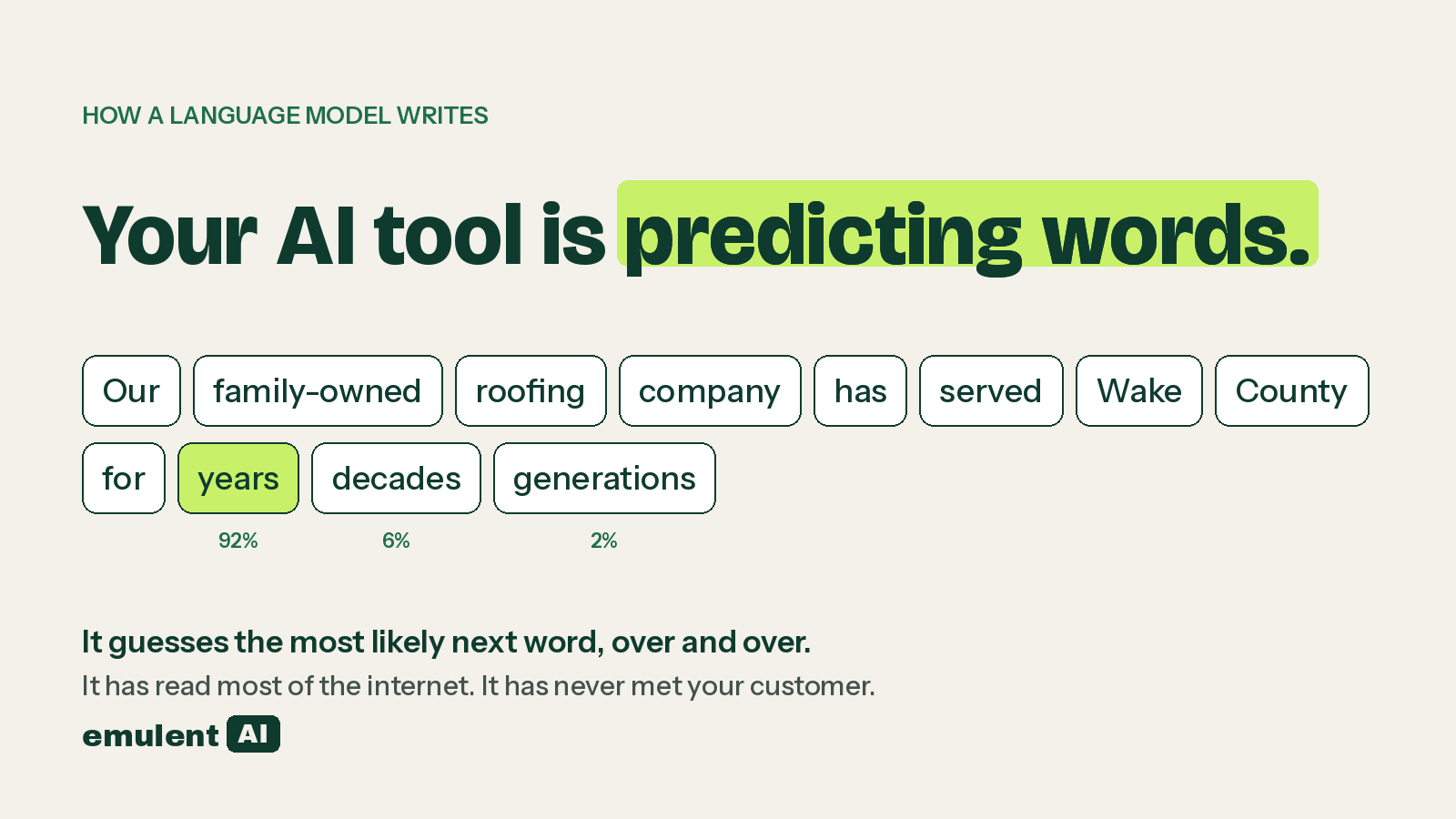
A language model writes by guessing the most likely next word, over and over, based on patterns in the text it was trained on. That is the whole trick. Google said much the same in its own search guidance on October 1, 2026, noting that generative models predict a likely sequence of words and do not retrieve facts. Once you accept that, most of the rules for using AI in marketing follow from it.
Three things that follow from prediction
First, the model learned from most of the public web. Its default answer is the average of what everyone has already said. Ask for a blog post on choosing a roofer and you get the post that already exists on a thousand roofing sites.
Second, it only sees the conversation in front of it. It knows nothing about your clients, your results or your brand unless you tell it. Memory features help, but they only hold what you have already given them.
Third, it produces text that sounds right. Sometimes that text is wrong, and it is delivered with the same confidence as everything else. There is a cartoon I use in talks: someone holds up a mushroom and asks the AI if it is safe to eat. “Yes!” Next panel, a gravestone, and the AI apologizing for the confusion and offering to share more about poisonous mushrooms. It gets a laugh. The same thing happens, with less drama, to a statistic in a white paper or a claim on a product page.
Google now says to fact-check all of it
Google’s October 1 update to its guidance on generative AI content says AI output can contain hallucinations and calls it “critical to manually factcheck and review all AI-generated content” before publishing. The update also pulled in language from Google’s quality rater guidelines: producing large amounts of AI text without manual oversight counts as little to no effort.
Google has not said it penalizes content for being AI-written. What it rewards is harder for AI alone to supply:
- Effort, meaning human work and care, with bulk automated production counted as low effort
- Original perspectives or data the reader can’t find everywhere else
- Real subject knowledge or first-hand experience
- Accuracy, judged more strictly on health, money and legal topics
A model can help with all four. It can’t provide the experience or the original data, because it doesn’t have them.
AI text now carries a hidden fingerprint
The transparency rules in Article 50 of the EU AI Act took effect on August 2, 2026. They require AI providers to mark generated content in a machine-readable way.
Anthropic says Claude models launched on or after that date embed an invisible statistical watermark in the text they write, and it applies the mark worldwide, not just in Europe. Older Claude models are being brought in during the EU’s transition period, which ends December 2, 2026. Nothing visible is added. The model leans toward certain word choices where several words would work equally well, and a detector can read that pattern later. Files Claude generates get signed provenance metadata where the format supports it.
OpenAI followed on October 5. Its watermark, called textGrain, is rolling out to ChatGPT and Codex text in the EU over the coming weeks. API customers anywhere can switch it on, but OpenAI says it is not a global default at launch.
For marketers, three details are worth knowing:
- The mark lives in the words, so it travels with copy and paste and can survive light editing.
- It applies to the words the model chooses. If you ask Claude to rewrite parts of your own draft, those rewritten parts can carry it.
- Detection is a probability, not proof. A detected mark suggests a model was involved; it says nothing about how much a person contributed, and a missing mark does not prove a human wrote the text.
Public detection tools for text are still limited (OpenAI’s text detector is open only to approved researchers for now). Even so, plan as if anything you publish from these tools can be identified as AI-assisted.
Using AI well is a communication skill
Because the model only knows what you tell it, the quality of the output tracks the quality of the brief. You talk to it in plain language. Technical skill has little to do with who gets good results.
Compare two requests. “Write a blog post about roof repair” gets you the internet average. “Write 800 words for homeowners in Wake County whose roofs were damaged in last month’s hail. We are a family-owned roofer, 22 years in business. Here are three questions customers asked us this week, and here is a post of ours they liked” gets you something you can work with. (Those details are made up for the example; yours would be real.)
Then give feedback the way you would with a colleague: say what is off and why. If you can’t explain what you want to a person, you won’t be able to explain it to AI either.
This is why subject matter experts get the most out of these tools. They know what good looks like, and they can spot the confident wrong answer before it goes live. AI can get you to good, fast. Getting to great is still your job.
Want your team to brief AI like a new hire?
Our hands-on workshops teach marketers to get good work out of AI and to catch the confident wrong answer before it ships.
Book a strategy call
Or call 773-791-3197