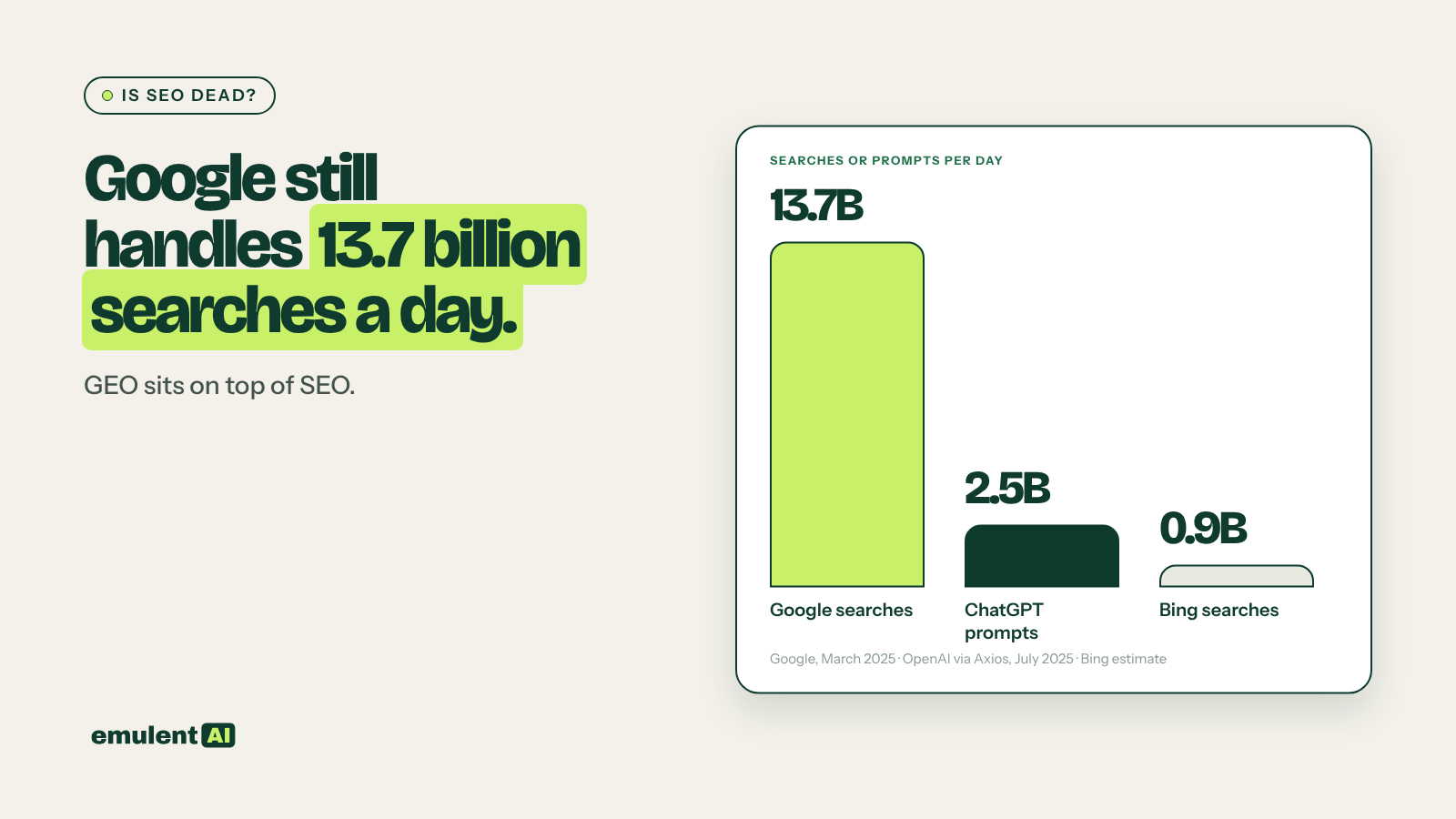
Google handles more than 5 trillion searches a year, which works out to about 13.7 billion a day, according to figures Google shared in March 2025. ChatGPT handles about 2.5 billion prompts a day (OpenAI, via Axios, July 2025), and that number counts every prompt, from recipes to cover letters. Bing sits at an estimated 900 million. Anthropic doesn’t publish a daily number for Claude.
Search is still mostly Google, and it’s still very large.
Where does the “SEO is dead” idea come from?
From a real drop in clicks. Pew Research Center found in July 2025 that when a Google results page showed an AI summary, 8% of visits led to a click on a regular result. Without a summary, it was 15%.
If your monthly report is built on organic clicks, that drop shows up. Some businesses saw it and decided search was over.
Why clicks don’t tell the whole story
AI tools search the web to build their answers. Google’s AI Overviews and AI Mode work from Google’s own index. A page that can’t be crawled or indexed can’t be cited, so the technical basics of SEO still decide whether you’re in the running at all.
The people who do click are worth more. A 2025 Semrush study put the average AI search visitor at 4.4 times the value of a traditional organic visitor, based on conversion rates. They’ve already read a summary, compared options and picked you.
So what is GEO?
GEO stands for generative engine optimization. It’s the work of getting your business named or cited in answers from ChatGPT, Gemini, Perplexity and Google’s AI tools.
It sits on top of SEO. The foundation stays the same: pages that load, get indexed and answer questions. GEO adds a few layers, like writing for full questions and getting other sites to mention you.
Google’s advice for the last 20 years has been to make useful content, show real expertise and earn a reputation people talk about. That’s the same work that builds a brand. The goal of showing up in AI answers is brand visibility. Clicks are a bonus.
Where SEO alone falls short
Ranking well is no longer enough by itself. Whitespark’s 2026 guide to AI Mode for local businesses found that a business ranked in Google’s top 10 has about a 25% chance of appearing in an AI Overview. Semrush found that about 90% of ChatGPT citations come from pages ranked 21st or lower in Google for related searches.
So a business can rank third and never get named, while a competitor on page three gets cited. Brand mentions, clear answers and reviews make up the difference.
What should you measure now?
Most businesses can measure one GEO number today: referral traffic from AI tools, which shows up in Google Analytics 4 from sources like chatgpt.com and perplexity.ai. Track it next to organic traffic.
The rest is harder to see. Someone reads your name in a ChatGPT answer, then searches for you by name a week later. Watch your branded search volume in Search Console. When AI tools start naming you, it tends to rise.
Put this to work with Bill.
Tell Bill what you found when you asked AI about your business. He’ll tell you what he would fix first.
Contact Bill directly
Or call 773-791-3197