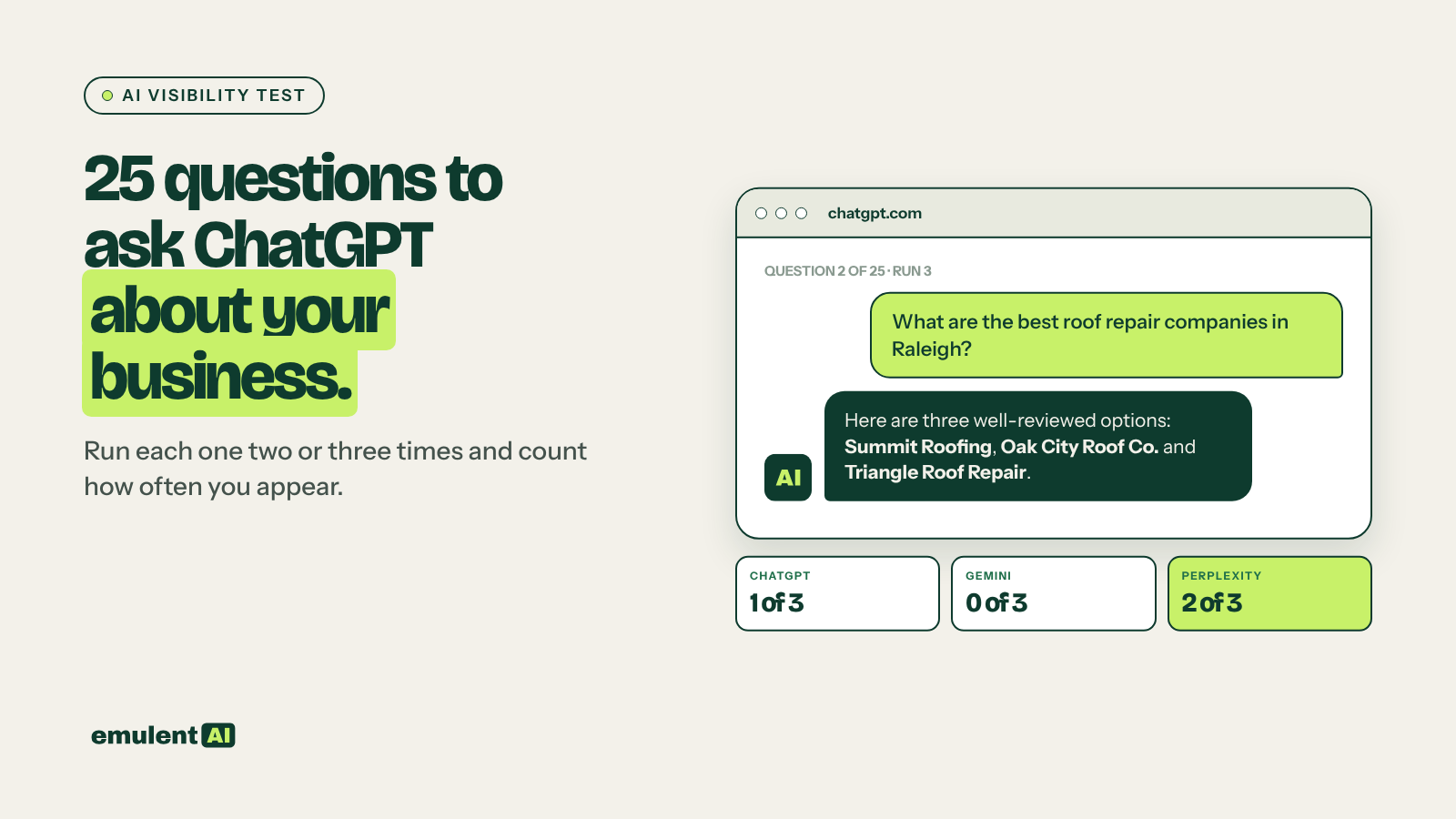
In February 2026, BrightLocal found that 45% of US consumers had used AI tools to find a local business. A year earlier the number was 6%. Most owners have never checked what those tools say about them, and you can do it in about an hour with the questions below.
How do you run the test?
Pick your category in the words a customer would use. “Roof repair” works. “Exterior envelope solutions” does not. Then fill in the brackets in each question and run it in ChatGPT, Gemini, Perplexity and Google’s AI Mode.
Use a fresh chat each time so your past conversations don’t steer the answer. Write down every business the tool names, the order it names them in, and any sites it links to. A spreadsheet with one tab per tool is enough.
Don’t expect the same answer twice. In January 2026, SparkToro and Gumshoe.ai ran 2,961 prompts and found that ChatGPT and Google’s AI returned the same list of brands less than 1% of the time for the same question. Run each question two or three times and count how often you appear. That count tells you more than any single answer.
Discovery and fit
These are the questions a stranger asks before they know your name.
- What are the best [product/service category] providers?
- What are the best [product/service category] companies in [location]?
- Which [product/service category] would you recommend for [target audience]?
- What are the best [product/service category] options for [industry]?
- What is the best [product/service category] for [specific use case]?
- Which companies can help me solve [customer problem]?
Question 2 is the one most local businesses care about. If you’re missing there but show up in question 6, the AI knows what you do but isn’t sure where you do it. Your Google Business Profile and your reviews are the first places to look.
Budget, features and trust
- What are the best [product/service category] options under [budget]?
- Which [product/service category] providers offer [key feature]?
- What are the best [product/service category] options that integrate with [tool/platform]?
- Which [product/service category] is easiest to implement for [team/company size]?
- What are the most reliable [product/service category] providers?
- Which [product/service category] companies have the best customer support?
Questions 11 and 12 lean hard on reviews. If an answer brings up a complaint you fixed two years ago, the AI is reading old reviews and nothing newer has replaced them.
Comparisons and alternatives
- Compare the top [number] [product/service category] providers for [use case].
- Which [product/service category] companies should I shortlist for [requirements]?
- What are the best alternatives to [competitor name]?
- What should I choose instead of [competitor name] if I need [requirement]?
Run question 15 with the name of the competitor you lose the most jobs to. The businesses the AI suggests instead are the group it thinks you belong to. If you aren’t on that list, it doesn’t see you as their peer yet.
Your brand
These show what AI says when someone already knows your name.
- What is [brand name], and what does it offer?
- Who is [brand name] best suited for?
- Is [brand name] a good choice for [specific use case]?
- What are the strengths and weaknesses of [brand name]?
- How does [brand name] compare with [competitor name]?
- What are the best alternatives to [brand name]?
- What do customers say about [brand name]?
- What should I know before buying from [brand name]?
- Which sources would you use to evaluate [brand name]?
Wrong answers are common here: an old address, a service you dropped, a price range from 2019. Question 25 is the most useful one on the list. It tells you which sites the tool trusts for your category, and those sites become your outreach list.
What do the answers mean?
If you aren’t named anywhere, few other sites mention you. AI tools lean on what the web says about a business, and a quiet web presence reads as no presence.
If you’re named but described wrong, find the source. It’s usually an old directory listing or an outdated page on your own site.
If one competitor shows up for everything, compare their answer to question 25 with yours. They’re probably listed on sites where you aren’t.
If you show up in Perplexity but not ChatGPT, or the other way around, that’s normal. Each tool runs its own searches.
Turn the 25 questions into a page
Write one page on your site that answers all 25 questions about your business, with each question as a heading. Write it yourself and use real numbers. For question 7, give your actual price range. For question 20, say what you don’t do. “We don’t take commercial jobs” is a fact an AI can repeat, and it sends you leads that fit.
One page won’t change the results by next week. What other sites say about you counts for more than what you say about yourself, so rerun the 25 questions every quarter and compare the counts.
Put this to work with Bill.
Tell Bill what you found when you asked AI about your business. He’ll tell you what he would fix first.
Contact Bill directly
Or call 773-791-3197