This guide is part of our series on using AI for local SEO.
A linking map is a spreadsheet of every location page, service page and service-in-town page, with the links each one should send and receive. Most multi-location sites have the pages but not the links. Service-in-town pages sit with nothing pointing to them except the XML sitemap, and location pages link to the homepage and nowhere else. AI can read a full crawl and propose every missing link in an afternoon.
What you need
- An AI assistant that accepts file uploads, such as Claude
- Screaming Frog or Semrush Site Audit to crawl the site
- Your list of services, your list of towns, and which neighboring towns sit next to each one
- A location sheet showing which services each location offers
- Any list of pages you plan to build, such as the build list from a local competitor gap map, so those pages go into the map before they exist
The structure to aim for
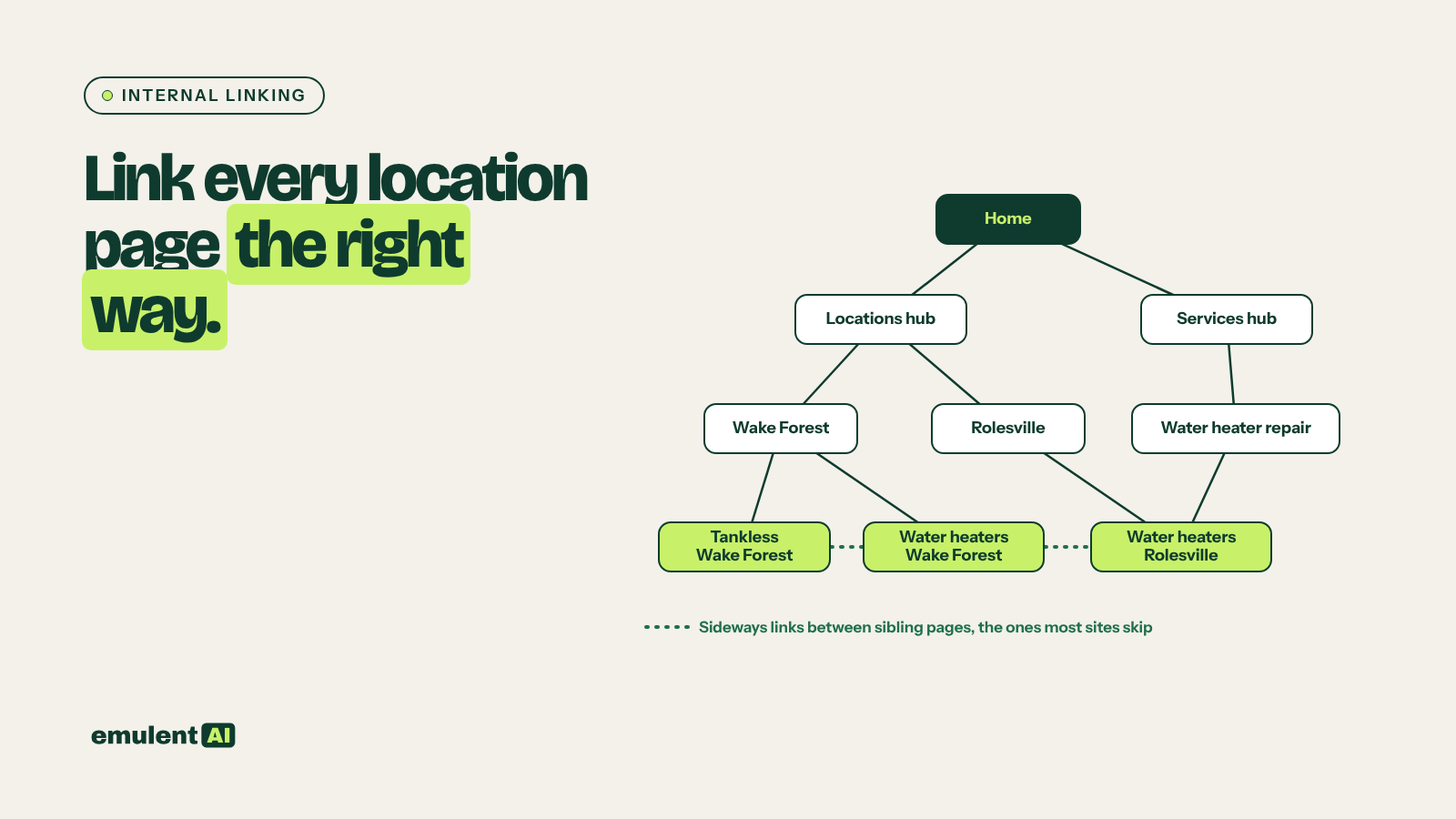
For a typical service business the hierarchy has four levels:
- The homepage links to the locations hub and the services hub.
- The locations hub links to every location page. The services hub links to every service page.
- Each location page links to the services offered at that location, and to the service-in-town pages for its own town and nearby towns. Each service page links to the locations that offer it.
- Each service-in-town page links up to its parent service page and its parent location page, and across to two or three sibling pages: the same service in the next town over, or a related service in the same town.
The sideways links in level 4 are the ones most sites skip. They are also what gets a new town page crawled and ranked quickly, because it picks up links from pages Google already visits often.
Step 1: Crawl the site and export the links
Run Screaming Frog (or Semrush Site Audit) on the whole site. Export two files:
- All internal HTML pages with URL, title, H1, inlinks count and crawl depth
- All internal links (in Screaming Frog, Bulk Export > Links > All Inlinks), with source, destination and anchor text
Step 2: Classify every page
Attached is a list of every internal URL with title and H1. Classify each URL
as one of: homepage, location hub, location page, services hub, service page,
service+location page, blog post, other. Add columns for the town (if any) and
the service (if any) each page targets, using the town and service lists
attached. Mark anything you cannot classify as "check". Output as CSV.
Review the “check” rows yourself. They are often old landing pages from a past campaign, and some should be redirected.
Step 3: Build the target link matrix
Using the classified page list, the town list with each town's neighboring
towns, and the list of which services each location offers, write the ideal
internal links for every page following these rules:
[paste the 4-level structure above]
Output a CSV with columns: source_url, target_url, suggested_anchor, rule.
Anchors should be natural and varied: use the service name, the town name,
or both, and do not repeat the same exact-match anchor more than twice across
the site for one target. Only link a location to a service if the services
column says that location offers it.
The output will look like this:
source_url,target_url,suggested_anchor,rule
/locations/wake-forest/,/services/water-heater-repair/,water heater repair,location to offered service
/locations/wake-forest/,/wake-forest/water-heater-repair/,water heater repair in Wake Forest,location to own service+town page
/wake-forest/water-heater-repair/,/rolesville/water-heater-repair/,Rolesville water heater service,sibling: same service nearby town
/wake-forest/water-heater-repair/,/wake-forest/tankless-water-heaters/,tankless installs,sibling: related service same town
Step 4: Compare the target map to what exists
Give the AI the target matrix and the actual inlinks export:
Compare the target link matrix to the actual internal links export. List:
1. Missing links (in the target, not on the site), grouped by source page so an
   editor can fix one page at a time
2. Orphan pages: any location, service or service+location page with fewer
   than 3 internal inlinks
3. Pages more than 3 clicks from the homepage
4. Links pointing to redirected or 404 URLs
5. Location pages linking to services that location does not offer
Grouping by source page is what makes the list usable. An editor opens one page, adds its six missing links, and moves on.
Step 5: Add the links where people will click them
A link inside a real content block does more for readers than a footer list of 60 towns, and a footer list of towns is the kind of thing Google’s spam policies call keyword stuffing. On each page:
- Put service links in the body where the service is described, plus a short “Services at this location” block.
- Add a “Nearby areas we serve” block on service-in-town pages with the two or three sibling links, written as a sentence or a short list.
- Use breadcrumbs (Home > Locations > Wake Forest > Water heater repair) with BreadcrumbList schema.
In the block editor or your page builder, save a template for each page type (location page, service-in-town page) with these blocks already in place. Every new page then starts with the right link slots, and editors only change the text and URLs inside them. The same templates carry over if you later build programmatic local pages.
Step 6: Re-crawl and repeat quarterly
After the edits, re-crawl and rerun step 4 to confirm the gaps closed. Then set a quarterly reminder. New pages, removed services, closed locations and menu redesigns break the map faster than most people expect, and the orphan count is the first number to creep back up.
Put this to work with Bill.
Tell Bill which locations and towns matter most to you. He’ll tell you which of these workflows to run first.
Contact Bill directly
Or call 773-791-3197