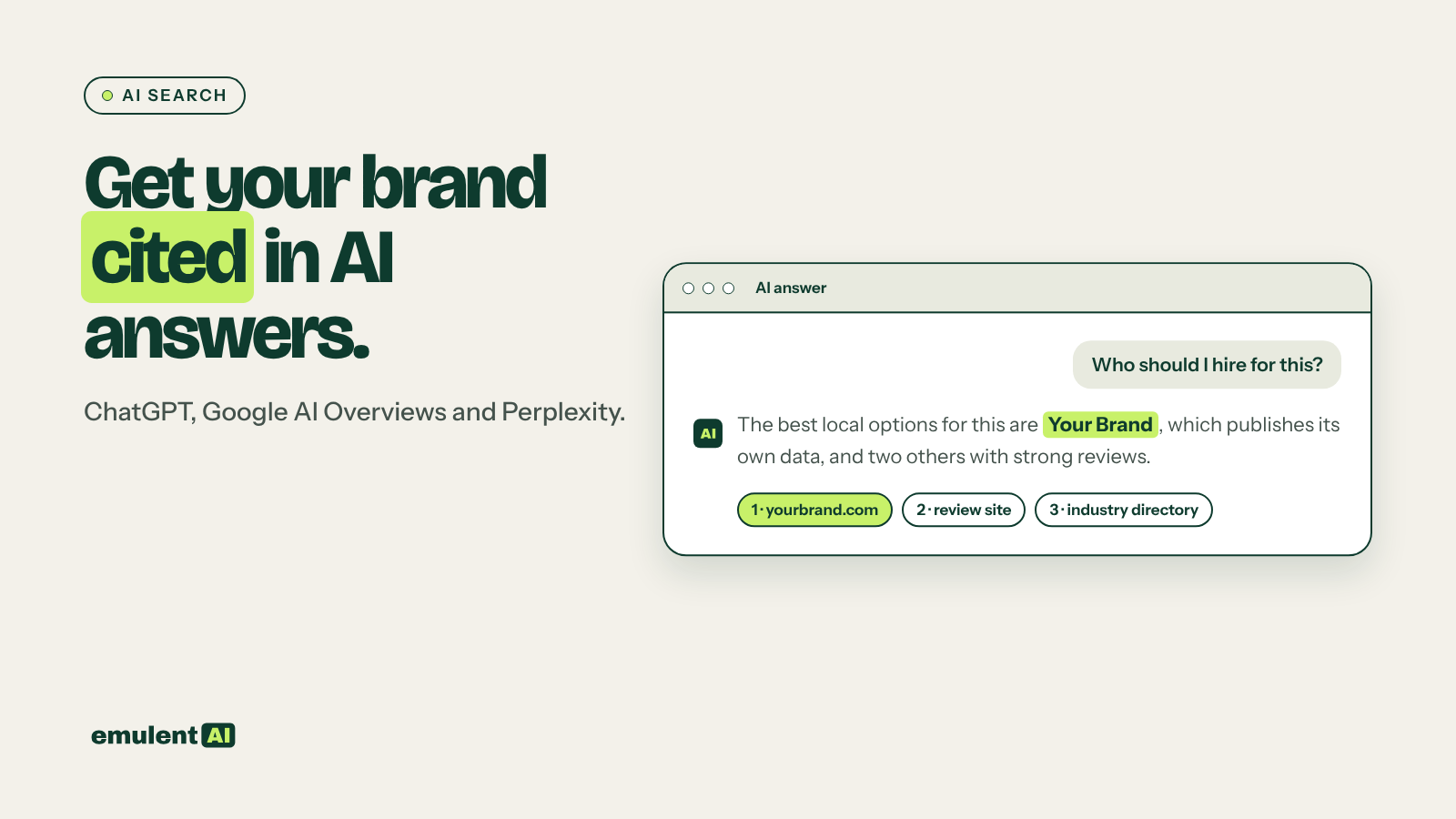
AI brand visibility is how often AI answer engines name your brand, link to your pages and describe you correctly when someone asks a question in your category. You earn most of it the same way you earn Google rankings. Google says so in its own documentation, and the assistants outside Google also pull from search indexes when they answer. The bar is higher, though. An AI answer already summarizes what everyone else said, so a page that repeats the consensus gives it no reason to cite you.
For close to three years I’ve been running marketing tests on the major AI platforms with their most advanced models. This article is how I’d approach AI visibility for a brand today, built on what Google, OpenAI, Microsoft and Perplexity publish about how their systems pick sources, plus the data on where people search.
What AI brand visibility means
There is no position one in a chat answer, so the old ranking report doesn’t translate. I look at four things instead:
- Mentions: your brand is named in the answer text.
- Citations: the answer links to one of your pages as a source.
- Accuracy: what the answer says about you (services, prices, locations, who runs the company) is true and current.
- Framing: whether you’re recommended, listed as one option among many, or mentioned with a warning.
Answers also change from one run to the next. When SparkToro had 600 volunteers run 12 brand-recommendation prompts a combined 2,961 times, it found less than a 1 in 100 chance that ChatGPT or Google’s AI would return the same list of brands twice in 100 runs. So read AI visibility as a percentage across many questions and many runs. How to collect that number is its own topic, and I cover it in the measurement article.
The impact of AI on brand visibility
The bigger change is what happens after the answer appears. Pew Research Center tracked the browsing of 900 U.S. adults in March 2025 and found that users clicked a traditional result on 8% of visits to a Google results page with an AI summary, against 15% when there was no summary. They clicked a link inside the summary itself on about 1% of visits. A buyer can now form an opinion of your company without ever reaching your site. Being named in the answer is part of being visible at all.
What it does to brand monitoring
Brand monitoring used to mean watching what people said about you: reviews, press, social posts. Now it also means watching what the models say. As I explain it in my talks, a language model doesn’t know things. It predicts the most likely next word, over and over, from patterns in what it was trained on. It produces plausible text, and sometimes it’s wrong with total confidence. A model can state an old price, a service you dropped or a competitor’s founder as yours, and sound certain. The only way to catch that is to ask the questions your buyers ask and read the answers.
Where people search now
The share data is real, but it measures different things, so read the table with the notes below it.
| Measure | Figure | Source |
|---|---|---|
| Google share of worldwide search, September 2026 | 89.94% | Statcounter search engine share |
| Bing share of worldwide search, September 2026 | 5.29% | Statcounter |
| ChatGPT share of AI chatbot referrals, September 2026 | 80.48% | Statcounter AI chatbot share |
| Google Gemini share of AI chatbot referrals | 10.91% | Statcounter |
| Perplexity share of AI chatbot referrals | 5.85% | Statcounter |
| Microsoft Copilot share of AI chatbot referrals | 1.79% | Statcounter |
| Claude share of AI chatbot referrals | 0.95% | Statcounter |
| ChatGPT weekly active users, February 2026 | 900 million | OpenAI, reported by TechCrunch |
| Google AI Mode monthly active users, July 2026 | Over 1 billion | Google Q2 2026 earnings remarks |
| Gemini app monthly active users, July 2026 | 950 million | Google Q2 2026 earnings remarks |
The Statcounter chatbot figures count the referral traffic that websites receive from each assistant, based on more than 3 billion page views a month across more than a million sites, per its May 2026 release. That is share of clicks sent to websites. It is not share of people using each tool. The numbers also move: the same release put ChatGPT at 76.85% in April 2026, a record low at the time.
What I take from it: Google still handles nearly nine in ten searches, and its AI answers are built on the same index as its classic results. ChatGPT sends most of the AI referral traffic that sites receive. A plan that covers only one of them is half a plan.
How AI answer engines choose sources
Each company publishes a different amount about this, and what they publish is short enough to quote.
Google’s guide to optimizing for generative AI features says AI Overviews and AI Mode “rely on our core Search ranking systems to retrieve relevant, up-to-date web pages from our Search index.” Both can use query fan-out, running several related searches across subtopics before writing the answer. Google’s AI features page sets the eligibility bar: a page must be indexed and eligible to show in Search with a snippet, and “There are no additional requirements to appear in AI Overviews or AI Mode, nor other special optimizations necessary.”
OpenAI’s publisher FAQ says any public website can appear in ChatGPT search, as long as you aren’t blocking its crawler, OAI-SearchBot. ChatGPT adds utm_source=chatgpt.com to the links it sends, so you can see that traffic in analytics.
Perplexity’s crawler documentation says PerplexityBot “is designed to surface and link websites in search results on Perplexity” and recommends allowing it in robots.txt. A second fetcher, Perplexity-User, loads pages when a person asks a question, and it generally ignores robots.txt.
Microsoft now reports citations directly. The AI Performance report in Bing Webmaster Tools shows how often your pages are cited across Copilot, AI summaries in Bing and some partner integrations, plus a sample of the “grounding queries” the AI used to find them.
Put together, the pattern is consistent. At the moment of the question, the engine searches an index and writes a summary around the pages it pulled. To show up you need to be retrievable (crawlable, indexed, ranking for the smaller searches a fan-out produces) and you need to be the page that has something the summary uses. Mentions without a link can also come from what a model absorbed in training, which is shaped by how much the web says about you and whether it says the same thing everywhere. That part moves slowly, and it’s the reason entity work exists.
What Google says to do and what to ignore
Google’s AI optimization guide is unusually direct. It says “optimizing for generative AI search is optimizing for the search experience, and thus still SEO.” The table condenses the rest of the guide.
| Do | Ignore |
|---|---|
| Write original content based on what you know first-hand | llms.txt and other AI text files (“Google Search itself doesn’t use them”) |
| Go past common knowledge; Google calls the opposite commodity content | Breaking pages into tiny chunks (Google says there’s no ideal page length) |
| Organize pages with paragraphs, sections and headings | Rewriting copy in special phrasing for AI |
| Keep pages crawlable, fast and free of duplicate versions | Special schema markup for AI features (there isn’t any) |
| Keep structured data consistent with the visible page text | Chasing inauthentic mentions across the web |
| Keep Merchant Center feeds and your Business Profile current | Mass-producing pages to sway AI answers, which breaks the scaled content abuse policy |
The guide also says “No third-party tool has access to our internal ranking or AI systems.” Keep that sentence handy when someone pitches a proprietary AEO or GEO method. You have probably seen the posts: “We replaced our entire SEO strategy with one ChatGPT prompt. Ranked #1 for 40 keywords in 30 days.” My advice on those is the same as in my talks. Take them with a grain of salt.
OpenAI and Perplexity publish crawler rules, not ranking guidance, so nobody outside those companies knows their exact selection logic. Since they retrieve from search indexes too, the same fundamentals are the best bet I know of.
Why average content doesn’t get cited
As I put it in my talks, “AI is the average of everything. Average never made anyone famous or built a brand.” An answer engine’s job is to summarize. If your page says what fifty other pages say, the summary doesn’t need your page; any of the fifty will do.
What gives a summary a reason to use you is something it can’t get elsewhere. That might be a number from your own data, a result from work you did, a definition from someone who does the job every day, a comparison built from real testing, or an opinion with the reasoning laid out. Google’s helpful content guidance says its raters judge main content on effort, originality, talent or skill, and accuracy, and that “Attribution or giving credit to other sources doesn’t replace the need for original effort.”
This is where most AI-assisted content programs go wrong. A model writing on its own pulls toward the center of what’s already published. That’s the opposite of what an answer engine needs from you. Use AI to research and outline. The substance has to come from your people and your results, which is how our approach is set up.
Find the gaps before you write anything
Before you publish anything new, find out where you’re missing. On one project we pulled Semrush keyword and content data for a client and 10 competitors. Claude compared the sets and surfaced the topics competitors ranked for that the client didn’t. Then our team decided which gaps were worth taking, based on the client’s business, and turned them into a ranked content calendar. The AI did the comparison. People decided what was worth chasing.
For AI answers, add a prompt check on top of the keyword gap:
- Write 25 to 50 questions your buyers ask before they buy, in their words. Mix category questions (“best accounting firm for restaurants in Raleigh”) with questions that name your brand.
- Run each one in ChatGPT, Google AI Mode, Gemini, Perplexity and Copilot, more than once.
- Record who is named, which pages are cited, and whether anything said about you is wrong.
- Compare the cited pages with your own. Look at what they have that yours don’t: data, specifics, a clear answer near the top, a page that exists at all.
- Mark two lists: topics where competitors are cited and you’re absent, and facts about you that the models get wrong.
The first list feeds the content calendar. The second list feeds the brand-facts cleanup in weeks three and four below.
A 90-day plan
| Weeks | Work | What you have at the end |
|---|---|---|
| 1 to 2 | Check robots.txt and your CDN for Googlebot, Bingbot, OAI-SearchBot and PerplexityBot. Confirm priority pages are indexed with Search Console’s URL Inspection tool. Open the generative AI performance report in Search Console and AI Performance in Bing Webmaster Tools. Run the prompt panel. | A baseline: crawl access confirmed, AI impressions and citations recorded, panel results saved |
| 3 to 4 | List your brand facts (legal name, address, services, pricing model, leadership, founding date). Fix mismatches on your site, Google Business Profile, LinkedIn and the directories that rank for your name. Add Organization structured data that matches the visible About page. | One consistent set of facts everywhere a model might look |
| 5 to 8 | Pick five to ten gaps where you have something original to say. Update pages that already rank before writing new ones. Add your own data, tables and images. | A short list of strong pages, each with something competitors don’t have |
| 9 to 12 | Earn real mentions: share your data with trade press, speak, appear on partner pages, ask real customers for reviews. Rerun the prompt panel and compare it with week one. | A second measurement and a decision on what to keep doing |
Set expectations honestly. On our AI search optimization work, technical fixes can show up in weeks, and content gains usually take three to six months. Treat day 90 as the first checkpoint.
If you want help with the baseline, that service starts with an AI visibility audit covering Google, AI Overviews and the AI assistants. Or book a strategy call and we’ll look at where your brand shows up today.
Put this to work with Bill.
Tell Bill where your team is with AI right now. He’ll tell you what he would do first and what he would leave alone.
Contact Bill directly
Or call 773-791-3197