AI is not going to replace digital marketers as a group. It is already replacing a long list of marketing tasks, and the marketers who hand those tasks over and move their own time to judgement, strategy and relationships are the ones who will be hired, kept and promoted. When people ask me in talks whether AI is coming for their job, my answer is always the same: “Not your job. The parts of your job that never needed you.”
That answer comes from close to three years of running marketing tests on the biggest AI platforms with their newest models, and from what the 2026 survey data shows about how companies are actually using AI in marketing.
What the 2026 data says about marketing jobs
The numbers point the same way. Work is moving to AI much faster than jobs are disappearing.
- McKinsey’s State of AI in 2026 found that 39 percent of respondents expect AI to reduce their company’s head count over the next year. Only 14 percent said AI had actually contributed to a workforce decline in the past year, which is less than half of the 32 percent who expected cuts a year earlier.
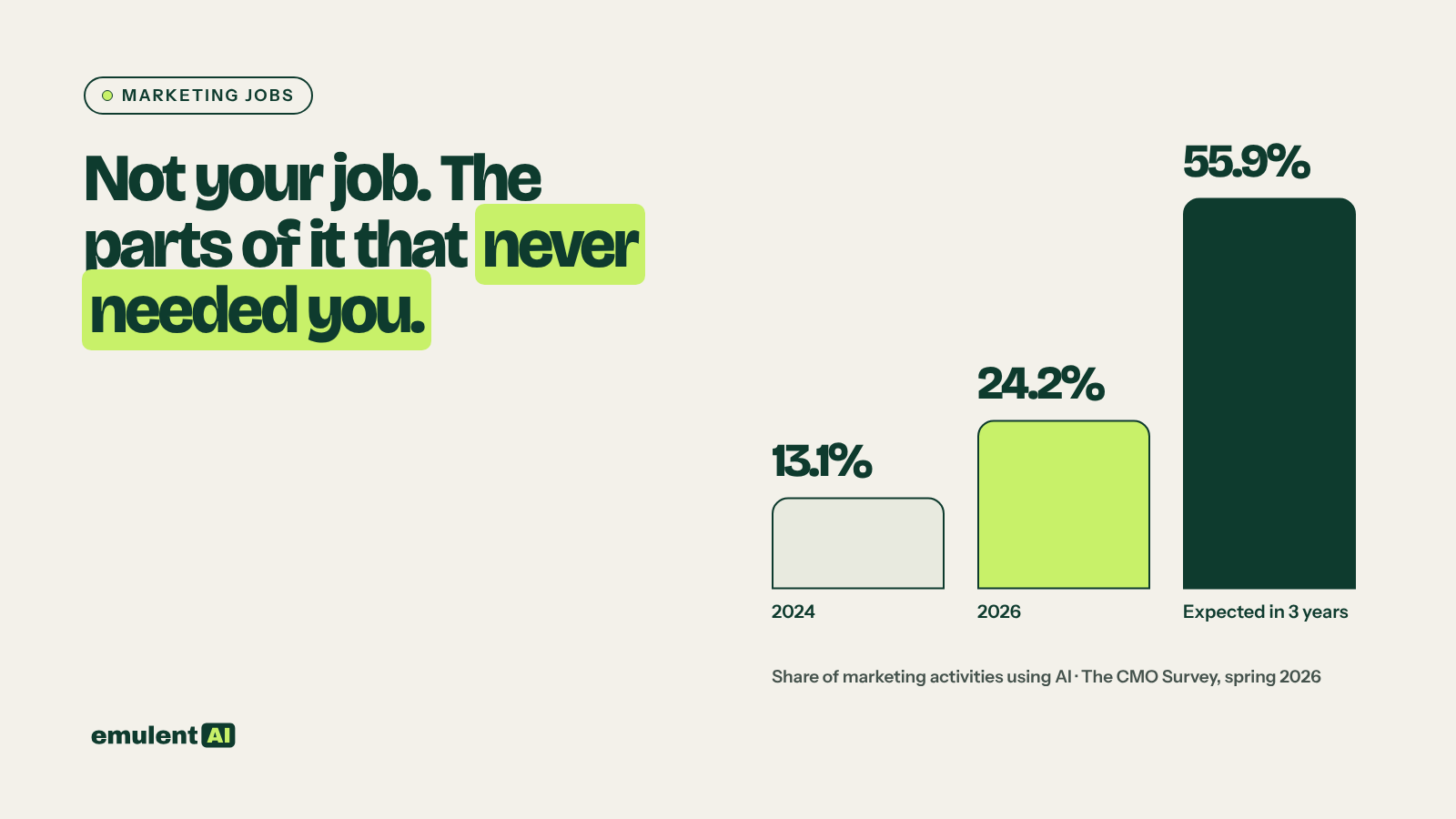
- The CMO Survey’s spring 2026 report (Duke’s Fuqua School of Business, 308 U.S. marketing leaders, fielded January 2026) puts AI in 24.2 percent of marketing activities today, up from 13.1 percent in 2024. Those same leaders expect it to reach 55.9 percent within three years. Marketing head count still grew 2.5 percent over the past year, down from 5.4 percent the year before.
- The Bureau of Labor Statistics projects employment of marketing managers to grow 7 percent from 2025 to 2035. Advertising and promotions managers are projected to shrink 4 percent.
Read together, that is a profession being reshaped from the inside. Hiring is slowing and the mix of work is changing. The job title survives; the job description does not.
The clearest picture of which work is exposed comes from Microsoft Research’s study of about 200,000 Bing Copilot conversations. It scored occupations by how much of their work AI was being used for. Media and communication workers, the group that includes writers and editors, scored highest of any occupational group at 0.38. Advertising, marketing, PR and sales managers scored 0.18. The writing and production side of marketing is far more exposed than the deciding and managing side. The authors also warn against reading the scores as a list of jobs about to vanish, because what happens to employment depends on business decisions nobody can predict.
The tasks going to AI
The work AI does well has two traits: it repeats, and a person can check it. These are the marketing jobs where I see it save real time without putting the brand at risk:
- First drafts of emails and landing pages
- Headline, subject line and call-to-action variations for testing
- Repurposing one long piece into social posts, email copy and ad copy
- Keyword clustering and search-intent grouping
- Meta descriptions, alt text and schema markup
- Summarizing call transcripts, reviews and survey responses
- Cleaning, reformatting and consolidating campaign data
- Competitor messaging and content audits
Here is what that looks like at scale. We audited 20,000 pages for a large website owner using Semrush and Claude. Semrush crawled every page and pulled the technical, ranking and backlink data. Claude read the full export, grouped issues by pattern and flagged the ones most likely to move rankings. Then our SEO team reviewed the groupings, threw out the false alarms and ranked the fixes by impact and effort. The client got a ranked fix list in place of a 20,000-row spreadsheet.
Notice where the people sit in that process. The sorting went to AI. The decisions about what was real and what to fix first stayed with the team.
The work staying with people
A language model does not know things. It predicts the most likely next word, over and over, based on patterns in what it was trained on. That has three consequences for marketers:
- It was trained on the internet, so its default answer is the average of what everyone has already said.
- It only sees the conversation in front of it. It has no memory of you, your clients or your brand unless you give it one.
- It produces plausible text, which is different from true text. Sometimes it is wrong with total confidence.
Those three limits decide what stays with you. Knowing what good looks like for your audience stays with you. So does deciding what to say and to whom, building relationships and trust, and putting your name on the finished work.
I make this point in talks with the scene from Good Will Hunting where Robin Williams’s character tells Matt Damon’s that reading every book about something is different from having stood there. AI has read everything about your market. It has never sat across the table from your customer. It knows the internet; it doesn’t know your customer.
The list of work that needs a person in charge is longer than most people expect: brand positioning, thought leadership with an actual point of view, legal, medical and financial copy, reading the room during a crisis or a layoff, interpreting results and deciding what to do next, original research and customer interviews, humor and local references, and anything that carries your name.
What happened when I let AI do the whole job
I tested the shortcut so you don’t have to. Starting in January 2025, I let AI write long-form content for a website and tracked the traffic. Monthly visits climbed from about 100 to about 1,700 by June 2025. By August they had collapsed to near zero. Traffic sat flat through the rest of 2025 and took about a year to climb back to roughly 1,400 by fall 2026.
Of the keywords that did rank from that AI-written content, 98 percent landed on page 3 of Google or deeper. That is close to invisible.
Google’s own guidance explains why. Its helpful content documentation says that using generative AI “to produce large amounts of text without manual oversight or curation” counts as little to no effort, and effort is one of the things its quality raters judge. Google is not against AI content. Meeting its bar with AI alone is close to impossible.
The lesson for your career is the same as the lesson for your website. Handing AI the whole job and shipping whatever comes back is the fastest way to make yourself replaceable, because anyone with a login can do that part.
Who is at risk and who is safe
The line I use most in talks on this topic: “AI won’t replace marketers. Marketers who use it well will replace the ones who don’t.”
| At risk | Safe | |
|---|---|---|
| How they use AI | Refuses to use it, or hands it the whole job | Gives it the tedious work and keeps the thinking |
| What they ship | Whatever comes back from the prompt | Work they have checked, edited and would sign |
| Where saved time goes | More volume of the same output | Strategy, customers and relationships |
| What they can explain | Nothing about how the tools fail | What AI does well, where it fails and why |
The refuser falls behind on speed. The over-truster ships errors and generic work until something breaks in public. The safe marketer sits in the middle and does the less glamorous work of checking.
How marketing roles are being redefined
Titles are changing more slowly than the work inside them. Here is how I see the split for common digital marketing roles, based on the lists above.
| Role | Work moving to AI | Work that grows |
|---|---|---|
| Content writer or copywriter | First drafts, variations, repurposing | Briefing, editing for voice, interviews, original reporting |
| SEO specialist | Keyword clustering, meta descriptions, alt text, schema drafts, audit triage | Deciding which fixes count, content strategy, AI search visibility |
| Marketing analyst | Cleaning, reformatting and consolidating data | Interpreting results and recommending the next move |
| Social media manager | Turning long pieces into posts, caption options | Community, reading the room, humor and cultural nuance |
| Marketing manager or CMO | Status reports, summaries, research pulls | Positioning, AI rules for the team, client and stakeholder trust |
The survey data shows how far most teams have to go. In Gartner’s 2026 CMO Spend Survey, 70 percent of CMOs said their internal processes are not yet mature enough to scale AI. The CMO Survey found that only 49.7 percent of marketing leaders say their teams have the skills and training to use their marketing technology, down from 54.1 percent in 2022, while training sits at 3.8 percent of marketing budgets. Companies are buying the tools faster than they are teaching people to use them. That gap is your opening.
Skills to build now
Getting good results from AI is a communication skill more than a technology skill. No code is required. You talk to it in plain language, and the output is only as good as your brief. If you can’t explain the task to a person, you can’t explain it to AI either. That is good news for subject-matter experts, because the people who know the work best write the best briefs.
The skills I would build first:
- Briefing AI like a new hire: give it context, the audience, the goal and examples of good work.
- Giving feedback the way you would to a colleague: say what is off and why, then ask for another pass.
- Feeding it what only you know, such as your data, your results and your opinions, so the output stops sounding like everyone else’s.
- Asking for options instead of answers, then choosing with taste.
- Verifying every fact, statistic and source before anything goes live.
- Measuring results (leads, revenue, hours saved) instead of output volume.
Become the person they can’t lose
When budgets are flat and AI is getting a bigger share of them (Gartner puts it at 15.3 percent of the average marketing budget in 2026), the safest marketer on the team is the one leadership can’t picture working without. Four habits get you there.
Know the tools. Learn what AI does well and where it fails. Most teams have nobody who can answer that with confidence, and the person who can becomes the one everyone asks.
Spend the saved time upstream. If AI gives you back five hours a week, put them into strategy, customer conversations and relationships. Don’t spend them producing more of the same.
Own the review. Catch what AI got wrong before it ships. Verification is a skill, and right now it is scarce.
Bring what AI can’t. Client stories, real results and a point of view earned by doing the work are the parts of marketing no model can produce, because they never made it onto the internet in the first place.
If your team wants help sorting which tasks go to AI and which stay with people, that is the core of our AI training and team enablement work and the second step of how we approach every engagement. The simplest place to start is a strategy call.
Put this to work with Bill.
Tell Bill where your team is with AI right now. He’ll tell you what he would do first and what he would leave alone.
Contact Bill directly
Or call 773-791-3197