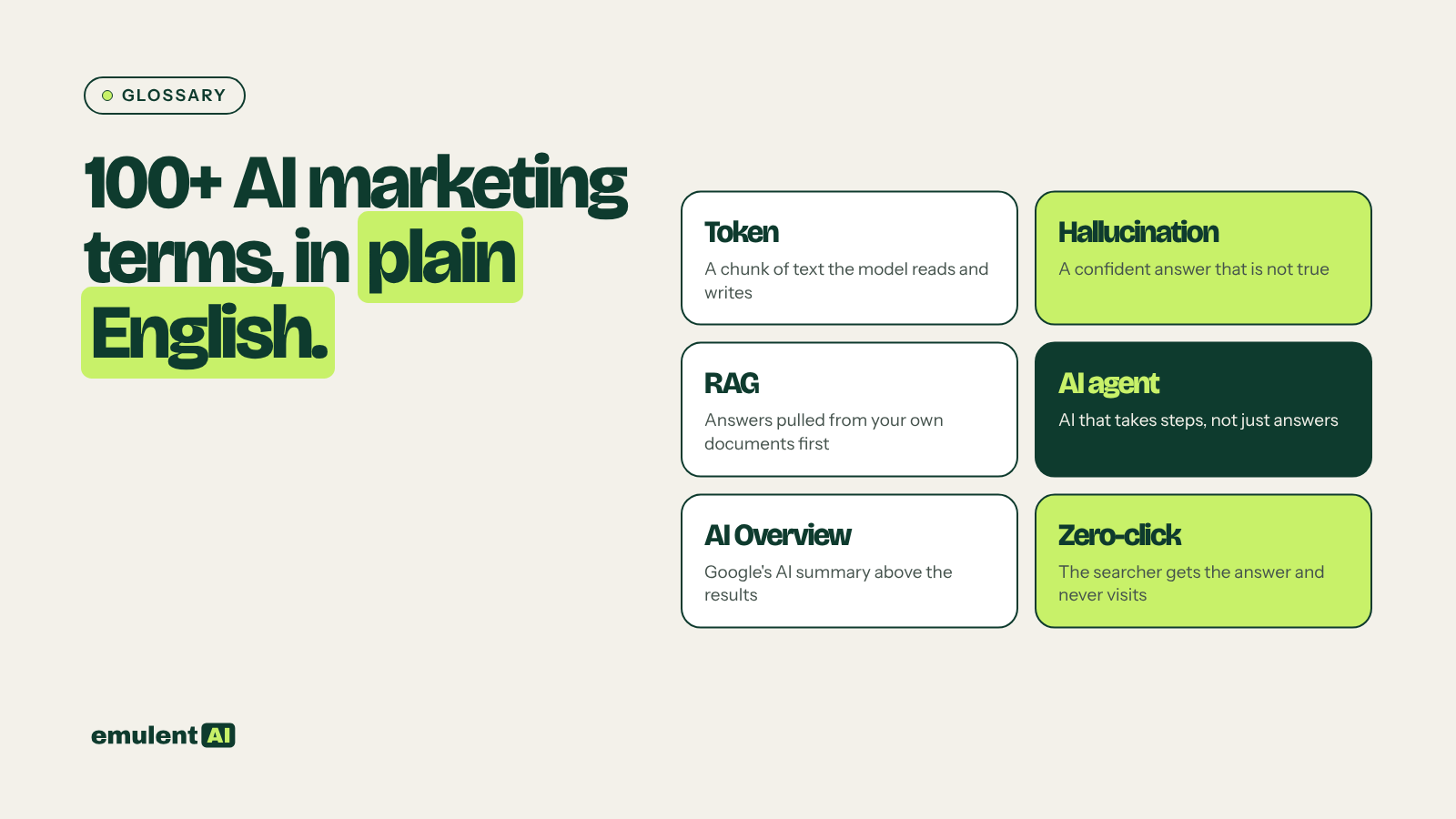
This glossary defines 105 AI marketing terms in plain English, grouped by the job they belong to: how the models work, how you prompt them, how AI search picks its sources, bots and agents, measurement, and the rules. Each entry gives the meaning first, then what it changes for a marketer.
I’ve spent close to three years running marketing tests on the most prominent AI platforms, and vocabulary is where most teams get lost first. Vendors use one word for several different things (“agent” is the worst offender), and plenty of the jargon exists to make ordinary automation sound new. Knowing the terms won’t make you good at AI. It will make you much harder to sell hype to.
How to use this glossary
Terms are alphabetized inside each section, so jump to the section that fits the conversation you’re about to have. If a vendor pitch is full of agent talk, start with the automation terms. If your SEO person keeps saying GEO, start with AI search.
One idea explains a surprising number of these entries, so it’s worth having in your head first: a language model does not know things. It predicts. Hallucination, grounding, RAG and temperature all make more sense once you see the model as a very good guesser.
If you’re bringing a team up to speed, this list makes a decent first-week reading assignment. Our AI training and team enablement work starts with the same vocabulary, because people can’t evaluate a tool they can’t describe.
Foundational AI terms
These are the words underneath everything else. You don’t need the math. You need to know what each one can and can’t do.
Algorithm
A set of rules a computer follows to turn an input into an output. In marketing, “the algorithm” usually means the ranking and recommendation systems at Google, Meta, TikTok or LinkedIn that decide who sees what. Most of those systems now learn their rules from data, so the rules shift constantly.
Artificial general intelligence (AGI)
A hypothetical AI that could match people across nearly any intellectual task. Nobody has built it, and the labs don’t agree on how they’d know if they had. For marketing planning you can set it aside. Nothing you can buy today is AGI, whatever the sales deck says.
Artificial intelligence (AI)
Software that does tasks we used to think needed human intelligence: recognizing images, understanding language, making predictions, writing. It’s an umbrella term. Most marketing AI is either machine learning (predictions from data) or generative AI (new text, images, audio or video). McKinsey’s State of AI 2025 found 88% of organizations regularly use AI in at least one business function, up from 78% a year earlier.
Computer vision
AI that interprets images and video: identifying objects, reading text in photos, matching one product to another. It powers visual search, automatic image tagging and some ad review systems.
Deep learning
Machine learning built on neural networks with many layers. It’s what made modern speech recognition, image generation and large language models possible. When a vendor says its product uses deep learning, ask what data it learned from, because the data decides what it’s good at.
Foundation model
A large model trained on broad data that other products are built on top of. GPT, Claude and Gemini are foundation model families. A lot of marketing software is a foundation model plus a prompt plus an interface, which is useful to know when you compare prices.
Inference
The moment a trained model produces an output from your input. Training happens once and costs a fortune; inference happens every time anyone sends a prompt. Usage-based AI pricing is mostly a charge for inference.
Large language model (LLM)
An AI model trained on huge amounts of text to generate language. The most useful thing to understand about an LLM is that it doesn’t know things. It predicts: it guesses the most likely next word, over and over, based on patterns in everything it was trained on.
That has three consequences I come back to in every talk I give. Because it learned from the internet, its default answer is the average of what everyone has already said. It only sees the conversation in front of it, so it has no memory of you, your clients or your brand unless you tell it. And it produces plausible text, which is a different thing from true text. Sometimes it’s wrong with total confidence.
Machine learning
A branch of AI in which systems learn patterns from data instead of following rules a person wrote. Bid strategies, lookalike audiences, lead scores, churn predictions and send-time optimization are machine learning. It was running inside ad platforms and email tools well before generative AI became a household term.
Natural language processing (NLP)
The field of AI that works with human language: classifying it, pulling meaning out of it, translating and summarizing it. Sentiment analysis, review tagging and chatbot intent detection are NLP tasks, and LLMs are now the usual way to do them.
Neural network
A model loosely inspired by the brain, made of layers of connected nodes that adjust their connections as they learn. You’ll rarely touch one directly. The term mostly shows up in vendor copy.
Parameters
The internal values a model adjusts during training. Parameter counts, often in the billions, are a rough signal of model size. Bigger isn’t automatically better for a marketing task. A smaller, cheaper model is often fine for tagging or reformatting.
Reinforcement learning
Training by trial and reward: the model tries actions and gets rewarded for good outcomes. One version, reinforcement learning from human feedback (RLHF), uses people’s ratings of answers to shape how chat assistants respond. It’s part of why assistants sound so agreeable, so push back when you ask one to critique your work and it only says nice things.
Supervised learning
Training a model on labeled examples (this email converted, that one didn’t) so it can predict the label for new data. Most lead-scoring and churn models are supervised. They are only as good as their labels, and a messy CRM produces a confident, wrong model.
Training data
The data a model learns from. For an LLM, that’s a vast collection of public text plus licensed and curated sources. Training data has a cutoff date, so a model can be out of date on anything recent unless it searches the web or you supply the facts.
Transformer
The neural network design behind modern LLMs, introduced in the 2017 Google paper “Attention Is All You Need”. Its attention mechanism lets a model weigh every word in a passage against every other word. The T in GPT stands for transformer.
Unsupervised learning
Training on unlabeled data so the model finds structure on its own, such as clusters of similar customers. It’s a common starting point for segmentation. A person still has to decide whether the clusters mean anything.
Generative AI and prompting terms
This is the vocabulary of using the tools day to day. Most of these terms describe ways to give the model more context, and context is what separates useful output from average output.
AI avatar
A synthetic video presenter generated from a script: either a stock character or a digital copy of a real person, made with that person’s consent. Teams use avatars for training videos, product explainers and translated versions of one video. Consent and disclosure are the hard parts (see deepfake and EU AI Act below).
Context window
The amount of text, measured in tokens, a model can consider at once, including your prompt, any files and its own replies. When a long chat starts ignoring early instructions, you’ve often gone past the useful part of the context window. Start a fresh chat with a tight summary.
Custom instructions
Standing instructions an assistant applies to every chat: who you are, how you work, the tone you want, what it should never do. Setting them is the third item on my AI setup checklist, because it saves you from re-explaining yourself in every prompt. Look for the setting in your assistant’s preferences.
Diffusion model
The type of model behind most AI image and video generators. It learns to turn random noise into an image step by step, guided by your text prompt.
Embedding
A list of numbers that captures the meaning of a piece of text or an image, so software can measure how similar two things are. Embeddings power semantic search, content clustering and related-post widgets. When an SEO tool says it groups keywords by meaning, embeddings are usually how.
Few-shot and zero-shot prompting
Few-shot prompting means including a handful of examples of what you want. Zero-shot is the same request with no examples. Three of your best subject lines will teach a model your style faster than a paragraph describing it.
Fine-tuning
Further training a foundation model on your own examples so it adopts a style or a task. It sounds like the answer to “make it sound like our brand.” For most marketing teams, good instructions, real examples and a reference kit get most of the way there for far less money and risk.
Generative AI
AI that creates new content (text, images, audio, video, code) from a prompt. Content creation is its top marketing use: 73.9% of companies in The CMO Survey’s 2026 report use AI for it. As I put it in my talks, “AI gets you to good, fast. Getting to great is still your job.”
Hallucination
When a model states something false with full confidence: an invented statistic, a fake source, a product feature that doesn’t exist. It happens because the model predicts plausible text and has no built-in way to check whether that text is true. Google’s own guidance on AI content says generative models don’t retrieve facts. In my talks I use a cartoon where an AI tells someone a mushroom is edible, then later apologizes that it was poisonous. It’s funny until it’s your pricing page. Verify every fact, stat and source before anything goes live.
Memory
A feature that lets an assistant remember details across chats. It’s useful, and it’s also a place where wrong or sensitive details pile up. If you turn it on, check what it saves and prune it monthly.
Multimodal AI
A model that handles more than one kind of input or output, such as text, images, audio and video. You can hand a multimodal model a screenshot of an ad and ask what’s wrong with it.
Project
A workspace inside an assistant where you keep files, instructions and chats for one client or recurring job, so the model starts every conversation with the right context. I recommend one per client. It also keeps one client’s material out of another client’s work.
Prompt
The instructions and context you give a model. Output quality tracks the quality of the brief: context, audience, goal and examples. AI is a communication skill more than a technology skill, and if you can’t explain a task to a person, you can’t explain it to AI.
Prompt engineering
The craft of writing prompts that get reliable output. The name makes it sound technical. In practice it’s mostly briefing well: being specific, giving examples, asking for options and telling the model what’s off and why when the first draft misses, the way you’d coach a new hire.
Reasoning model
A model that works through a problem in intermediate steps before it answers, sometimes shown on screen as “thinking” (the step-by-step text is often called chain of thought). Reasoning models are slower and cost more per answer, and they do better on analysis, math and multi-step plans. You don’t need one for a subject line.
Retrieval-augmented generation (RAG)
A technique where a system first retrieves relevant documents, then has the model write its answer from them. Google’s AI optimization guide describes RAG, which it says is also known as grounding, as a way to improve the quality, accuracy and freshness of AI responses. RAG is how AI search cites web pages, and it’s how a company chatbot answers from your help docs instead of from guesswork.
Synthetic media
Images, video, audio or text generated or substantially altered by AI. The term covers everything from a swapped photo background to a fully synthetic spokesperson. Regulators increasingly want it labeled (see AI disclosure and EU AI Act).
System prompt
Hidden instructions a developer or tool gives the model before the user’s message, setting its role, rules and limits. Every branded chatbot has one. A weak system prompt is why some bots wander off topic or promise things the business never approved.
Temperature
A setting that controls how predictable a model’s word choices are. Low temperature gives consistent, conservative output. Higher temperature gives more variety and more mistakes, which is fine for brainstorming and risky for facts.
Token
The unit a model reads and writes: a word, part of a word or a punctuation mark. Pricing, speed and context windows are all measured in tokens.
Vector database
A database that stores embeddings so a system can find content by meaning instead of exact words. It’s the storage layer behind most RAG chatbots and semantic site search.
AI search terms
Search is where AI has changed marketing fastest. Google’s own documentation is the best source on these terms, and it’s blunter than most of the industry about what doesn’t work.
AI crawler
A bot that collects web pages for an AI company, either to train models or to fetch pages live when someone asks a question. You control access in robots.txt. Blocking a crawler can keep your content out of training, and it can also keep your brand out of answers, so decide on purpose.
AI Mode
Google’s search mode for longer, more involved questions. It returns a detailed AI-generated response with links to supporting sites, according to Google Search Central. Traffic from AI Mode and AI Overviews is counted in Search Console’s Performance report under the “Web” search type.
AI Overviews
The AI-generated summaries at the top of many Google results, with links for further reading. Google says there are “no additional requirements” to appear in them beyond being indexed and eligible to show in Search with a snippet. The usual SEO basics still apply.
AI visibility
How often, and how accurately, your brand shows up in AI-generated answers to the questions your buyers ask. It’s measured by running a fixed panel of prompts through tools like ChatGPT, Gemini, Perplexity and Google’s AI features, then tracking mentions, citations and sentiment. Our AI search optimization work starts with an audit of exactly this.
Answer engine
Any tool that answers a question directly instead of handing back a list of links: ChatGPT, Perplexity, Gemini, Copilot, Google’s AI features and voice assistants. The move from search engines to answer engines gives “ranking” a second meaning. You also want to be the source the answer is built from.
Answer engine optimization (AEO)
Work aimed at getting your content used and cited in direct answers. Google’s AI optimization guide defines AEO and GEO, then says plainly that optimizing for generative AI search “is still SEO.” Be skeptical of anyone selling AEO as a separate bag of tricks.
Citation
A linked source shown inside or beside an AI answer. Citations are the AI-era version of a ranking, since they’re how a reader gets from the answer to your site. Citation rate (how often your pages are cited across a set of prompts) is one of the numbers worth tracking.
Commodity content
Content built from common knowledge that anyone, or any model, could have written. Google’s AI optimization guide tells site owners to create non-commodity content with a unique point of view, first-hand experience and expert insight. A model’s default output is commodity content by design, because it’s the average of what’s already out there.
E-E-A-T
Experience, expertise, authoritativeness and trustworthiness, the qualities Google’s quality raters look for. Google’s helpful content guidance says trust is the most important of the four and that E-E-A-T itself “isn’t a specific ranking factor.” It’s still the best checklist for content that has to compete with AI-written pages, because first-hand experience is the part a model can’t supply.
Entity
A distinct thing a search engine understands, such as a person, company, product or place, along with its attributes and relationships. Search engines and LLMs reason about entities as well as keywords. Consistent facts about your company across your site, profiles and directories give them one version of you to learn.
Generative engine optimization (GEO)
Another name for optimizing to appear in AI-generated answers. Google treats GEO as part of SEO and says many suggested AEO and GEO tactics aren’t effective or supported. Most of it is a new label on familiar work: well-organized pages, real expertise, technical health and consistent brand facts.
Google-Extended
A token you can use in robots.txt to limit whether Google uses your content for AI training and grounding in its systems outside Search. Google’s AI features in Search, including AI Overviews and AI Mode, follow your regular Googlebot rules instead.
Knowledge graph
A database of entities and the relationships between them. Google’s Knowledge Graph feeds the knowledge panels you see beside some results. Keep the public facts about your brand consistent so there’s only one version to pick up.
llms.txt
A proposed text file that lists a site’s most important content for language models. Google’s AI optimization guide says Google Search doesn’t use it and that creating one “will neither harm nor help” your visibility. Don’t let anyone bill you for one as a ranking fix.
Query fan-out
How AI search answers a question: the system breaks it into a set of related searches, runs them at the same time and builds one answer from the combined results. Google’s example is a lawn-weed question that spawns searches like “best herbicides for lawns.” It means you can be cited for a question you never targeted, if you cover one of its subtopics well.
Scaled content abuse
Google’s spam policy term for producing large numbers of pages mainly to manipulate rankings. Google’s generative AI content guidance, updated October 1, 2026, says using AI to generate many pages without adding value for users may violate it. Google isn’t against AI content, but matching what it rewards (effort, originality, skill and experience, accuracy) is nearly impossible with AI alone.
My own data shows what happens. After AI started writing long-form content in January 2025, monthly traffic I tracked climbed from about 100 visits to about 1,700 by June, collapsed to near zero by August and took about a year to climb back to roughly 1,400. Of the keywords that ranked from that AI-written content, 98% landed on page 3 or deeper.
Schema markup
Code on a page, usually JSON-LD using the schema.org vocabulary, that labels what the page is about: an organization, a product, an article, a review. It still earns rich results. Google says there’s “no special schema.org markup” needed for its AI features, so treat pitches for special “AI schema” with suspicion.
Share of answers
The percentage of AI answers, across a defined set of prompts, that mention or cite your brand. Think of it as share of voice for answer engines. The number depends heavily on which prompts you pick, so keep the prompt set fixed from month to month.
Zero-click search
A search that ends without a click to any website because the answer was on the results page. When an AI answer names your brand, you got visibility even without a visit, which is why AI visibility is tracked separately from traffic.
Automation terms: from chatbots to agents
“Agent” is the most stretched word in marketing right now. Some products sold as agents are a prompt with a button on it. These entries separate what each kind of system does.
Advantage+
Meta’s set of automated ad tools that hand audience targeting, and increasingly creative, to Meta’s AI, as eMarketer has reported. Like Performance Max, it works best with clean conversion data and a clear goal. Posts claiming AI ran an ad account for a month and tripled ROAS deserve a grain of salt.
Agentic AI
AI systems that pursue a goal across several steps with some independence: planning, using tools, checking results and adjusting. In McKinsey’s 2025 survey, 23% of respondents said their organizations were scaling an agentic AI system somewhere in the business and another 39% were experimenting. In any single function, no more than 10% said they were scaling agents.
AI agent
A system that can take actions for you as well as answer: searching, filling forms, updating a CRM, sending a draft for approval. The question to ask about any agent is what it’s allowed to do without a person signing off.
AI assistant
A chat-based helper built into a tool or available on its own, such as ChatGPT, Claude, Gemini or Microsoft Copilot. Some vendors call theirs a copilot. Assistants respond when you ask; agents act. Most teams get more from learning one assistant well than from adding five.
AI marketing bot
Software that uses AI to hold marketing conversations or run marketing tasks: answering website visitors, qualifying leads by chat or SMS, replying to social comments, booking appointments. Good ones hand the conversation to a person when it turns sensitive or high-stakes. Before you put one in front of customers, ask whether they’d care that AI did it. In Gartner’s March 2026 consumer survey, 50% of U.S. consumers said they’d prefer to give their business to brands that don’t use generative AI.
API
An application programming interface: the connection that lets one piece of software send data or instructions to another. Every AI integration, from your CRM drafting emails with a model to a report pulling numbers from Google Ads, runs on APIs. When a vendor says its tool “integrates with” something, ask whether that’s a live API connection or a CSV export.
Brand bot
A chatbot or assistant built to speak as your brand, set up with your voice, offers and policies. It needs a tight system prompt, a list of things it must never say and a clear path to a human. A brand bot that improvises is a liability with your logo on it.
Chatbot
A program that holds a text conversation. Older chatbots followed scripted decision trees; current ones use LLMs, often with RAG over your own content. They also create real liability. In Moffatt v. Air Canada (2024), a British Columbia tribunal held the airline responsible after its website chatbot gave a grieving customer wrong information about bereavement fares, and rejected the argument that the chatbot was responsible for its own words (Manatt).
Conversational AI
The broader category of AI that understands and replies in natural language, by text or voice. Chatbots, voice agents and AI SMS all fall inside it.
Human in the loop
A workflow where a person reviews, approves or corrects AI output before it takes effect. The review helper we built for local businesses works this way: it drafts a reply to every review, flags the ones that need care and never posts on its own. The owner or manager sends every reply.
Marketing automation
Software that runs rule-based marketing tasks such as email sequences, lead routing, list updates and triggered messages. It existed long before generative AI. Most platforms now add AI for writing, segmentation and send-time choices on top of the same rules.
Model Context Protocol (MCP)
An open standard Anthropic released in November 2024 for connecting AI assistants to the systems where your data lives (Anthropic). In marketing terms, it lets an assistant read from and act in tools like your file storage, CRM or analytics through one kind of connector instead of a custom integration for each.
No-code automation
Tools that connect apps and build workflows without programming, by dragging steps together or describing the job in plain language. They’re the fastest way to turn a repeated task into a reusable tool, which is item eight on my setup checklist.
Performance Max
A Google Ads campaign type that uses Google AI to serve ads across all Google Ads inventory, including YouTube, Display, Search, Discover, Gmail and Maps, from one campaign (Google Ads Help). You supply goals, budgets, assets and audience signals, and Google decides placement and bidding. The quality of your conversion data decides how good those decisions are.
Voice agent
An AI system that handles phone calls with a synthetic voice. In the U.S., the FCC ruled in 2024 that AI-generated voices count as “artificial” under the Telephone Consumer Protection Act, which brings AI voice calls under the TCPA’s robocall rules (FCC). Get consent sorted before you launch one.
Measurement terms
AI is very good at the grunt work of marketing data: cleaning, reformatting, consolidating and summarizing. Interpreting the result and deciding what to do next stays with you.
A/B testing
Showing two versions of an ad, email or page to comparable audiences to see which performs better. AI makes variations cheap to produce, and headline, subject line and CTA variations for testing are some of the best jobs to hand it. You still need enough traffic for a winner to mean anything.
Attribution
Assigning credit for a conversion to the touchpoints that came before it. Google Analytics 4 retired its first-click, linear, time-decay and position-based models in November 2023, leaving data-driven and last-click options (Google Analytics Help).
Customer data platform (CDP)
Software that pulls customer data from many sources (your site, CRM, email, ads, stores) into unified profiles other tools can use. AI personalization is only as good as the CDP or CRM data feeding it.
Customer lifetime value (CLV or LTV)
The total revenue or margin you expect from a customer over the whole relationship. Predictive models estimate it early so you can spend more to win customers likely to be worth more. Check the predictions against real cohorts before you trust them with budget.
Data analytics in marketing
Collecting, cleaning and analyzing marketing data to see what’s working and decide what to do next: channel performance, customer behavior, campaign results, pricing tests. AI speeds up every step except the decision. We used AI to pull 900,000 biotech specimen records from scattered, inconsistent sources into one database the team can search by any of 20 attributes in seconds, with people checking the AI’s classifications against the source records. On a 20,000-page SEO audit, Semrush gathered the data, Claude grouped the issues by pattern, and our SEO team threw out false alarms and ranked the fixes.
Data-driven attribution
An attribution model that uses your account’s own data to estimate how much each touchpoint contributed, instead of a fixed rule. Google describes it as using “your account’s data to calculate the actual contribution of each click interaction.” It beats last click, but it can only see what you track.
First-party data
Data you collect directly from your customers and audience: purchases, site behavior, email engagement, CRM records. It’s the input that lets AI tell you something the internet can’t. AI knows the internet. It doesn’t know your customer until you give it this.
Incrementality
The share of results that wouldn’t have happened without the marketing. Lift tests, which hold out a control group, measure it. Platform-reported conversions can include sales you’d have made anyway, so run an incrementality test before you scale spend on the platform’s word.
Lead scoring
Ranking leads by how likely they are to buy, using fit (company size, role) and behavior (pages viewed, emails opened). AI lead scoring learns the weights from past conversions. If your sales team never marks deals closed-lost in the CRM, the model learns from half the story.
Marketing mix modeling (MMM)
A statistical method that estimates how much each channel contributes to sales using aggregate data over time, without tracking individuals. Because it works on aggregate data, it doesn’t depend on cookies. Google’s Meridian is an open-source MMM.
Predictive analytics
Using historical data to forecast what’s likely to happen: who will churn, which leads will close, what demand looks like next quarter. Predictions are probabilities. A 70% churn score is a reason to call the customer, and it isn’t a certainty.
Segmentation
Dividing an audience into groups that share traits or behavior so you can market to each one differently. AI can draft personas and segments from real data in minutes. Treat them as drafts and check them against what your sales team hears on calls.
Sentiment analysis
Using NLP to classify text, such as reviews, social posts and survey answers, as positive, negative or neutral. It’s how I tracked what happened after AI-written brand statements went live: positive sentiment had held around 65% for the six months before launch, then fell to about 30% within six months after. Efficiency you gain can be brand trust you lose.
Share of voice
Your brand’s share of the visibility or conversation in a category, across ad impressions, organic rankings, social mentions and now AI answers. Define the competitor set and the channels before you measure, or the number will move for reasons that have nothing to do with you.
Zero-party data
Information customers give you on purpose, such as preferences, quiz answers and stated interests. It’s the most reliable input for personalization because nobody had to infer it.
Governance and compliance terms
These terms decide what you’re allowed to do with AI and what happens when it goes wrong. None of this is legal advice. When a campaign touches regulated claims or another country’s rules, bring in your own counsel.
AI bias
Systematic unfairness in AI output, usually inherited from skewed training data or the way a system was set up. In marketing it shows up in who sees an ad, which customers a model decides are worth pursuing, and stereotyped images.
AI disclosure
Telling people when AI made, or substantially shaped, what they’re reading or talking to. Gartner recommends labeling AI-driven experiences and giving customers a clear choice to opt out, and 68% of U.S. consumers in its survey said they frequently wonder whether the content they see is real. A simple test before you skip disclosure: would I be fine with them finding out?
AI governance
The policies, roles, approvals and records that decide how an organization uses AI. A workable marketing policy can start with six questions I ask before handing anything to AI. Would I sign it? Can I check it? What breaks if it’s wrong? Would they care that AI did it? Would I be fine with them finding out? Does it fit my brand and experience? Our AI governance work builds policy around those questions.
AI washing
Overstating what AI does in a product or service to sell it. Regulators treat it as ordinary deception. When the FTC announced Operation AI Comply in September 2024, then-Chair Lina Khan said there is “no AI exemption from the laws on the books” (FTC).
C2PA and Content Credentials
The Coalition for Content Provenance and Authenticity (C2PA) publishes an open technical standard, called Content Credentials, that records where a piece of digital content came from and how it was changed (C2PA). The coalition compares it to a nutrition label for digital content. Anthropic now attaches C2PA metadata to images Claude generates.
Data training opt-out
The setting that decides whether your chats can be used to train a provider’s future models. OpenAI says it may train on content from individual ChatGPT plans unless you turn off “Improve the model for everyone,” and that it doesn’t train on ChatGPT Business, Enterprise, Edu or API data by default (OpenAI). Anthropic asks Free, Pro and Max users to choose, and excludes Team, Enterprise and API use (Anthropic). Decide before you paste anything about a client.
Deepfake
Synthetic audio, video or images that make a real person appear to say or do something they didn’t. Under the EU AI Act, deployers have to tell people when they’re exposed to deepfake content. Never create a likeness of a real person without written consent.
EU AI Act
The European Union’s AI law. Its Article 50 transparency rules apply from August 2, 2026, according to the European Commission. Providers have to design systems so people know when they’re interacting with AI and mark AI-generated content in a machine-readable way. Deployers have to disclose deepfakes and AI-generated text on topics of public interest published without human review. If your marketing reaches people in the EU, check with counsel how it applies to you.
Explainable AI (XAI)
Methods that show why a model produced an output, such as which factors drove a lead score. Ask for it from any vendor whose model decides who sees an offer or what price they get.
NIST AI Risk Management Framework
A voluntary U.S. framework for managing AI risk, released January 26, 2023, built around four functions: govern, map, measure and manage (NIST). NIST added a generative AI profile in July 2024. It’s a sensible skeleton for a marketing AI policy even though nobody requires you to use it.
Prompt injection
An attack where instructions hidden in a prompt, web page or file change how a model behaves. OWASP lists it first in its 2025 Top 10 for LLM applications and separates direct injection, in the user’s own input, from indirect injection, in websites or files the model reads (OWASP). It’s the reason an AI agent that browses the web shouldn’t have unchecked access to your accounts.
Shadow AI
AI tools people use for work without approval or oversight, usually on personal accounts. It’s the easiest way for client data to end up somewhere it shouldn’t. Write a never-paste list (passwords, logins, API keys, customer data) and give people an approved tool so they don’t need a workaround.
Watermarking
Embedding an invisible signal in AI output so software can later detect that AI produced it. Anthropic began watermarking text from Claude models released on or after August 2, 2026, tying the move to the EU AI Act, and marks Claude’s images with C2PA metadata (SiliconANGLE). In October 2026, OpenAI said it would watermark eligible ChatGPT and Codex text in the EU and is “not making text watermarking a global default at launch” (VKTR). Detection is imperfect on short or heavily edited text. The safe assumption for marketers is that AI-written copy can be identified.
Terms to watch
These are newer or still settling. Learn what they mean now and decide later whether they deserve budget.
Agentic commerce
Shopping in which an AI agent finds, compares and buys products on a person’s behalf. It changes what “place” means in marketing, because your product data has to be readable by agents as well as by people.
Model collapse
The loss of quality when models are trained on content generated by other models. A 2024 Nature paper by Ilia Shumailov and colleagues found that training on recursively generated data causes “irreversible defects” in which the tails of the original content distribution disappear (University of Oxford OATML). For marketers, it’s one more reason original material keeps its worth as the web fills with AI copy.
Small language model
A compact model that runs cheaply, sometimes on a laptop or phone. Small models are often good enough for tagging, sorting and reformatting, which covers a lot of marketing operations work, and running one locally keeps the data in-house.
Synthetic respondents
AI-generated personas used to answer survey or research questions in place of real people. They’re fast and cheap for testing whether a questionnaire makes sense. They aren’t your customers, and original research and customer interviews stay on my list of work that needs a human.
Universal Commerce Protocol (UCP)
An open standard Google announced on January 12, 2026, developed with companies including Shopify, Etsy, Wayfair, Target and Walmart, that gives AI assistants a common way to reach merchant systems for tasks like product discovery and checkout (SD Times). Google’s AI optimization guide mentions it as an emerging protocol. If you sell online, watch whether your platform supports it.
What to do with this list
Pick the five terms from this glossary that came up in your last vendor meeting, and ask the vendor to show you each one working on your own data instead of a demo account. The answers will tell you more than the pitch did. If you’d like a second opinion on what you heard, book a strategy call and bring the list.
Put this to work with Bill.
Tell Bill where your team is with AI right now. He’ll tell you what he would do first and what he would leave alone.
Contact Bill directly
Or call 773-791-3197