The people I see getting the best results from AI are good at explaining things. They can tell a colleague what the job is, who it’s for, what done looks like and where the traps are. None of that needs code, and very little of it depends on knowing the latest prompt trick.
So when a team asks us to train them on AI, most of the session is about communication. We spend the time on writing a better brief and giving useful feedback, with a short block at the end on checking what comes back. If you can’t explain a task to a person, you won’t be able to explain it to a model either. Below is why that’s true, a before-and-after brief you can steal, and how we run the training.
Why prompt hacks fade and briefing doesn’t
A language model doesn’t know things the way you do. It predicts the most likely next word based on patterns from its training. That has three consequences for anyone writing marketing with it, and each one points back to the brief.
- It was trained largely on the public web, so with nothing else to go on, its answer is the average of what everyone has already said.
- It only sees the conversation in front of it. It has no memory of your clients, your brand or last quarter’s results unless you supply them.
- It produces plausible text, and plausible can be wrong with total confidence.
Prompt hacks try to fix the output with magic phrasing. A good brief fixes the input. The model can’t guess your audience or your positioning, so it fills every gap with the safe middle. The more gaps you leave, the more generic the result.
Plenty of teams are in this position. In The CMO Survey’s 2026 report, 73.9% of companies said they use AI in marketing for content creation, up from 49.2% in fall 2023. When three in four teams are drawing from the same models, the brief is where your work starts to look different from theirs.
Brief it like a new hire
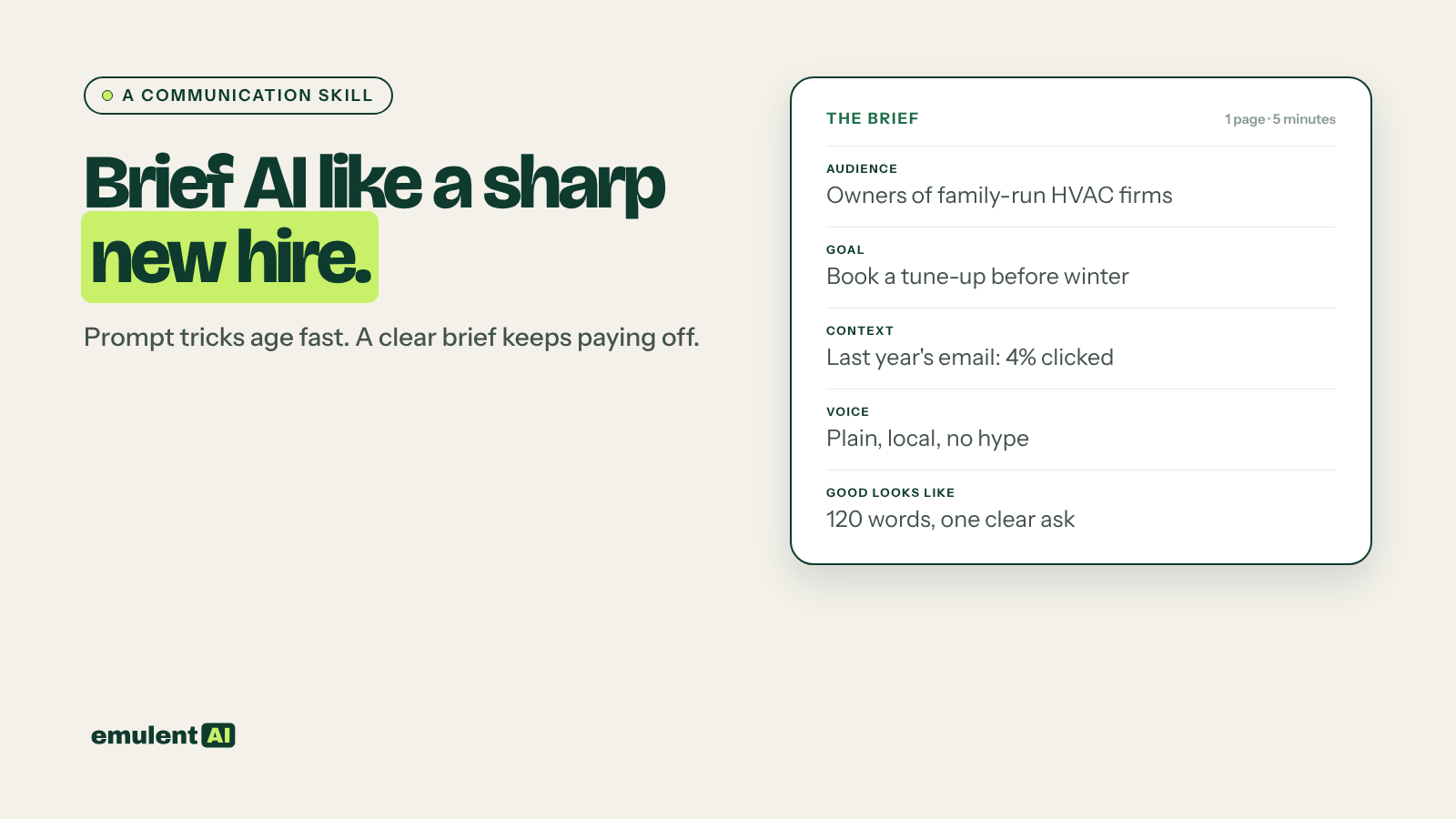
Picture a smart person on their first day. They’re quick and willing, but they don’t know your clients, your tone or why the last campaign flopped. You wouldn’t hand them a one-line request and expect a finished piece. You’d tell them four things.
- Context: what the business is, what’s happening and why this task exists now.
- Audience: who will read it, what they already believe and what they worry about.
- Goal: the one thing the piece has to do, and how you’ll know it worked.
- Examples: something you liked, something you didn’t, and why.
Then add what only you know. Your results, your customer language, your opinions. That’s the material the model can’t pull from the public web, and it’s what moves the output away from average.
A before-and-after brief
The example below is an illustration I wrote for this post. The company is made up, and so are its details. It shows the difference a brief makes on an everyday marketing task.
Before
Write an email announcing our new spring lawn care plan.
You’ll get something back in seconds, and it will read like every lawn care email ever sent. Bright greeting, “lush green lawn,” a discount nobody approved, a call to action to “book today.” Nothing in it is wrong, exactly. Nothing in it is yours, either.
After
You’re helping me write a customer email for a small, family-run lawn care company in a suburban market. We’ve done one-off mowing and cleanups for eight years. This spring we’re launching a seasonal plan: four scheduled visits, March to June, one flat price.
The readers are past customers who booked us at least once in the last two years. Most are homeowners in their 40s to 60s. From our call notes, their biggest complaint about other companies is crews that don’t show up when promised.
The goal is replies. We want people to answer the email with their address so we can quote them, so there’s no link and no discount. Keep it under 150 words, written from the owner in first person, plain and friendly. Don’t use the words “lush” or “transform.”
Below are two emails from last fall. The first got a lot of replies and the second got almost none. The first one worked because it sounded like the owner talking.
Give me three versions with different opening lines, and tell me which you’d send and why.
The second brief takes about five minutes longer to write. It carries context, audience, goal and examples, and it includes a detail only the business could know (the complaint about no-show crews). It also asks for options instead of one answer, which leaves the choice with the person who knows the customers.
In real use, the writer would paste both emails under the brief.
Feedback is the other half of the skill
Most people stop after the first draft. They either ship it or give up and say AI “doesn’t work for us.” Both are mistakes. The first response is where the conversation starts.
Treat it the way you’d treat a colleague’s draft. Say what’s off and why. “Too formal” is weak feedback. “The second sentence sounds like a bank; our owner would say ‘we finally put together a plan people kept asking for'” is useful, because it gives the model something specific to copy.
A few habits help here:
- Ask for options, then choose with your own taste.
- Point to the exact line that’s wrong instead of asking for “better.”
- When a fix works, save it into your standing instructions so you don’t repeat it next week.
- Check every fact, number and claim before anything leaves the building.
That last one deserves its own line. In McKinsey’s 2025 State of AI survey, over half of respondents said their organization had at least one negative consequence from AI in the past year, and inaccuracy was the most common. A clear brief cuts down on errors. It doesn’t remove them.
How we train teams for clarity, context and feedback
Our workshops at Emulent are hands-on, and people work on their own tasks, not canned exercises. The format below is what we use for a team getting started.
Explain it to a person first
Each participant picks a real task from their week and explains it out loud to a partner, who isn’t allowed to ask questions until the end. Then the partner lists what they’d still need to know. That list is almost always the missing part of the brief. It’s a fast way to show people that the gap was never the tool.
Build the context once
Next we set up what a new hire would get on day one: a short reference kit (brand voice notes, audience descriptions, a few examples of work you’re proud of), standing instructions about who you are and how you work, and a separate project for each client or recurring job so details don’t bleed between them. Done once, this saves people from rewriting the same background in every chat.
Run feedback rounds
Participants send their brief, read the result, and give two rounds of specific feedback. Then they compare the third draft to the first. We talk about which feedback changed the output and which did nothing.
Check before it ships
We end on verification: find every claim in the final draft and confirm it against a source, or cut it. This is the habit that protects your name.
Why this puts subject experts ahead
If output depends on how well you communicate, then the people who know the subject best have an edge. A senior strategist knows which customer objection to address, which claim legal will flag and what a good result looks like. Someone without that knowledge can’t brief for it and can’t spot what’s missing in the draft.
AI gets you to good quickly. Getting to great is still a human job, and it starts with knowing what great means for your customers. That knowledge is what your team brings, and the brief is how they hand it over.
Where to start
Pick one task your team does every week. Have two people write a brief for it using the four parts above, run both, and compare. You’ll see the difference in one sitting.
If you’d like help building this into a habit across the team, our AI training and team enablement workshops are built around exactly this kind of hands-on practice. And if your team hasn’t settled on one assistant yet, start with AI tool selection and implementation so everyone is learning the same setup.
Put this to work with Bill.
Tell Bill where your team is with AI right now. He’ll tell you what he would do first and what he would leave alone.
Contact Bill directly
Or call 773-791-3197